Fast and furious...but how fast?

If you're not sure you will like a fast lens, and you're affraid to buy one, don't forget about the f:1.5 Jupiter 3. Get yourself a J3 and a Fed 2 or Zorki 6 for +/-100 USD (or slightly more for a Kiev and J3 in Kiev/Contax mount) and you're ready to play. Keep 200 asa film and your f:2 lens on one camera and 3200 asa and your f:1.5 lens on the other and you are prepared for most light conditions. The J3 is not much larger than a J8 and very light.

Wim
 
Brian Sweeney said:
The Summarit 5cm F1.5 is the bargain of Leica lenses, but you will need to budget ~$80 for a CLA and look for one without coating damage.

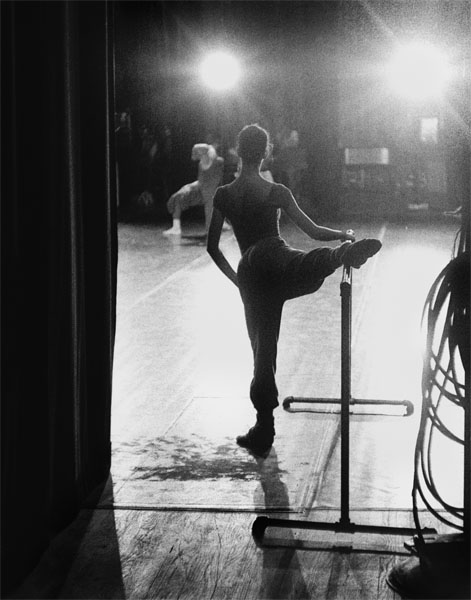
Even after cleaning, don't aim a Summarit into the light... unless you enjoy "atmospheric" lighting effects, which sometimes are quite nice. I probably wouldn't have liked this picture (one from my gallery) nearly as much if I had shot it with a modern, multi-coated, low-flare lens:


U588I1119758663.SEQ.0.jpg
 
I do not really like fast films after a darkroom printing session with disappointing results (Neopan 1600, and it was a lot better than Kodak Tmz). Then I switched to printing a Tmax 100 negative and was blown away. I have not used fast films since, though I have a couple in the fridge just in case I want to have another go.

I have a 50/1.2 lens that I have not used much. I do most indoors low light photography with a 50/3.5 and sometimes a 35/2 with 400 film. Steadying the elbows works well when I start to go over the edge. When it gets even darker I have found that the photos I have taken tend to get rather boring anyway, so I do not bother anymore.

Using the 50/1.2 I can switch to ISO 100 film instead, but the 50/3.5 has better depth of field which is valuable when you are close and I like the results I get with it..
I will probably experiment with the 50/1.2 in low light outdoors in the coming winter.

/Håkan
 
jlw said:
. unless you enjoy "atmospheric" lighting effects, which sometimes are quite nice.
G][/QUOTE]

I like this photo, it does have strong atmospheric effects indeed ! it is well exposed, i think you got the maximum out of the film.
But on the other hand it's a well suited example for a discussion about low light photography too ( I really don't like this "available darkness " nonsense) and I ask myself if not Tri-X and a very discrete and unobtrousive (fill in) flash (small soft box) would have made a better result ?
Saying "better" I do not mean the technical quality only, I do mean the artistic quality too. As I said, a thought only which came to my mind while watching this nice photo.
Best regards,
bertram
 
Bertram2 said:
I like this photo, it does have strong atmospheric effects indeed ! it is well exposed, i think you got the maximum out of the film.
But on the other hand it's a well suited example for a discussion about low light photography too ( I really don't like this "available darkness " nonsense) and I ask myself if not Tri-X and a very discrete and unobtrousive (fill in) flash (small soft box) would have made a better result ?

Well, let's look at that in a strictly practical sense. In this particular example, firing off ANY flash (no matter how diffused or unobtrusive) would have gotten me kicked out of the theater! It's usually an assumed but unspoken rule, and in this case (because there was a lot of press interest in this performance) I was warned explicitly.

And as it happens, this was the last picture on the roll -- so if I had decided to ignore the rule and chance the use of flash for the first picture on the roll, I wouldn't have been around to have a chance to get this one.

There are a lot of other situations in which the use of flash, even if tolerated, changes the dynamics of the picture-taking situation in a way that may make it impossible to get the kind of result you want.

Now, I do agree with what you're getting at: If you know in advance the kind of picture you want to make, and have the opportunity to control the situation, the best way to get a result of high technical quality is to create the kind of lighting and environment that will let you use the equipment that will yield that quality. If you can fully control the environment and lighting, you can use whatever camera, film/sensor, lens, etc. will give you the best image.

That's exactly why I own a car-trunk-load of studio flash equipment, and am willing to haul it around and set it up whenever the opportunity presents itself to use it.

BUT... my problem with this scenario is that the pictures I can previsualize inside my head usually aren't as good as the ones that walk up and hit me in the face by accident! And given that the range of my creativity is limited, I can't afford NOT to take advantage of those accidents.

That means I have to work with equipment that's portable, flexible, responsive, and usable in a wide range of conditions. That's why I shoot with a rangefinder camera, and it's also why I find it invaluable to have a high-speed lens or two at the ready.

The image quality may not be as good, but the picture quality is better.


To put it another way: For me, photography is like golf, not like pool. In pool (at least where I play) we use a house rule called "gentleman's call." You're not allowed to win on a slop shot; if you luck into a shot that was NOT what you had intended, you're supposed to fess up and award the match to the other guy.

In golf, on the other hand, the rule is always "rub o' the green." That means that luck (good or bad) counts just as much as intention. If you're just trying to blunder out of the greenside bunker, and the ball happens to get caught by a gust of wind, bounce off a passing vulture, and fall into the cup -- hey, it still counts, no matter what it does to your opponent's blood pressure. It's just rub o' the green.


Photographers differ widely in skill level, which may be one reason there are such strongly-held diverse opinions on this subject. Personally, my skill level isn't high enough to play "gentleman's call" in my photography -- I have to take the rub o' the green every chance I get. Packing a high-speed lens is one way to help me get away with it.

 
Wow, this generated some conversation in my absence!

So, comparing the Summarit, Canon 1.5, and Canon 1.4, what's the size/weight differences. (Approximate). Which ones have the best bokeh?

I know that last one is an objective question entirely, so I accept only scientific answers!

🙂
 
jlw said:
Well, let's look at that in a strictly practical sense. In this particular example, firing off ANY flash (no matter how diffused or unobtrusive) would have gotten me kicked out of the theater!.

I see, you had no choice at all. Not surprising in this kind of environment and many other environments too which strictly exclude flash from various reasons.
There a fast lens is a MUST no matter if amateur or pro.

My question has been absolutely hypothethical, and correctly asked it should have been if you would have prefered ( if allowed) to take a slower ISO, a slower lens stopped down and my tiny little Metz 34CS2 flash to get an easier lightning situation and another result, which would not have been better necessarily, I know.

All the many years I have avoided flash almost at any price and since a while i doubt if this was right. I now always carry this tiny little flash with me as a ultima ratio, and I try to find out if and how one can get acceptable results with it in low light environments.

And watching your photo exactly this came to my mind, my question was hypothetical , as I said and not meant as an arrogant suggestion how you can do your work better, which I generally like and estimate.

Sorry if it sounded like this ! 🙂

Best,

Bertram
 
Dear Bertram2,

Maybe I will come to your equanimity and adopt flash one day, but I doubt it. To me it's the one thing that looks worse than digital.

Cheers,

Roger
 
Last edited:
I think Brian summed it up. Most lenses are better when stopped down from the maximum by up to three stops.

So in theory an F1.4 lens will work better at F2 (with less vignetting) than say an F2 lens wide open.

Bottom line, you gotta weigh up cost v weight v size.
 
Roger Hicks said:
Dear Bertram2,

Maybe I will come to your equanimity and adopt flash one day, but I doubt it. To me it's the one thing that looks worse than digital.

Cheers,

Roger

WOW, Roger , mon dieu , you must really HATE it !!!! 😀 😀 😀
But you are right, MOSTLY flash looks even worse than digital, also for me.
Hope this kind of commitment will not cause trouble again. 🙄
I have not adopted it yet, I just try to find out if this is unavoidable or if there are techniques who allow acceptable results under certain circumstances.
Most of all I am interested in the fill-in flash issue, but also in the low light shooting.
I simply find it interesting to experiment a bit, I have seen flash shots which I would prefer to a 3200 or 6400 ISO shot at f1.5 with grain like golf balls and a lot motion blur. As said I have not adopted it yet, maybe I'll come back to my starting point at the end, who knows. Then I can say too i have been there.
Mais je suis revenu parce que tout cela n'est que merde. 😉

Best regards to the lovely South West of France,
Bertram
 
Don't worry, I didn't take any offense.

And I agree that a small flash is a useful thing to have, when circumstances permit it. One thing for which it's especially good is adding a bit of direction to light that's bright enough for photography, but too "flat" to be interesting. A lot of fluorescent-lit interiors fall into this category -- there's plenty of light, but it doesn't come from anywhere in particular, so you don't get any shadowing or sense of volume.

A small flash, positioned off the camera to fall at an angle on the subject, and set to fill in at a bit less than 1 stop over the ambient-light exposure, will give your subject some shape without spoiling the natural look of the photo.
 
jlw said:
Don't worry, I didn't take any offense.


A small flash, positioned off the camera to fall at an angle on the subject, and set to fill in at a bit less than 1 stop over the ambient-light exposure, will give your subject some shape without spoiling the natural look of the photo.

Exactly ! Perfectly described example !! The little Metz CS34 is always off camera, either in my breastspocket or in my left hand held up at my lhs when I shoot, connected to the camera with a spiral cable. The flash is so small that I can hide it completely in my hand, like a package of cigarettes .

Tanks for keeping cool btw , I mean this silly digital joke I made ! 😀

Regards,
bertram
 
How fast your lens should be really depends on your budget, your usage, and your ability to hand-hold the camera. In that order.

For a long time I used a Nikon SLR. I had one of the best lenses ever made for the thing as well: the 50mm f/1.4 Nikkor AI. The lens, when wide open, is pretty sharp and gives a pretty shallow DOF. When opened to f/2 or f/2.8, the lens is tack-sharp and gives a very nice shallow DOF close-up. I used it mainly for close-up shots where I needed the DOF as shallow as possible to blur out as much of the background noise as possible. That lens served me well.

Now that I'm moving to the RF camp I've realized something and I'm liking it: I can now hand-hold the camera at much slower shutter speeds than I could ever hold the SLR. I can hand-hold the P at around 1/15th of a second whereas I could only use the Nikon SLR at 1/60th or so. Mirror slap effects this. This makes me happy with the lens I have, a 50/1.8, because I realise that I no longer need the extra stop.

I will, of course, buy another 50 somewhere down the road probably, but I can shoot in a dark bar with ISO 400 film and be fine with what I have. If I need more speed, I'll go the cheaper route and up the ISO speed of my film instead of buying a new lens.

It really depends on your own personal preferences as to shooting and, also, how you develop film.
 
I believe what seems to be a general aversion to adding additional artificial light to a photo has been carried to an extreme.

Certainly if you mount a flash on the hotshoe, eight inches above the lens, you are going to get what every photographer who considers himself creative hates -- a uniformly lit photo with no scene enhancing shadows. But when you take the flash off the camera you can actually use the light to your advantage.

On the walls of the printing firm where I work are a series of absolutely beautiful 16 x 20 prints of employees at work in the pressroom, bindery and office. They were shot in 1940 by a LIFE Magazine photographer who was illustrating a story on the publishing business. The feature never ran (WWII intervened).

In the photos the muscles of the pressmen's arms stand out like steel bands with beautiful detail in their hands and faces. But much of the clutter in the background is hidden in the shadows. The viewer only sees what the photographer wanted them to see. The depth of field is precisely controlled in every shot. The lighting is Classic LIFE from that period.

Now I can tell you from looking at these original blowups that they weren't shot with any 35 mm camera of the period. Probably 4x5 or possibly larger. You didn't have lenses fast enough on those babies to freeze people at work in the dimly-lit buildings of the period. There was artificial lighting used. My guess would be flashbulbs. A lot of planning and light placement went into every shot. But there is no way you could duplicate those photos with modern, superfast lenses and film using only available light.

The old LIFE photographers used artificial light to paint their subjects.

Pardon me for rambling, but one more example: In the early 1970s National Geographic did a feature on our region with an emphasis on the Basque population (we have the largest Basque community outside Spain). I can't remember the name of the photographer but when he came to town to photograph the festivities at the annual Basque Dance he used Nikon F cameras -- but he also mounted 11 high powered strobes in the rafters of the fieldhouse where the dance was held. National Geographic ran one photo from the dance with the dancers whirling around in their colorful costumes. The hall was dark and there is no way the photographer could have shot it available light using Kodachrome--or by using a single flash. What looked like "available light" was actually produced by about 11 gigawatts🙂 of additional illumination.

So, there is a place and a time for flashes--even a single flash.

I seldom use a flash, but I almost always carry one with me. I never mount it on the accessory shoe ( unless I'm shooting family snaps) and the cord is long enough so I can get the flash a least an arm's length from the camera. With one light I won't be duplicating the LIFE photos but sometimes I believe it adds something that is needed to the photo.
 
I edited my previous entry to include the Canon 50mm F1.4 examples. Also see the thread over on the Nikon forum for examples of the Nikkor 5cm F1.4 in both S-Mount and LTM, and some more axamples from the Summarit. I guess those Summilux users just do not want to post any shots.

I have not used Flash with my interchangeable lens RF's. For documentation work, I like the Nikon SB29 "Ring" Flash. It's not bad for portraits, either. The shot of the SP on the next link is with the SB29 and Micro-Nikkor 60mm F2.8.

Thread on the Nikkor, with some Summarit shots:
http://www.rangefinderforum.com/forums/showthread.php?t=9602
 
Last edited by a moderator:
kiev4a said:
I believe what seems to be a general aversion to adding additional artificial light to a photo has been carried to an extreme................

Certainly if you mount a flash on the hotshoe, eight inches above the lens, you are going to get what every photographer who considers himself creative hates .......


With one light I won't be duplicating the LIFE photos but sometimes I believe it adds something that is needed to the photo.

Wayne , this is exactly what I meant, I did like your stories which are perfect examples of a somehow forgotten skill. Where does this aversion come from ?
If ever possible amateurs refer to the pros, justifying that they buy too expensive cameras, too fast lenses, too expensive films, too heavy zooms ,going digital etc . 😉

But if it comes to adding some available light from a flash this is a sin for some tho ALL pros used it and still use it today.Even Robert Doisneau used it from time to time, there is a wonderful photo of a young couple dancing all alone on on a Parisian "place" downtown at night, the flash cuts it outta the dark and thus illustrates strongly their faraway ecstasy and happiness our of time and space, a masterpiece possible to shoot only with a flash.

This is one of a series he shot there , really NOT the best one but it demonstrates the idea.

Best regards,
Bertram
 
Stephanie Brim said:
How fast your lens should be really depends on your budget, your usage, and your ability to hand-hold the camera. In that order.
.

Sorry no, surely not in this order, Stephanie.
Budget cannot decide if the lens is useful or not for you tho I know there are enuff folks who buy everything just because the can afford it and want to own it.

What does "usage" mean in this context ? I did not understand it.

And when it comes to handheld shooting in low light: Aperture and shuttertime are only mathematical equivalents , but they have a very different impact on your pics.
You don't get one stop using 1,5 instedad of f2 as you get it from the double ISO , you have to pay with severe restrictions concerning DOF.
Have you ever realized how marginal your DOF really is for a 1,4/50 at 6ft for example ? It is 0,35 feet ! With this DOF you get hardly a portrait head sharp from nose to ears.

So a fast lens is of VERY limited use , you will find that confirmed after some time of practising with it at all apertures.

BTW I haven't found your gallery recently, AFAIR there had been one ,did you delete all pics or do I remember wrongly ?

Regards,
Bertram
 
Thanks everyone for the cool conversation, even the veer into flash. I'm not a flash user--great work can be done with them, but for me, photography is about sucking light in and not throwing it out--but that's just me.

I've lots to think about in terms of fast lenses. Of the shots I've seen, the Canon 50/1.4 appeal to me the most. Of course, that's low-res online images, but they all are equally-hampered.

I've got a 40/2 Rokkor on the CL that's in UPS's clutches at the moment...I'll give that a spin and see how it shakes down.

cheers
doug
 
Bertram2 said:
Sorry no, surely not in this order, Stephanie.
Budget cannot decide if the lens is useful or not for you tho I know there are enuff folks who buy everything just because the can afford it and want to own it.

Coming from Stephanie's viewpoint, and one that I can also understand, budget = lack of funds 🙂, and is the _main_ deciding factor on how fast of a lense one can get. Once you get past the "budget = lack of $$$" problem, then you can change the order around.
 
Back
Top Bottom