Heath Robinson Scanning thread

tedwin

Established
Local time
12:31 AM
Joined
Apr 4, 2008
Messages
119
Location
Auckland
Noticed on another thread people discussing buying scanners purely for proofing purposes. I manage with a lightbox, a piece of glass and a digicam. Takes about 5 mins to get a 36 exposure contact sheet saved to my desktop.
Admittedly not good enough for showing to others, but then you can always swap to a macro lens for your favourites. Good quality prints require slightly more effort. My current method involves an inverted enlarger head with the lens removed.
For black and white I find the results preferable to my coolscan, less obvious grain. Now I have started to use a wider colour space I have no issue with colour neg films either. Its alot quicker than the coolscan.
I got to this method after trying all sorts of contraptions, usually involving homemade diffusers, plastic tubes, neg holders and various types of flashgun. I like the way I do it now, and think maybe its a good excuse to buy one of those nice macro planar lenses 🙂

I would be really interested to hear how others have found ways to digitise their negatives or silver prints. Because whilst being content, everyday is a day at school.....

Ted.
 
Superb idea Ted,

I grabbed a tiny minox 8x11mm negative strip - and this is the result of just holding it in front of my E-420 + 50mm + EX-25 giving an image of about 4Mpixels.

minoxneg.jpg


I'm inspired : I will now have to make a special negative holder to keep the negatives flat, and the camera square - then see just how much detail can be recovered.

Now if I run multiple good frame shots through photoacute - the theory says I get 16Mpixels of scan 🙄 good enough for gigapan film ?
 
I have a Nikon Coolpix 990 on a copy stand. I use two Norman LH2 strobe heads with small octaboxes for opaque things like prints and documents (a camera is way faster than a scanner for archiving documents) and I use a small Logan 5500K lightpad for negs and transparencies. I'm mostly digitizing for the web, so this method works fine. I've even used it for four-color offset print reproduction, and as long as the final image isn't huge, the 3.36 Mpix files are plenty. All the examples in my gallery here on the RF forum were done this way. I've indicated for each one whether it was digitized from a neg or a print.

I started doing this when I only had a 35mm scanner and an opaque flatbed scanner, and I wanted to digitize medium and large format negs and transparencies. I don't usually need super high resolution for the web, but I've been thinking of upgrading the camera rather than replacing my Agfa Duoscan with another scanner, because I have good macro lenses, and it's much more convenient for me to digitize this way. The only downside is that I sometimes get lighting or surface artifacts from prints that aren't perfectly flat, but I found that surface artifacts were a problem when scanning prints with a flatbed scanner as well. I could cross polarize, but then I'd have to make other changes to my lighting setup that would take up more space that I don't particularly have.
 
Last edited:
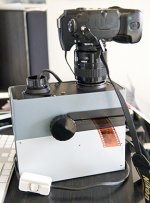
Here's a snap of current set up. The camera just sits there on its own, even with the vertical grip. Handy really enables me to use mirror up and self timer. Every little helps I suppose.

Durst F60, available just about everywhere for about $20. (the dslr, macro lens, computer & software are a little bit more!)
 

Attachments

  • DurstF60.jpg
    DurstF60.jpg
    87.4 KB · Views: 0
Last edited:
That's pretty good, much like one of the slide copiers, which was essentially a dichro enlarging head with a carrier for slides or film pointing upward, and a copy stand column with a bellows, macro lens, and camera mount.

If I'm copying a neg that's 4x5" or smaller, I usually use one of the anti-newton glass negative carriers from my Omega D-II on the light box. For bigger negs, I use a sheet of glass on top.

Another trick that you might try with this setup for a higher resolution image is to shoot the film in segments and stitch. My Coolpix doesn't get close enough (though it has surprisingly good macro capability) to do multiple images with 35mm, but I've done it a few times with medium and large format negs or transparencies.
 
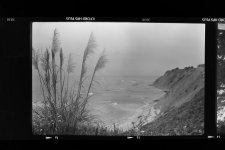
Will post a couple of images to show how I get on. Hopefully small enough not to take forever to see, but big enough to get the idea about how well / badly it works. When shooting colour neg film I end up with a TIFF file of about 60Mb, from an uncompressed RAW image (Nikon D300)

Photo posting, purely for scanning evaluation. As I understand it first photo postings in a forum should always be a cat even if you don't own one, so..

APX100, Rodinal 50+1 20deg 13mins 50mm Summicron
WebCat.jpg


Fuji Superia 200, Zeiss 28 2.8 this one tricky to get colours right
BritomartWeb.jpg


Fuji NPH400, Zeiss 28 2.8 (I think)
PersonWeb.jpg
 
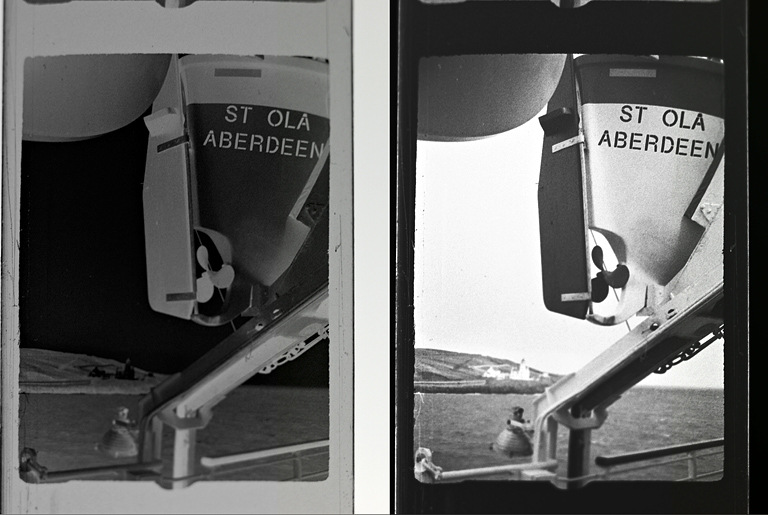
I'm getting very encouraging results with a D80 on a copy stand, inverted 50mm lens at the end of a 35-105 zoom and one of those old film viewers with the big flat soft 8X10 white light. A MF-size piece of AN glass on top of the 35mm film to keep it flat and away we go. The soft white light takes care of most blemishes in the film, like scratches, "fog" and such.

Exposure is manually controlled, files are saved raw and post-processed later. With slides, it's very fast. With negatives there is the editing step in between to reverse the image but that's still a lot faster than using a line-by-line scanner.
Not as detailed as a film scanner, but faster. Certainly good enough for web purposes.

Now, where is my 24MP dslr for real detail?... 😱
 
I do this with my F30 on tungsten WB against a blue sky for my colour negs. It works well enough for a 5x7. I use a blackended cut out peice of cardboard to avoid reflections off the camera.
 
I use a Coolscan 8000ED with glass carrier for both 35mm and medium format work. I don't have a digital camera with high enough resolution to photograph negs. Most of my work is medium format and my D-SLR gives barely 35mm quality. I have made 16x20 prints from my 645 negs and grain is not an issue.
 
Here's a snap of current set up. The camera just sits there on its own, even with the vertical grip. Handy really enables me to use mirror up and self timer. Every little helps I suppose.

Durst F60, available just about everywhere for about $20. (the dslr, macro lens, computer & software are a little bit more!)

What am I looking at there? What's the box?
 
Back
Top Bottom