Help identifying a bellows camera

Toastno6

Member
Local time
7:45 AM
Joined
Oct 16, 2013
Messages
26
Hi folks,

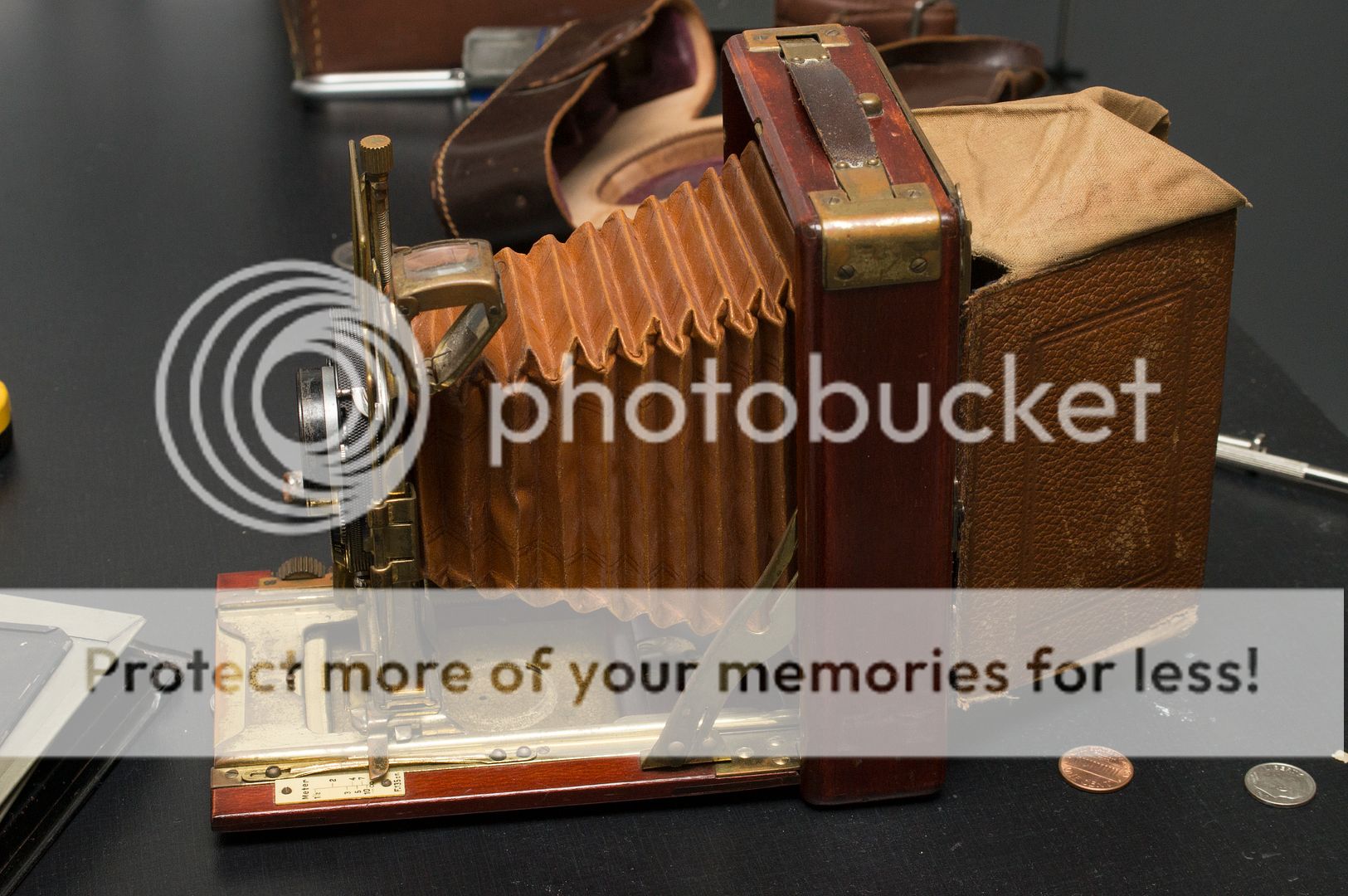
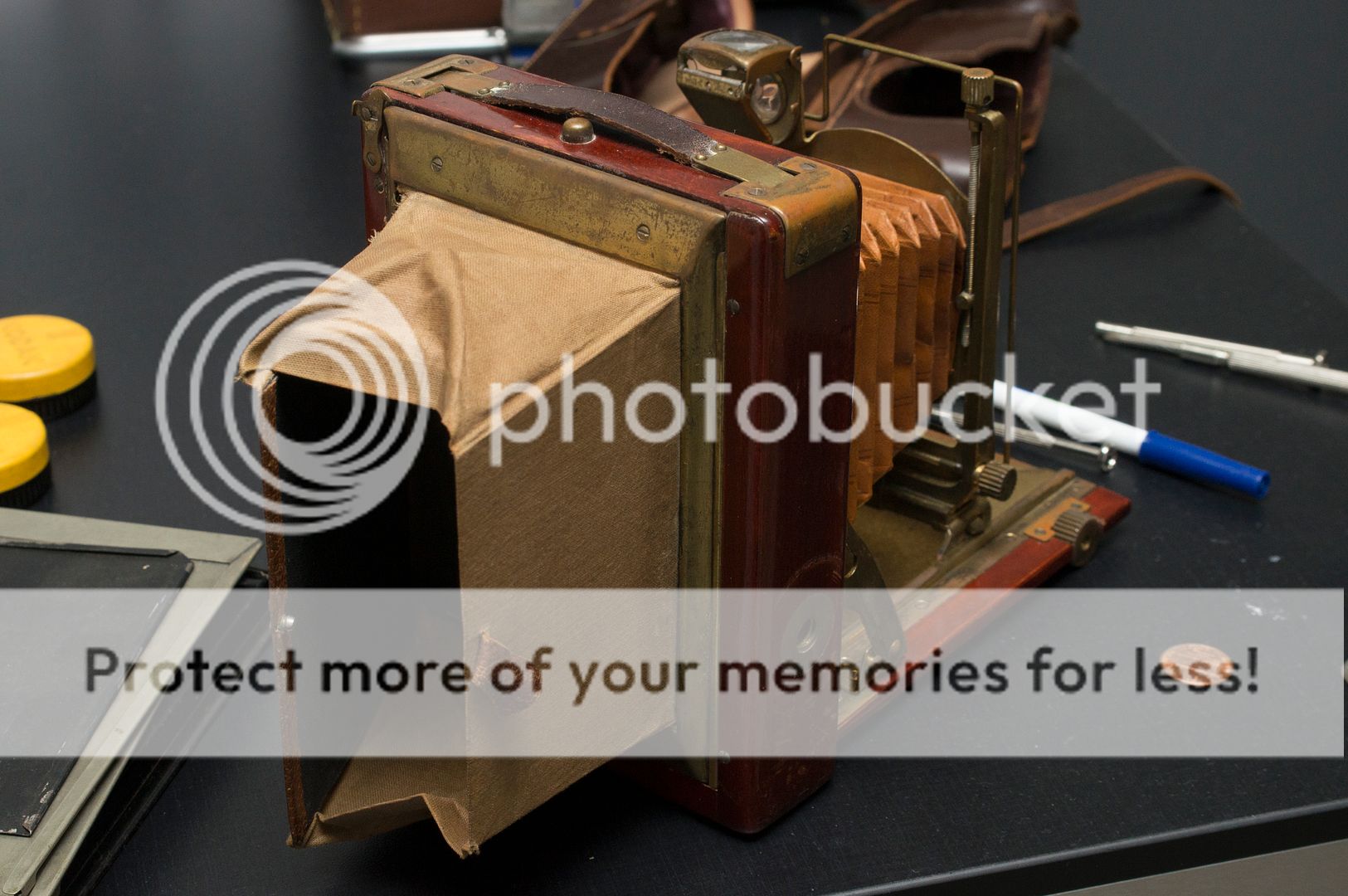
So this is part of a collection I inherited from my dad (sitting in attic since the 70's, want's it to be used/sold/not get ruined in a Massachusetts attic, you know the drill). I've managed to find info on everything in the collection except this guy. I know about the lens but not the camera. The closest I could come to any kind of positive ID was that it's a tropical camera but not a Contessa. The plan eventually is to try to sell it so I can get the more modern (i.e. 1935) parts of the collection CLA'd but I'm terrified of advertising it without really knowing what it is. I know it's not really a fit in any of the forum sections here but I've had so much great info about the Leicas that I was wondering if anyone here might be able to help. Thanks!
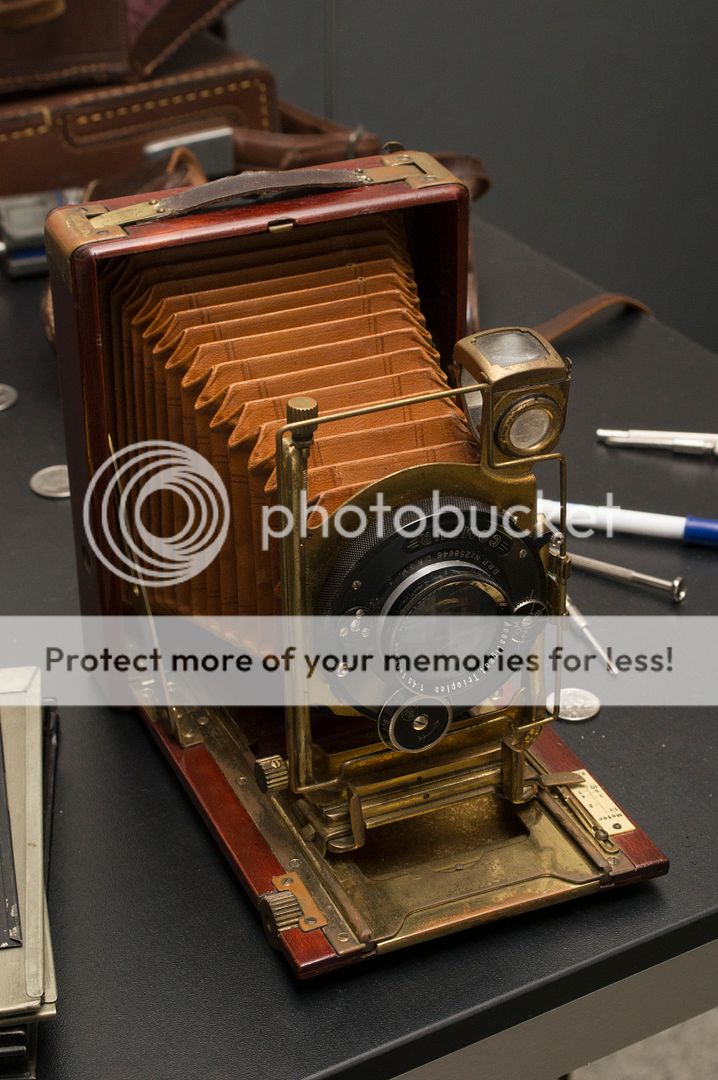
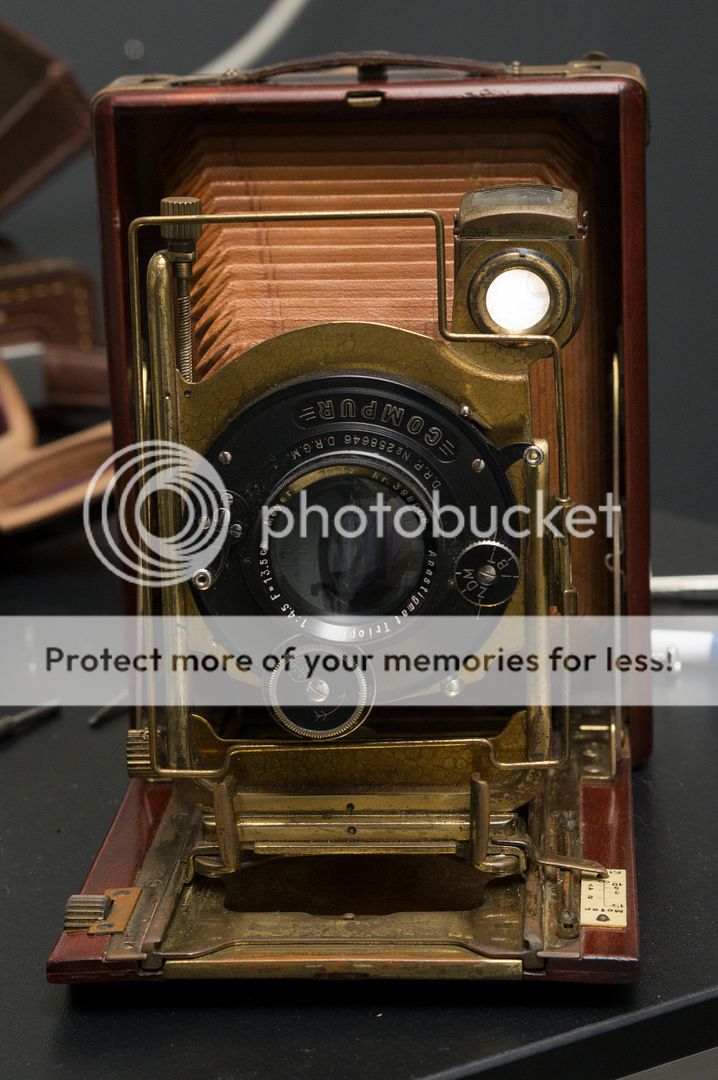
Bellows_zpsbba08339.jpg


Bellows_3_zps444a0d6d.jpg


Bellows_2_zps3157a7df.jpg


Bellows_1_zpsdc19970a.jpg
 
The way the lens board is set up reminds me of Rodenstock plate cameras, with the two release tabs on the front. Welta also used tabs like this. Most cameras of this type used fixed tabs that were only used to pull the lens board out.
 
May I ask, what size plate? I have a 9x12cm camera of similar layout (not the same, and mine isn't branded anyway). My reason for asking is that in this era (1920's +/-) English and American cameras were Imperial sizes and continental European cameras metric. Should allow you to cut the number of manufacturers by 50% ;-)

The outside (track not plate) dimensions of my focusing screen are 150 x 102mm (Apx 6 inches x 4 inches), the plate itself, not surprisingly, 90mm x 120mm. (3.5 x 4.7 inches). Imperial plates were 5 x 4 inches.
 
Well this is definitely narrowing it down although I'm having a hard time measuring the various plates/viewing devices I have as they're all different overall sizes. Even the film exposure area of the plates is a little different. I fell back on just measuring the exposed area on the back of the camera which turns out is almost exactly 3.5 by 4.7 inches, so metric? Thanks for the help everyone!

Camera_zps6ba3aa02.jpg
 
Wow, beautiful camera and a great idea to convert to Polaroid. If there's a way to do it without hacking mine I might give it a try. The lens is something I was thinking of trying on my SLT-57 because bellows adapters are pretty cheap.
 
Well this is definitely narrowing it down although I'm having a hard time measuring the various plates/viewing devices I have as they're all different overall sizes. Even the film exposure area of the plates is a little different. I fell back on just measuring the exposed area on the back of the camera which turns out is almost exactly 3.5 by 4.7 inches, so metric?

Forget about the exposed area - plates/sheet film are dimensioned by plate/sheet size. Either you are measuring at the wrong spot (you have to check the plate size in the holder, not the camera cut-out) and it is 9x12cm, or your camera might be a 10x15cm hard masked down to 4x5" for export. At any rate I can only find references to the Hüttig or (later) ICA Ideal being made in 6.5x9, 9x12, 10x15 and 13x18cm - if they were made in imperial size these weren't listed in period German sales catalogues.
 
I noted the lens was a 13.5 cm lens. It was not exclusively so, but that generally meant 9x12, at least by the 30's or so. I haven't seen many wooden cameras in 9x12 that weren't also covered in leather instead of finished wood.

As to the tabs, there were other folding cameras that did that. I think the Kodak/Nagle did that but an not sure. I would have to check some of mine at home, but it wouldn't be significant, as my are all leather coated cameras, and possibly not as old as yours.
 
As to the tabs, there were other folding cameras that did that.

Pretty much all of them did - it is one of the key parts that define the entire genre of double extension plate folders. This one looks a bit more old fashioned than the cast/stamped metal tab types common in the twenties, so it might be a pre 1914 camera - but then, the luxury/mould proof "Tropen" versions may have received stronger hand-made hardware past the time they went industrial production in general. It probably is a ICA (post 1909) or Zeiss Ikon (post 1926), as Hüttig merged into ICA a mere year after introduction of the Ideal - both ICA and ZI usually printed or embossed a model number somewhere on the body, which should provide an exact identification.
 
Awesome, thanks guys. This thing is proving to be a real headache. I just discovered the number '358' stamped underneath the focus track. You would have thought if they were going to stamp something they could go for a manufacturers ID as well as just a number!
 
The lens has a great look when shot wide open on Polaroid (Fuji) color film. I use the Macro Bellows to mount other LF lenses on my Nikon and it works quite well. Be sure to post pics from that lens.
Pete
 
Did a check on the back of the door you showed and Tropen Adoro name came up on a web site.

Camera is very close to yours and came in 3 sizes, so might check images to find a match

C238.JPG


DON
 
Did a check on the back of the door you showed and Tropen Adoro name came up on a web site.

Camera is very close to yours

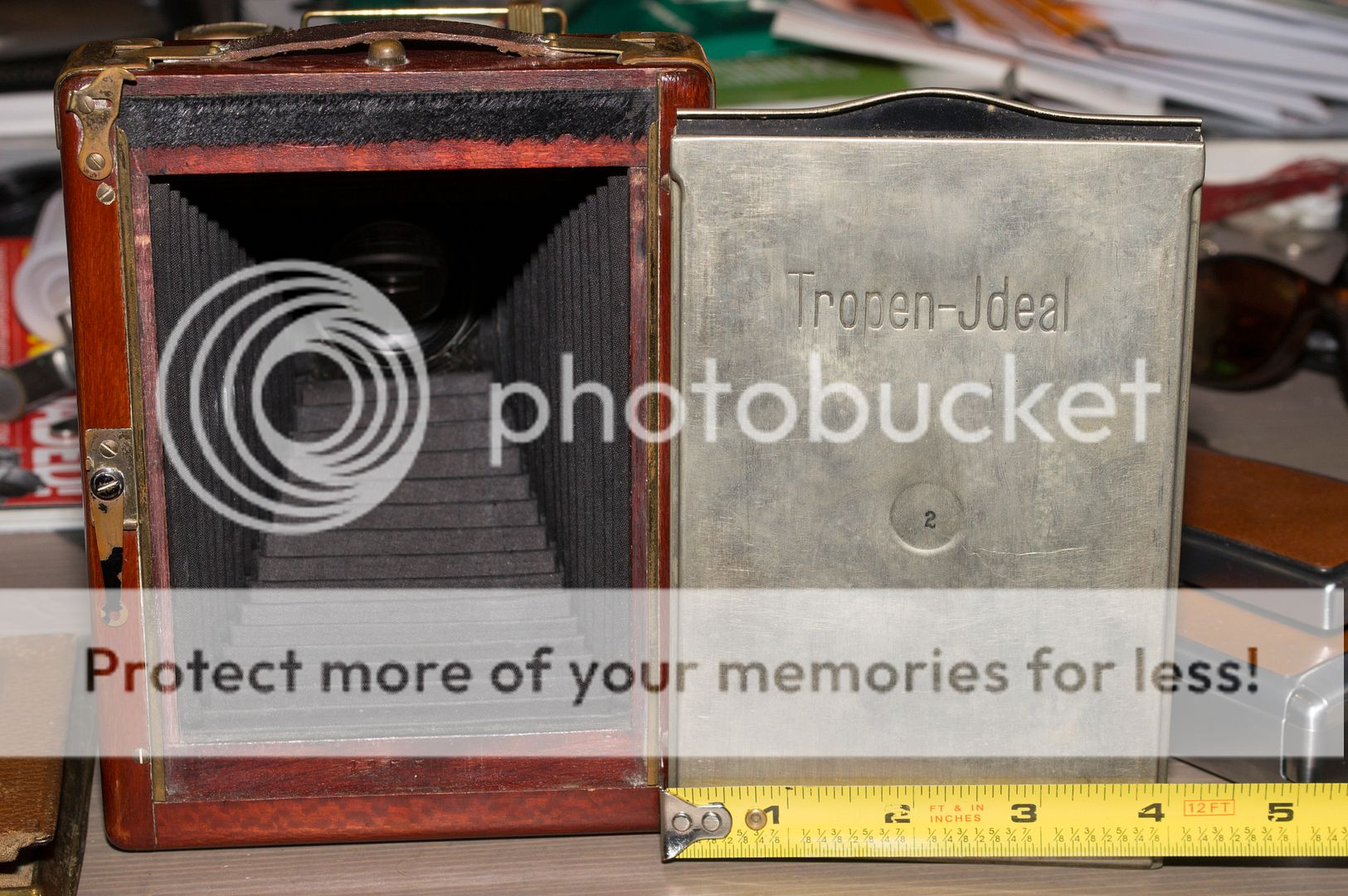
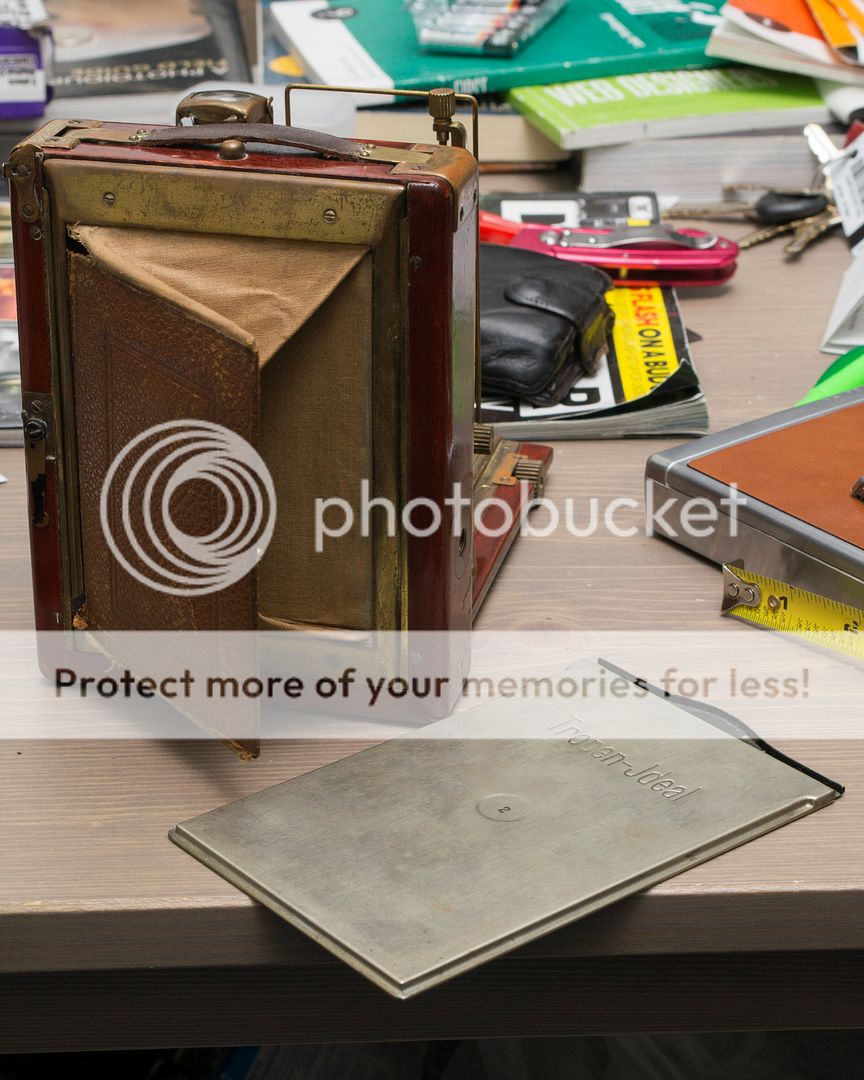
The back door actually says "Tropen Ideal"! So a Tropen Ideal it is, unless that has been swapped - which is unlikely, as misplaced backs tend to be from plain (i.e. black leather covered) cameras.
 
Lol, sorry guys that's just one of the film plates! Sorry if the pic looks a little misleading, I laid the film plate against the camera for a measurement/size comparison. The Tropen boxes don't match up with the box on mine, their metal flanges are full width and their boxes are deeper.

Camera_1_zpsb1f7378a.jpg
 
Lol, sorry guys that's just one of the film plates! Sorry if the pic looks a little misleading, I laid the film plate against the camera for a measurement/size comparison. The Tropen boxes don't match up with the box on mine, their metal flanges are full width and their boxes are deeper.

Ah well, if you swapped the holder with something that is known to come from another camera, all bets are off, and if it should be a different Falz type, it is indeed unlikely that it is a Ideal as the sub-companies of ICA usually stuck to their one corporate Falz until they standardized on one type in Zeiss Ikon days. YMMV, though, as they sometimes made cameras with non-regular Falz types on request, for buyers that desired a camera that shared the same backs with their others.

In any case, I can't quite figure out where you are talking of holders, matte frame and other components when you speak of "boxes" and "plates" - if that is a holder that fits and came with the camera, I'd still suspect it to be original, and the camera to be whatever is stated on the holder. Even more so if the camera comes out of private possession and never was subjected to the collectible camera fair treatment. If alien holders were added to a Tropen back in the period, these usually were black painted regular no-names (or at the very best a anonymous Tropen finish one) and not camera-branded Tropen version ones.

At any rate, 358 does look very much like a ICA type number - but that does not mean it must be a Ideal, much of the German camera industry merged into ICA and later Zeiss Ikon, which leaves a very wide field for research. I'll see whether I can find anything - but my pre-war references are dealers catalogues, which did not carry every model, and are particularly incomplete when it comes to luxury/export ones like a Tropen.
 
Ica and Zeiss numbers are four digit with a slash after the 3rd digit. Btw the lens / shutter combination on this camera is upside down: it is a dial type Compur shutter made by Friedrich Deckel of Munich. The dial is supposed to be right up. The camera might be tampered with and not bearing anymore its original lens / shutter combination. This type of cameras was typically built in Germany; not British or American.

This camera very much resembles the Ihagee Tropen series of camera's AKA neugold and neusilber; but looking at details, it doesn't give a match:
http://collectiblend.com/Cameras/Ihagee/Neugold-Tropen-910.html
Since it has no name or clear type serial it is no Ica and not a Zeiss either.
But it comes very near the Tropen Rio made by Orionwerk:
http://www.vintagephoto.tv/rio.shtml
and W. Kenngott from Germany made something comparable:
http://www.earlyphotography.co.uk/site/entry_C572.html
But the best match seems to be an Italian camera build with the idea of the German
MERKEL MINERVA camera:
https://sites.google.com/site/ldtomei/laacktropicalc1923
Btw your camera is missing part of the sportsviewfinder (see the screwholes in the wooden body).
Here's another Italian camera which bears some resemblance with yours:
http://www.ebay.nl/itm/Tropen-Tropi...le_e_professionale&hash=item19d7e620e7&_uhb=1
 
The internal dimensions of the ground glass focusing area should be pretty close to actually size of the plate film (usually), so u should be able to tell if it is at least a 9x12 or some other size.

The plate camera forum that I mentioned has a thread that tries to list all te known plate holder outside dimension variations... I think it was intended as a cross reference database so that people could buy other brand plate holders if they could not find their own maker.

Gary
 
Ica and Zeiss numbers are four digit with a slash after the 3rd digit.

That was a extra size (or version) designator behind the three digit base model number. It only was consistently introduced years after ICA started, none of my pre-war or WWI cameras have it. Their earlier cameras usually had a three digit number (and different numbers for each size) - some even had completely different identification schemes as the companies that merged into ICA used up their earlier parts inventory, sometimes for years...
 
Btw the lens / shutter combination on this camera is upside down: it is a dial type Compur shutter made by Friedrich Deckel of Munich. The dial is supposed to be right up. The camera might be tampered with and not bearing anymore its original lens / shutter combination.

The lens would match the body - its serial puts it around 1919. It is perhaps a bit suspect for being too low grade for a Tropen, these were luxury cameras and usually had a up-market Tessar or Doppelanastigmat rather than this plain triplet type.

It is quite common for the lenses to be rotated on the panel, as users tried to force stiffened shutters and aperture blades.
 
Back
Top Bottom