
Help with poor prints

Rivetdigger

Newbie
Local time
11:29 AM
Joined
May 1, 2007
Messages
7
I’ve just had a roll of TMAX400 back from a lab. They were taken with an Oly 35RC with separate incident light readings. All the prints exhibit the same issue as shown below. They seem to me to have very high contrast (hard grade paper) with blown out highlights and solid shadows. I scanned the neg with my old 1200 dpi flatbed and the results on screen looked similar. With a loupe and lightbox I could see detail in the highlights and shadows, although not a lot.
If I’d over exposed the neg, I would have expected blown highlights, but wouldn’t I have got grey shadows, not solid?
Vice versa, if I’d under exposed the neg, I would have expected maybe reasonable highlights and solid shadows? I seem to have both!

Can anybody assist?
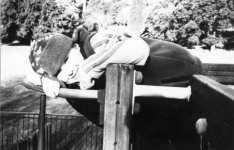
 

Attachments

  • TMP10.jpg
    TMP10.jpg
    38.6 KB · Views: 0
Its because you shot in high contrast light. It is hard to maintain full detail in the dark and light areas in a scene with bright sunlit and deep shadow areas. One of the reasons I rarely shoot on sunny days. With most films, you must reduce developing time about 30% and give about one stop more exposure to lower contrast when shooting in bright sun conditions.
 
900s.jpg


mirror.jpg


These are two examples of sunny day shots with both bright sunlit areas and deep shadow areas in the same photo that I maintained full tonal range in by reducing dev. time 30% and increasing exposure one stop.
 
The old rule of thumb is "expose for the shadows, develop for the highlights". That usually has to be fine tuned a bit, but it's a start. My gues is that the lab over developed your film. My experience with T-Max is that yes, it has finer grain than Tri-X, but at the expense of exposure latitude. Until you start developing your own negatives you might continue to have problems like this. Labs tend to use one developer, keep replenishing it, and have no idea as to what your subject might be or what you expect it to look like.
 
Thanks Christopher. I don't process my own films and a film can be in the camera for weeks sometimes. It would be difficult for me to alter development times as it would have been used in varying conditions.

If the film was over-developed, is it worth me sending the film back to the lab? Is there anything they could do?

I have tried Kodak 400CN via my local lab and I was pleased with the results - maybe that's the way to go.
 
It looks over developed to me. Commercial labs run fixed development time, so you have to find the best EI for your film.

Sacrifice a roll of film to fine tune to the processing of the lab.
Take a roll and shoot "average scenes" (ones that cover the whole tonal range) and in every photo bracket +/- at least 1 stop. [I would do -2(1600),-1(800),-1/2(500),0(400),+1/2(320),+1(200),+2(100) -blank-]
Then send it out and see which frames have the best tonality
So next time adjust your ASA/EI setting accordingly.

From what I see -1/2 to -1 will give you better results from what the lab is doing, looks over developed to me.

Cheers


I’ve just had a roll of TMAX400 back from a lab. They were taken with an Oly 35RC with separate incident light readings. All the prints exhibit the same issue as shown below. They seem to me to have very high contrast (hard grade paper) with blown out highlights and solid shadows. I scanned the neg with my old 1200 dpi flatbed and the results on screen looked similar. With a loupe and lightbox I could see detail in the highlights and shadows, although not a lot.
If I’d over exposed the neg, I would have expected blown highlights, but wouldn’t I have got grey shadows, not solid?
Vice versa, if I’d under exposed the neg, I would have expected maybe reasonable highlights and solid shadows? I seem to have both!

Can anybody assist?
 
Thanks Christopher. I don't process my own films and a film can be in the camera for weeks sometimes. It would be difficult for me to alter development times as it would have been used in varying conditions.

If the film was over-developed, is it worth me sending the film back to the lab? Is there anything they could do?

I have tried Kodak 400CN via my local lab and I was pleased with the results - maybe that's the way to go.

No, they can't do anything about it to change the negs themselves. You can have prints done by hand on low-contrast paper, or you can work on them in photoshop to fix the contrast.
 
try scanning the negative yourself or using a variable contrast paper with no contrast filter to get an idea of how much contrast is actually in the photo. since you left everything up to the lab it's kinda hard to track down whether it's overexposure, overdevelopment or a bad print.
 
All the prints exhibit the same issue as shown below. They seem to me to have very high contrast (hard grade paper) with blown out highlights and solid shadows.

Hmm... let me get this straight. You darkroom-print yourself, but send the negative to the lab for development?

I'm not saying this is wrong, but I'd develop my own negatives first before even thinking of trying to do darkroom-printing. For the exact reason that Chris and Al said above, you need the control that the lab can't give you.

You already have most of the chemicals anyways, the only thing different is the developer.

Unless I completely misunderstood your situation, in that case, sorry 🙂
 
Hi Will,

I posted the film to a lab for developing and printing.

I spoke to them yesterday and suggested the film may have been over-developed. They said it had'nt.
They still have digital copies on site and offered to re-print with less contrast. It will be interesting to see the results.
Thanks, Mike
 
Did they come up with the "that silm is too contrasty" excuse?
If they did next time shoot as ASA 500 or 640 or better yet run a test like I described above to find the right ASA

Hi Will,

I posted the film to a lab for developing and printing.

I spoke to them yesterday and suggested the film may have been over-developed. They said it had'nt.
They still have digital copies on site and offered to re-print with less contrast. It will be interesting to see the results.
Thanks, Mike
 
Hi Will,

Did they come up with the "that silm is too contrasty" excuse? Have you been speaking to the same lab????
Yes, they did use that line. Strange how all 36 exposures were the same "contrasty situation"!
Mike
 
that is a VERY COMMON line from labs all over the place
there is no such thing as a Too flat or Too contrasty film, just exposure and development are not mathced.
I have developed my own since I was 10, but for a while I worked in a photo-studio and we sent the film out to be developed. Then we changed film (Agfapan became APX) and the fotos came back weird looking, and the dude said something along those lines.... I just laughed since I had used that film for my personal pleasure and have actually found it incredibly nice

So I talked to the pro and he told me to shoot a bowl of fruit with a grey card as I told you before (but in 1/3rds increases) and send it out. BINGO! no more problems 😉
 
Back
Top Bottom