How Long Until Medium Format Mirrorless smaller than today's High End SLRs?

How Long Until Medium Format Mirrorless smaller than today's High End SLRs?

  • 2015

    Votes: 5 9.1%
  • 2016 Photokina

    Votes: 8 14.5%
  • 2018 Photokina

    Votes: 20 36.4%
  • NEVER

    Votes: 22 40.0%

  • Total voters
    55
Not sure what you mean but if you are asking when a small mirrorless camera will equal the quality of film based medium format camera, well I just don't know. I'm quite sure my very limited experience with medium format and current mirrorless cameras disqualifies me to give an opinion.
 
I voted never, but I meant 'not for a long time'. There is practically zero demand for medium format digital at all, I think investment will diminish, and I think it's more likely digital medium format will go away, rather than improve. A shame, but I think that's where it's headed.
 
On a Hasselblad, the lens sits about 60mm in front of the film plane. Even if a smaller, thinner body is feasible, the lenses will stick out miles. The bigger the film (or sensor), the longer the lens needs to be, to cover the same area. I don't see how a medium format camera could be any more compact than they are already. The smallest you could make it would be a super wide angle, an SWC with a digital back - ! there it is, the first mirror less digital medium format.

The idea of using a phone or a pad as a viewfinder is interesting, but if 'standard' lenses are required, a rather large and deep camera obscura will be required to fit the sensor to. 80mm standard for a 6x6, 150mm for a 4x5inch negative. And MF format sensors will never be cheap, 6x6 is two and a half-times the area of a 24megapixel full-frame : so many pixels, much processing power, wow.

Cheers
 
Last edited:
For me it's more about things that border on the subjective and intangible, like exquisitely subtle gradations and a sense of being both more lush and also more correct at the same time than its smaller format relatives.

There are many things that medium format does differently than 35mm or smaller.

DOF, tonality, dynamic range...

Anyway, I don't see it happening this decade, but probably next.
 
The Alpa Cameras and the like ARE digital mirrorless MF cameras, and depending on the lens they are not much bigger than pro DSLRs (if at all). Even the trick with the iPhone as a viewfinder has already been done in them. If the new backs were just a bit thinner, I'd see no problem size wise. But no way you can handle such a camera like a mirrorless APSC with liveview and AF, if this was intended by the OP.
Kind regards, Klaus
 
The optical characteristics for medium format are different and produce a different look than 35mm -- so while the same detail may be possible the same look wont -- and the dynamic range of larger pixels might yield a "better" result on MF -- all I want for Xmas is a 1/2 inch thick replacement door with a 2 1/4 x 2 1/4 sensor for my Rolleiflex -- it could be powered by the energy generated by the winding crank!

Amen, Brother... let us together SING the praises of that medium format look. 🙂

And please make another that replaces the film cassette in my Hassy A12. 🙂
 
There are many things that medium format does differently than 35mm or smaller.

DOF, tonality, dynamic range...

Anyway, I don't see it happening this decade, but probably next.

DOF rendering may be different, but I don't see how it is an advantage over 135. Maybe the difference is preferable to some photographers, but it would take a very specific comparison between specific lenses to tease out the difference.

There is no gain of dynamic range just by virtue of being medium format. My 645D has worse dynamic range than my A7, because it has a older sensor design.

Tonality may be one of the issues, but we have 135 systems with such amazing level of performance, I fail to see the need for anyone, even a discerning professional photographer to choose medium format on the virtue of tonality alone. Some may want to, but it is mostly up to personal preferences.
 
DOF rendering may be different, but I don't see how it is an advantage over 135.

I'm not so sure.

If Phase One digital backs have advantages over full frame 35 digital cameras, wouldn't medium format digital mirrorless cameras have advantages as well?

Pros don't spends 30K plus on a digital back trying to impress M240 guys at the local camera club. There is a professional NEED for such quality.

I think its only a matter of time until some major camera maker combines BIG sensors with an interchangeable lens "mirrorless" camera body and that it almost certainly will be lighter weight than 2014's big and heavy TOP of the line Nikon and Canon DSRs. Whether the finder will be an EVF or a wireless connection to a tablet or both, time will tell.

Stephen
 
I'm not so sure.

If Phase One digital backs have advantages over full frame 35 digital cameras, wouldn't medium format digital mirrorless cameras have advantages as well?

Pros don't spends 30K plus on a digital back trying to impress M240 guys at the local camera club. There is a professional NEED for such quality.

I think its only a matter of time until some major camera maker combines BIG sensors with an interchangeable lens "mirrorless" camera body and that it almost certainly will be lighter weight than 2014's big and heavy TOP of the line Nikon and Canon DSRs. Whether the finder will be an EVF or a wireless connection to a tablet or both, time will tell.

Stephen

It is my understanding, as someone who dabbled with Pentax and Hasselblad medium format digital, that pros use Phase One and Hassy for:

1. Leaf shutter lenses allowing high speed sync
2. sheer resolution unmatched by 135 format systems (40MP+)
3. very high tonal depth at base iso, far above most 135 format system

There is very little, if any value in MFDBs beside the three points. DOF does not matter nearly as much. Large format OOF is totally different - and I appreciate the kind of LF "look" a 4*5 or 8*10 gives, but I don't see the point with 645
 
The optical characteristics for medium format are different and produce a different look than 35mm -- so while the same detail may be possible the same look wont -- and the dynamic range of larger pixels might yield a "better" result on MF -- all I want for Xmas is a 1/2 inch thick replacement door with a 2 1/4 x 2 1/4 sensor for my Rolleiflex -- it could be powered by the energy generated by the winding crank!

With very fast 35mm lenses the rendering / appearance can look about the same as MF. The nikon D800/810 has 14.4 stops of dynamic range which beat my Hasselblad digital that I just sold by over 2 stops. MF at best can get close to the Nikon. There's really no big difference in optics except 35mm size cameras have faster apertures and a much greater range of optics. The only area MF beats the D810 is color depth. The D810 captures 14 bit and most MF 16. On a top of the line monitor I can see a difference but there's no way to put it on paper and the difference isn't that much.

I don't see it happening and don't think there's a reason for it. The cost would be out of sight. You'd probably pay $30,000 or more for a body and optics would be huge and slow. Look at the size of H series Hasselblad AF lenses. In any case the back focus distance would dictate a rather large camera, mirror or no mirror. Shooting RF lenses on it like the Mamiya 6 would generate another set of problems with wides.
 
how long will it take until we have medium format mirrorless cameras -- interchangeable lens cameras -- that are smaller (ie lighter weight) than 2014's high end Nikon & Canon DSLRs?
The technology is already there, with some compromise. The question is only when (some would argue if, and some of those probably make the decisions) this makes sense commercially.

The big obstacle is building a new lens lineup for mirrorless. It is pretty much required to make the system interesting for the masses in this little niche. No large manufacturer is happy to develop the product and sell it to the relatively few who will only use their existing lenses. A niche manufacturer, perhaps.

It's interesting to see what happens and when. I'd like for the mount and lens system of whatever comes out first to be future proof to allow bigger sensors, though. The digital medium format of today is pretty good, but I hope it is soon viable to go bigger.
 
I fail to see the need for anyone, even a discerning professional photographer to choose medium format on the virtue of tonality alone. Some may want to, but it is mostly up to personal preferences.

You may fail to see, but many of us (who actually use different formats in practice and know the IQ difference) see.

Actually I wait for a digital LF. I know it's a long way off, but someday we're maybe there.

Problem with the current digital MF is that the sensors themselves actually are very small in MF terms, 645 or smaller. 645, it's the smallest MF, some don't even call it a medium format, since it's just around 2 times over FF. A proper MF starts with 6x7 or bigger, that's over 5 times the area of a 35mm fullframe. You can't beat the physics, hence why the LF is still The King of Photography when it comes to the fundamentals of IQ. It's proven many times over. Limits in usage of different gear in the practice is another issue, but IQ-wise there's no competition, there's only physics.
 
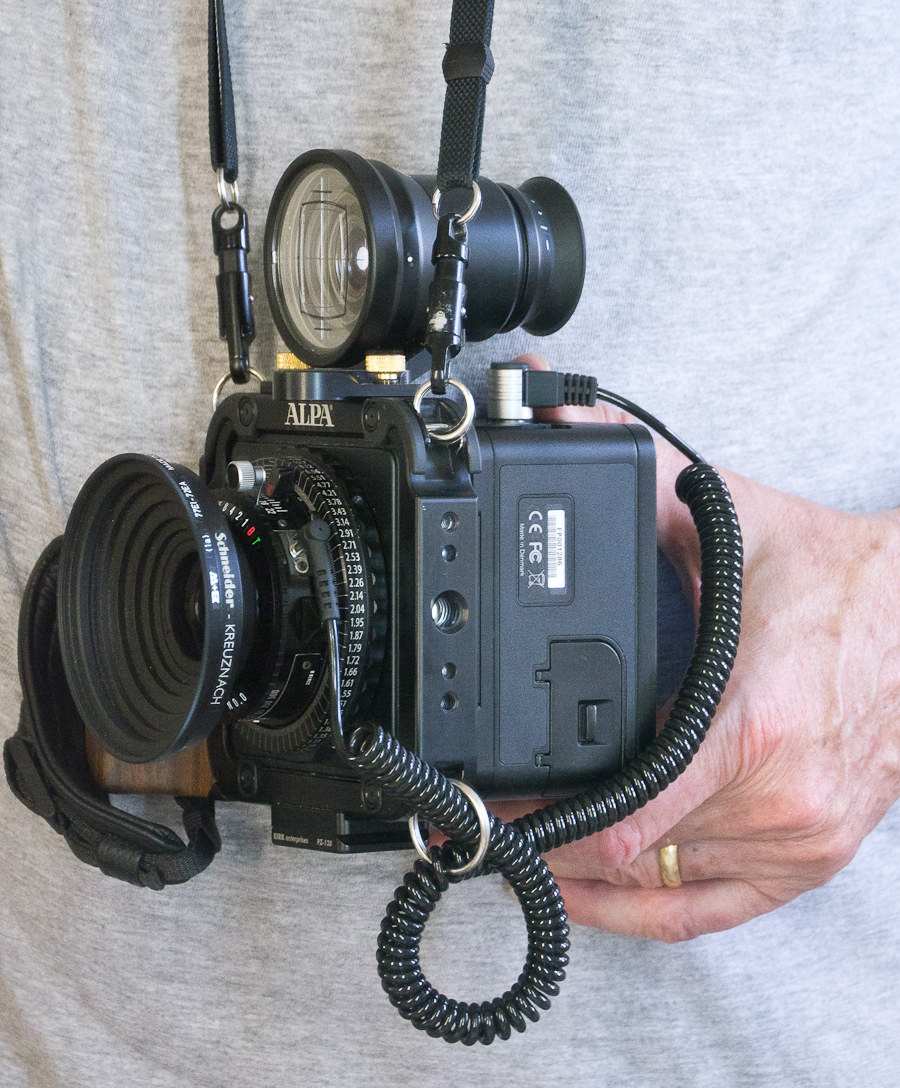
An Alpa TC with digital back is (depending on your metric) smaller than a FF DLSR.

20110809-August-9-2011-08-35-39-AM_P00036-1308.jpg

Not my photo, original article here: http://www.woodycampbell.com/portrait/alpa-tc-2/
 
The optical characteristics for medium format are different and produce a different look than 35mm -- so while the same detail may be possible the same look wont -- and the dynamic range of larger pixels might yield a "better" result on MF -- all I want for Xmas is a 1/2 inch thick replacement door with a 2 1/4 x 2 1/4 sensor for my Rolleiflex -- it could be powered by the energy generated by the winding crank!

Completely agree.
 
If I look at my Fuji MF rangefinders then I don't think you can get them much smaller. You still have the lens to consider and the focal length isn't going to change. Then there is the battery that won't be much smaller than a roll of 120 film (different form but volume stays). Weight might be a bit smaller using more plastic or composite.

I'd like a digital 6x9 back for that one.
 
Back
Top Bottom
