
I don't shoot film, I'm not rich enough...

I feel a bit sad about the hybrid workflow... Sad because some years ago I considered it a great option... But there's visible sharpness and tonal loss while scanning: and I mean even with the best scanners...

For example: what 35mm color film and camera, after scanning, give us similar results to an M9? That's what I mean...

Yet the hybrid system has a strong point apart from its digital processing strengths: it allows us to have great physical originals, and those originals might take two other roads sometime in the future: optical, analog printing, or, future, better digital ways of scanning and printing...

Cheers,

Juan


But a small loss in tonal range and sharpness doesn't mean a lot for me obviously Juan because I still prefered the look of scanned cheap Kodak colour film to what I was getting from my M8 at it's best!

When I shot a gallery opening for a friend one night with Fuji Pro 800Z instead of my usual M8 I was blown away by how much more I liked the look of the scanned Fuji film for the final result!
 
I buy generic C41 35mm film for prices between $0.25 and $1.25 USD per roll in bulk purchases on eBay, the 99-cent store, sometimes here, or at other photo sites (often expired, but rarely an issue). I process it to negatives at Walmart for $1.50 a roll and scan it myself - all very cheap. I have low cost ways to shoot color slides too, but I won't bore you with the details. Film is cheap if you want it to be.

Unless prices have changed in the last couple of years, it costs anywhere from $3- $5 per roll to process C-41 up here in Canada (Calgary). B&W film - at around $15/roll. Expensive.

Somebody correct me if I'm wrong with the prices.
 
There is another term: film Luddite

Luddites did not merely stick to old ways. They sought to overthrow the new, often by sabotage (another word with a lovely etymology). I do not think many film shooters are actively trying to sabotage digital photography.
 
i think it's part of being a purist...and if you're a purist then you're just a little better than everyone else.

Well, if you're a purist, you are actually just a little better than everyone else, or not, but it sure makes you feel as if you were a lot better.

That's, I guess, a major reason why people become purists about things: it makes them feel as if they were better than everyone else.
 
There is nothing about film, with one exception, that has anything at all to do with whether or not the photographer thinks before shooting.
I wholly disagree. When many of us are talking about film we're talking about using cameras without much automation--- at best a rangefinder (which still demands thought to consider depth-of-field) and maybe a TTL lightmeter although most probably an outboard one. The digitial cameras that almost everyone here might use are, by contrast, all about automation. Sure there are film rangefinders with significant amounts of automation such as the Contax G2 and even anti-shake built into optics such as Canon's IS (Image Stabilization) range and there is the possibility with a number of digital cameras to use them with less automation but.... The film camp used to be filled with discussions "Rangefinder versus SLR", "Zone focusing versus Rangefinder", "TLR versus SLR", "Reflected spot versus Incident metering".. This is just bumping this up...
The discussion could here instead be about automation.

Shoot and review?
And throw-away? I think this is dangerous. With the flood of images one can often throw away some good with the bad....
But if one has the time in the field I see no reason why not to take digital snapshots to examine a motive before taking photos. Before digital this was common practice in cine and large format but using Polaroid--- and sometimes video as assist. A small digital capture device (with 5 Mpixel and beyond sensors being included in our telephones we probably already have one in our pockets....) is probably good to augment a director's finder in one's kit....
 
Unless prices have changed in the last couple of years, it costs anywhere from $3- $5 per roll to process C-41 up here in Canada (Calgary). B&W film - at around $15/roll. Expensive.

Somebody correct me if I'm wrong with the prices.

$15 a roll for development? At least in the US people use a gun to rob you😱 Think its time for more people in Canada to start processing their own B&W.
 
I feel a bit sad about the hybrid workflow... Sad because some years ago I considered it a great option... But there's visible sharpness and tonal loss while scanning: and I mean even with the best scanners...

For example: what 35mm color film and camera, after scanning, give us similar results to an M9? That's what I mean...

Yet the hybrid system has a strong point apart from its digital processing strengths: it allows us to have great physical originals, and those originals might take two other roads sometime in the future: optical, analog printing, or, future, better digital ways of scanning and printing...

Cheers,

Juan

Juan
The simple fact is getting an M9 would be extremely unhealthy for a lot of people here, including myself. As our wife's would likely kill us when they saw the bill LOL.
 
The discussion could here instead be about automation.

Oh no, it's 1980 again.

And throw-away? I think this is dangerous. With the flood of images one can often throw away some good with the bad....

If it was fine for Garry Winogrand, who was more of a throw-away shooter than most who use a digital camera today, it should be fine for most of us.
 
If you already own a canon dslr it is a no brainer when it comes to what is most expensive (this person who stated that film was too expensive owns a canon dslr according to the OP).

I am probably a bit naive, but it always get a bit surprised over how dangerous digital cameras are. If they frightens you, take out the battery. And if you are so brave and use it, most likely it will not change your DNA in any way........
 
But a small loss in tonal range and sharpness doesn't mean a lot for me obviously Juan because I still prefered the look of scanned cheap Kodak colour film to what I was getting from my M8 at it's best!

When I shot a gallery opening for a friend one night with Fuji Pro 800Z instead of my usual M8 I was blown away by how much more I liked the look of the scanned Fuji film for the final result!

I know: that's why I shoot color film too... But in one hand wet color printing is even better, and in the other hand for sure there are digital ways to make M8/M9 files have better tone, but I know nothing there... Well, I do, I have studied and used Photoshop for years, but I know there are specialized people... Color is quite a complex field... Maybe in a few years pro digital color processing will be a more common skill beyond levels and color balance/selective color/saturation... Lately I have seen incredible digital prints after digital capture but I just can't get there by now by myself... And I think it's not about the camera but about the skills when using software... All I was saying is I doubt the hybrid process is the best way for today or the future... And the tonal and sharpness loss isn't minimal: I see it relevant. Just my perception, of course, and all this thinking of commercial photography, not of art photography, where these considerations are secondary to me.

Cheers,

Juan
 
Juan
The simple fact is getting an M9 would be extremely unhealthy for a lot of people here, including myself. As our wife's would likely kill us when they saw the bill LOL.

I'm with you there...😀

But what if you had the money and the digital processing skills? Wouldn't shooting color on the M9 make sense? I think Bill Pierce and Roger Hicks and other members are right when they consider the M9 is a great or maybe the best option for color photography from all points of view. I'm not a digital fan, but I do see the M9 as a historical turning point... Time will tell...

Cheers,

Juan
 
I wholly disagree.

But, Edward, what's to stop someone from thinking about a shot, regardless of the camera? There is nothing magical about a camera that compels people to think, or encourages people to shoot without thinking.

You're right that automation, or lack of it, plays a role in this. I suspect it changes the nature of any thinking that's going on. Chimping, and checking the histogram, for instance, could be characterized as pushing the thinking to after the shot is taken. Likewise, someone shooting a traditional unmetered RF in Sunny 16 mode might choose to snap away with great mindless abandon. Or not, depending on the choices they made.

My point is simply that because film imposes an absolute cost that digital does not, using film may prompt photographers to take more care with each shot, since each shot consumes a piece of a limited resource. That sentiment is expressed frequently here, and the sentiment is a recognition that film imposes costs that digital does not.
 
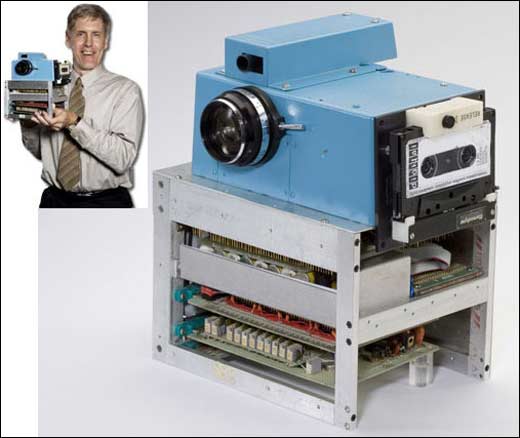
This below was the most important historical turning point ...the world's first digital camera! 😀

The M9 was probaly historically significant for Leica but for digital photography generally ... not so much IMO!


kodak_digicam.jpg
 
I'm with you there...😀

But what if you had the money and the digital processing skills? Wouldn't shooting color on the M9 make sense? I think Bill Pierce and Roger Hicks and other members are right when they consider the M9 is a great or maybe the best option for color photography from all points of view. I'm not a digital fan, but I do see the M9 as a historical turning point... Time will tell...

Cheers,

Juan

Oh if had the money and the lens I'd get an M9 in an instant 😀

Simple fact of the matter is I loved the results I got from my 5D but I simply wanted to try something different so I picked up an M4-2 and a few more lens for my Bronica SQ along with a couple of MF folders.
Who knows in few years I might switch back to mostly digital as to be honest I have no loyalty one way or the other.
 
This below was the most important historical turning point ...the world's first digital camera! 😀

The M9 was probaly historically significant for Leica but for digital photography generally ... not so much IMO!


kodak_digicam.jpg

Oh my... A true classic! 😀

Look at those lines: a design beauty! Amazing IQ! Unobtrusive!

Drool, Ken Rockwell! 😛

Cheers,

Juan
 
No relation at all between AE and chimping. When AE is used it doesn't take the photographer's attention away from reality. On the contrary, AE gives the photographer the option to keep his/her eyes on the real scenes all the time.

Cheers,

Juan
 
I just think it is funny that a few here make like the camera is always glued to their eyes 24/7. Sure, in street photography mode, you should be ready... and also in SOME other forms as well. However, certain types of photography do not require quick reflexes and spontaneity. You can relax, chimp, eat a sandwich, drink a beer, and still get your photo. What works for you doesn't alway work for the next person.
 
Oh no, it's 1980 again.
In a sense.. Perhaps even late 1960s.. Its German mechanical cameras versus the Japanese automated single lens reflex.. Its also "Does one really need shutter speeds beyond 1/1000th?".... or any of the other features then offered up in the specifications shoot-outs... Not much different from the Ghz, Gbyte, MPixel, sensor size blah blah of today..

If it was fine for Garry Winogrand, who was more of a throw-away shooter than most who use a digital camera today, it should be fine for most of us.
Garry Winogrand never used a digital camera. Its pure speculation if he would should be still have been among us.. But.. as an aside.. Garry did not throw away images... He just shot like a mad-man.... Of those over 300,000 unused images.. Just think if he tossed most of them out...? He did not use them.. but some are quite amazing! With digital workflows I'm sure they'd be lost.. the digital workflow encourages and provides incentives to toss out what one does not want to keep as keeping is expensive..
Every digital street photog I know shoots like a madman (Winograd style) but tosses all but the "keepers" out.. I know of none that keep them all... Winogrand, like many film sheet photographers, more or less did...

And I think this is the point: the cost of shooting is inverted:
  • With film it costs per capture. The cost to retain the image is marginal.
  • With digital the cost to capture is marginal but the cost to retain the image is high.
Thus with digital one tends to view the images with the eyes of the moment, filter and toss.. With film there is no demand for a decision.. What's good "today" might get printed.. and the rest might never or be "re-discovered" later... Some images I'd suggest become interesting with time, paradigm shifts..

Maybe that's the Zeitgeist.. Digital is for those who think today and not about changes tomorrow.. Its like tattoos and silicon breasts..
 
In a sense.. Perhaps even late 1960s.. Its German mechanical cameras versus the Japanese automated single lens reflex.

Well, the comparison should also make it pretty clear who won and what photographers actually wanted, amateurs and professionals alike.

And I think this is the point: the cost of shooting is inverted:
  • With film it costs per capture. The cost to retain the image is marginal.
  • With digital the cost to capture is marginal but the cost to retain the image is high.

Is it? How much hard drive space do you think Winogrand's 300,000 unused images would occupy? How many $100 hard drives do you have to buy for that?

In case you're worried about the longevity of hard drives - an LTO-3 tape holds 400 GB uncompressed, is specified to last at least 20-30 years, and costs $35; how many tapes do you need for those 300,000 images? You need a drive, but you don't need to worry about it too much; the installed investment in tape libraries is large enough that you can be sure that someone will be around to read them for you.

And how much do 10,000 film sleeves, 10,000 contact prints, and 500 folders to hold them cost? Shelf space in an archival environment? Keeping the gear around so that you can make prints or scan them? Making a copy of each film strip so that everything won't be lost in case the archive burns down?

Maybe that's the Zeitgeist.. Digital is for those who think today and not about changes tomorrow.. Its like tattoos and silicon breasts..

You don't have to get that tattoo just because you can, you know, just like you don't have to chimp just because you can. I'd say digital requires a bit of thought and planning ahead to do it well, but then it is easy. No need to throw in big words like Zeitgeist. Anyway, since you guys are so proud of how the film camera forces you to think and plan ahead, I don't think this idea is all that alien to you.
 
Back
Top Bottom