Irregular Crop Ratios

When you make pictures, do as you desire, and when you view pictures, respect the other guy's privilege to do the same.
Why, in fact, does an image have to be rectangular ?

So, I guess that I am saying "loosen up a bit".
 
I was influenced early on by wide screen cinema aspect ratios. Of these, I feel that two that influenced me the most were VistaVision (composed to look right on screen when projected anywhere from 1.66:1 to 2:1); and Todd-AO/Panavision70 (about 2.2:1). Experiments convinced me that most still photos look best at less extreme ratios. I think 2:1 is wide enough, and standardized on this ratio for my "wide-screen" slide shows, which I project on my 4 x 8 foot screen. I also will shoot 35mm slides in the standard 3:2. More recently, I find that many of my digital photos look good either cropped to the 16:9 ratio, or shot that way in-camera. If I had it to do over, I might have adopted a similar ratio for projected slides; maybe 1:75 or 1:85 (the latter being Hollywood's standard Academy aperture). IMAX doesn't seem to feel the need for the wider ratios: they use 1.44:1.

When preparing prints for display, I will crop to what ever ratio is best for the picture. I don't want to force the image into an arbitrary ratio. Monet didn't with his water lilies!
 
Maybe not "irregular" ratios but it is common practice to crop....

Many fashion photographers that shoot (or had shot) 6x6 crop. I think many of them are masters...

Of course, if you are talking about cropping a Hassy for a magazine, then by all means. I'm only talking about irregular almost squares, etc.
 
As long as picture framing is appropriate it doesn't matter.
Which crop is this?

_MG_9637_stitch21_out%2520copy.JPG

Again, I'm referring to the presented ratio. This 1:1.
 
When you make pictures, do as you desire, and when you view pictures, respect the other guy's privilege to do the same.
Why, in fact, does an image have to be rectangular ?

So, I guess that I am saying "loosen up a bit".

I probably do need to loosen up a bit. I do respect the photographers privilege, but I may disagree with his/her choice of ratio.

It doesn't have to be a rectangle....it can be a square. 😉
 
I used to crop freely, without regard to any aspect ratio, but that was a long time ago. Nowadays I prefer to stick with a small variety of crops for the sake of consistency. Mine are 1:1, 3:2 and 2:1. I find this personal gives me the freedom to crop images to suit the image, while freeing me from the tyranny of being forced to solely accept what the capture medium imposes.

I will sometimes crop to 8:10 for printing purposes, but really have a personal aversion to the 4:5 crop ratio, preferring 3:2 which I am used to, or square which I love.

I guess my roots in 35mm cameras show, and the ratios I prefer are rooted in 3:2, either going more rectangular with a pano crop, or cutting off the edges and going square but with 3:2 in the middle.
 
Again, I'm referring to the presented ratio. This 1:1.

1:1 refers to cartesian coordinates. The round picture is in polar coordinates represented by 0 to 100% on the radius (r) axis, and 0-360 degrees on the angle (theta) axis. It is translated to cartesian coordinates in order to be displayed on your computer screen. Cartesian circles are always 1:1, so yeah, it's 1:1 if you limit yourself to computer representation.
 
I usually try not to crop or if I have to do it I keep the camera ratio (which mainly is 2:3 or 1:1). When I have a series of pictures it helps having a more uniform view. But there are cases where an irregular crop is required to enhance the look of the image and if it is the case I have absolutely no objection to do it. It is the final image what is important, not the way I got it.
robert
 
Opening this out a little, does anyone feel some ratios suit some subjects better than others.
Personally, and this is a generalisation, so let's say usually, I prefer to make portraits in either 6x6 or 6x7, rather than 35mm which I often find too long.
 
Opening this out a little, does anyone feel some ratios suit some subjects better than others.
Personally, and this is a generalisation, so let's say usually, I prefer to make portraits in either 6x6 or 6x7, rather than 35mm which I often find too long.

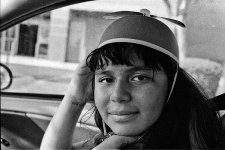
I like 3x2 horizontal portraits where there is a 'rule of thirds' point. An example is attached.
 

Attachments

  • beaniehat3.jpg
    beaniehat3.jpg
    137.3 KB · Views: 0
If you want to hang it in a gallery, you might as well do whatever you like with it.
But if it's part of an obvious sequence at an event it would just be contrived and waste your own time to crop every photo to a different ratio. Just batch it for your own sanity.
 
Opening this out a little, does anyone feel some ratios suit some subjects better than others.
Personally, and this is a generalisation, so let's say usually, I prefer to make portraits in either 6x6 or 6x7, rather than 35mm which I often find too long.

I agree. I prefer 4:5, overall (close enough to 6:7). But I shoot square because of my camera.
 
Well, I typically shoot in 4:3 or 3:2, Native formats for my 2 cameras....
But, I do use 1:1 on occasion...with my Digital..

I try to utilize the whole area, or a tad more, with very small cropping in editing...

But, I'll crop for more powerful image if needed.

I had a "fast Candid" the other day, and I quickly framed and snapped... but, I was bit too far to the left... so I cropped it 1:1. The main subject was on on the left, and I had too much space behind her..The 1:1 Crop still had the image I envisioned though...

The original had a few more people on the right, but, one guy was cut off a little too much, so I cropped that out.

Monument Circle, Indianapolis, IN. 8-15-2013 par Peter Arbib, on ipernity

I also had to make a film print 8x12, because 11x14 did not work.. (I am building a wall of 11x14 B&W Street Photography prints) So an 8x12 will fit in an 11x14 frame to keep the consistency of the 11x14 framed wall

 
Back
Top Bottom