It is time for a poll

It is time for a poll


  • Total voters
    301
  • Poll closed .
film=B&W maybe 60-70% and remaining digital for color with some converted to B&W via SilverEfex. thus 70/30….. though the more advanced digital becomes the more sterile and less interesting it becomes for me and has me more interested in "organic imperfections"….
 
I chose "I use digital cameras more often than film cameras." But in truth I've been 100% digital since shortly after I got an M8 early in 2008. Film shot after that was essentially sorting out and testing an ongoing repair problem with a film camera.

I got a Kodak (by Chinon) DC50 in 1996 for documenting issues at work, but when I still hadn't used it after 3 or 4 years, my wife adopted it. I got a Canon PowerShot G3 in 2004 for documenting issues at work... and actually did use it for that and for product shots. I continued with film for serious photography. Until the M8, and then suddenly I went totally digital.

About a year later, the parent company of our local mini-lab shrank their business and closed most of their outlying stores. Sorry to see them go, as I had been a very frequent customer, but it seemed to be a sign of the times.
 
I am not photographing as much as I used to, due to family and work constraints. But I would guess about 50-50, maybe 55-45 in favor of film. My digital P&S for snapshots of family and at work. Film for my own pleasure.
 
Think about this: If you're used to using higher end film gear, no "small, light-weight, fixed-lens digital camera" is going to give you the kind of shooting experience or quality that you're used to. By making that the basis of your judgement of a digital camera, you're biasing your evaluation immediately to be negative on digital cameras. If you're used to using a $100-200 35mm film point and shoot, however, any number of "small, light-weight, fixed-lens digital camera" choices will out-perform that handily. So pick what you choose to base your evaluation on carefully. Pick something that is equivalent to what you are used to using in a film camera as the basis of comparison. G
A Fuji x100 or x100s isn't good enough?
 
To all concerned: Please do not push this simple thread to (strong) personal opinions that may cause others to be offended.
 
99% digital these days as there's not much around here that motivates me to use 4x5 film. Hopefully in the not to distance future I'll be able to start working with models on a more regular bases at which time I'll start shooting more film.
 
If you're used to using a Nikon FM2 or Leica M6, no it isn't. Poor responsiveness, cluttered controls, etc, get in the way. G
Aaaah.
Casually my 35 mm cameras are a Nikon FM3a and a Leica MP.
Which digital camera do you think is at the level of these two film cameras?
I'm very reluctant in buying a digital camera. Now I use only iphone. My "serious" shots would be always film. But I'm considering an "easy" camera for "family photos".
On the other hand I consider respnsiveness fundamental. In other words I pretend that the camera shot when I want.
I like indoor BW shooting and 40 mm equivalent focal lenght.
May be the digital photography is not yet for me.
 
Aaaah.
Casually my 35 mm cameras are a Nikon FM3a and a Leica MP.
Which digital camera do you think is at the level of these two film cameras?
I'm very reluctant in buying a digital camera. Now I use only iphone. My "serious" shots would be always film. But I'm considering an "easy" camera for "family photos".
On the other hand I consider respnsiveness fundamental. In other words I pretend that the camera shot when I want.
I like indoor BW shooting and 40 mm equivalent focal lenght.
May be the digital photography is not yet for me.

I use a Sony A7 with my Nikkor and Leica R SLR lenses ... It provides much the same shooting experience as my FE2/FM2 did (manual focus, good responsiveness, same format/same lenses, about the same size overall, good viewfinder), with FAR more sensitivity. For even more responsiveness, a higher end Nikon DSLR or an Olympus E-M1 adds AF and much more speed.

For an RF camera like the MP, there's only one choice ... the Leica M line. But there again, I've come to prefer the Sony A7 overall.

G
 
I love using a variety of cameras and lenses that I have been lucky enough to save up and collect over the years. I reckon I am pretty even split between time using film and digital (although I would take far more digital photos). I continue to enjoy the look of confusion on each of my three (little) kid's faces as they discover that not all my cameras have a 'TV' on the back where they can instantly see their mugshot 🙂
 
When my son was little, he picked up my Canon F-1, and looking at the empty little square black plastic holder on the back of the film door (that holds the torn off end of a film box so you know what film is in the camera), he said, "This camera's broken Dad."

I asked him why he said that, and he said it was because the "screen on the back didn't work".

Best,
-Tim
 
I use a Sony A7 with my Nikkor and Leica R SLR lenses ... It provides much the same shooting experience as my FE2/FM2 did (manual focus, good responsiveness, same format/same lenses, about the same size overall, good viewfinder), with FAR more sensitivity. For even more responsiveness, a higher end Nikon DSLR or an Olympus E-M1 adds AF and much more speed. For an RF camera like the MP, there's only one choice ... the Leica M line. But there again, I've come to prefer the Sony A7 overall. G
Thanks.
I'm not going to spend more than € 500 for a digital camera, so for the moment nothing digital.
 
Thanks.
I'm not going to spend more than € 500 for a digital camera, so for the moment nothing digital.

Why arbitrarily put such a low value on a digital camera?

Digital camera purchases are front-loaded: you pay up front for a quality camera with a good sensor and responsiveness, add a couple of storage cards and batteries. From that point on the costs in use are very low.

Film camera purchases are end-loaded: you pay a modest amount up front for a quality camera (these days, anyway) and you pay an ongoing tithe as you use it for film and processing. Over time, with a good camera that you use a lot, the cost of film and processing surpasses the cost of the camera.

You can buy a very good quality digital camera that's a couple of years old for very little money too—buy a used Nikon D700 DSLR body, use your same Nikon lenses on it; you'll get fantastic quality and use it for the next decade at very little additional cost. (I've been doing that with an Olympus E-1 that I bought in 2008 for 1/10 its original price. Old design and low on pixels and sensitivity, but beautiful 5Mpixel images, wonderful design and responsiveness, and superb lenses.)

Digital cameras and sensors continue to improve and mature, but by-and-large almost any quality camera made since 2006 (and a couple made even before that like the E-1) can be a solid purchase with a long future in it, unless you want to always have the bleeding edge. Something like the Sony A7 is a bit expensive since it's relatively new but it's pretty much state of the art sensor-wise, has a good viewfinder, and is adaptable to whatever lenses you want to use with it. You can get one of them, use your Nikkor and most of your longer focal length RF lenses, and it will provide you with an excellent camera for a decade or maybe more at a very reasonable overall cost. AND it's a camera that performs at a level comparable to your film cameras.

If you just want a point and shoot, the X100 would work ok. But just like film point and shoots, they lack the ergonomics, responsiveness, and versatility of the cameras you're used to using.

G
 
Why arbitrarily put such a low value on a digital camera? Digital camera purchases are front-loaded: you pay up front for a quality camera with a good sensor and responsiveness, add a couple of storage cards and batteries. From that point on the costs in use are very low. Film camera purchases are end-loaded: you pay a modest amount up front for a quality camera (these days, anyway) and you pay an ongoing tithe as you use it for film and processing. Over time, with a good camera that you use a lot, the cost of film and processing surpasses the cost of the camera. You can buy a very good quality digital camera that's a couple of years old for very little money too—buy a used Nikon D700 DSLR body, use your same Nikon lenses on it; you'll get fantastic quality and use it for the next decade at very little additional cost. (I've been doing that with an Olympus E-1 that I bought in 2008 for 1/10 its original price. Old design and low on pixels and sensitivity, but beautiful 5Mpixel images, wonderful design and responsiveness, and superb lenses.) Digital cameras and sensors continue to improve and mature, but by-and-large almost any quality camera made since 2006 (and a couple made even before that like the E-1) can be a solid purchase with a long future in it, unless you want to always have the bleeding edge. Something like the Sony A7 is a bit expensive since it's relatively new but it's pretty much state of the art sensor-wise, has a good viewfinder, and is adaptable to whatever lenses you want to use with it. You can get one of them, use your Nikkor and most of your longer focal length RF lenses, and it will provide you with an excellent camera for a decade or maybe more at a very reasonable overall cost. AND it's a camera that performs at a level comparable to your film cameras. If you just want a point and shoot, the X100 would work ok. But just like film point and shoots, they lack the ergonomics, responsiveness, and versatility of the cameras you're used to using. G
Why film costs more? I shot only BW. Make contact sheet and print only the best shots. Also with a digital camera I should print the best shots. For me an image on a screen isn't a photo (personal opinion). I know nikon d700 is compatible with my optics. Also a d200 (less expensive). But since I have an MP DSLR are too big. I've thought M8.2 may be a choice (when the price falls), but have heard has noise problem at high iso speed.
 
Why film costs more? I shot only BW. Make contact sheet and print only the best shots. Also with a digital camera I should print the best shots. For me an image on a screen isn't a photo (personal opinion). I know nikon d700 is compatible with my optics. Also a d200 (less expensive). But since I have an MP DSLR are too big. I've thought M8.2 may be a choice (when the price falls), but have heard has noise problem at high iso speed.

Because no matter how little it costs, you are consuming film and chemistry with every exposure you make. That will eventually cost more than the camera does, if you keep shooting film long enough. It's inevitable.

I also print most of my favorite photos. That's why I did not articulate a print cost.

Even though the M8.2 may have "noise problem at high ISO speed", it can produce far less grainy photos at ISO settings that well outstrip 35mm film, like ISO 1200. The M9 sensor is very similar, only bigger, and I've produced ISO 2500 exposures that are far nicer than any comparable hi-speed 35mm film exposures from the point of view of grain and dynamic range.

The size issue is why I prefer to adapt lenses to the A7 rather than buy a Nikon DSLR.

G
 
Because no matter how little it costs, you are consuming film and chemistry with every exposure you make. That will eventually cost more than the camera does, if you keep shooting film long enough. It's inevitable. I also print most of my favorite photos. That's why I did not articulate a print cost. Even though the M8.2 may have "noise problem at high ISO speed", it can produce far less grainy photos at ISO settings that well outstrip 35mm film, like ISO 1200. The M9 sensor is very similar, only bigger, and I've produced ISO 2500 exposures that are far nicer than any comparable hi-speed 35mm film exposures from the point of view of grain and dynamic range. G
I'm happy to gear from you that M8.2 is good until ISO 1200.
I think this could be my digital camera. How do you print BW? I don't like digital printers. Only chemical print. In Europe we have Ilford (i live in Italy). I tried with film and results are not excellent, but satisfactory.
 
I'm happy to gear from you that M8.2 is good until ISO 1200.
I think this could be my digital camera. How do you print BW? I don't like digital printers. Only chemical print. In Europe we have Ilford (i live in Italy). I tried with film and results are not excellent, but satisfactory.

I print all my work, B&W or color, with an ancient Epson R2400. The R2400 was the first consumer-grade printer with an inkset that could achieve the quality I want in my B&W work, and papers for digital printing, combined with the Epson K3 inkset, have advanced to the point where the results are superior to my eye than anything I was ever able to produce in a home darkroom. All of the work I've hung in galleries, exhibitions, and sold to clients has been produced on that printer, from October 2005 to the present day. (Yes, it's about time for a new printer, but the old R2400 is still working...)

There are several choices in printers available nowadays that are up to the task, but I prefer to stick with the Epson K3 inkset that I know.

B&W with a digital camera (except the Leica M Monochrom) is a rendering process: the camera captures a full spectrum image, you have to learn how to render it to B&W and output it to a printer in a satisfying way. It's very much the same as learning how to process film and print in the darkroom, only it happens on a computer with software rather than in a darkroom with chemical baths. Once you learn how to do it, and presuming a printer of suitable quality, high quality inkjet printing is a consistent and rational process.

BTW, when people say "high ISO" these days, they typically mean ISO 6400, 12800, 25600, etc. ISO 1200/1600/3200 aren't even considered high ISO anymore, whereas with film "hi speed" is definitely ISO 400 and above.
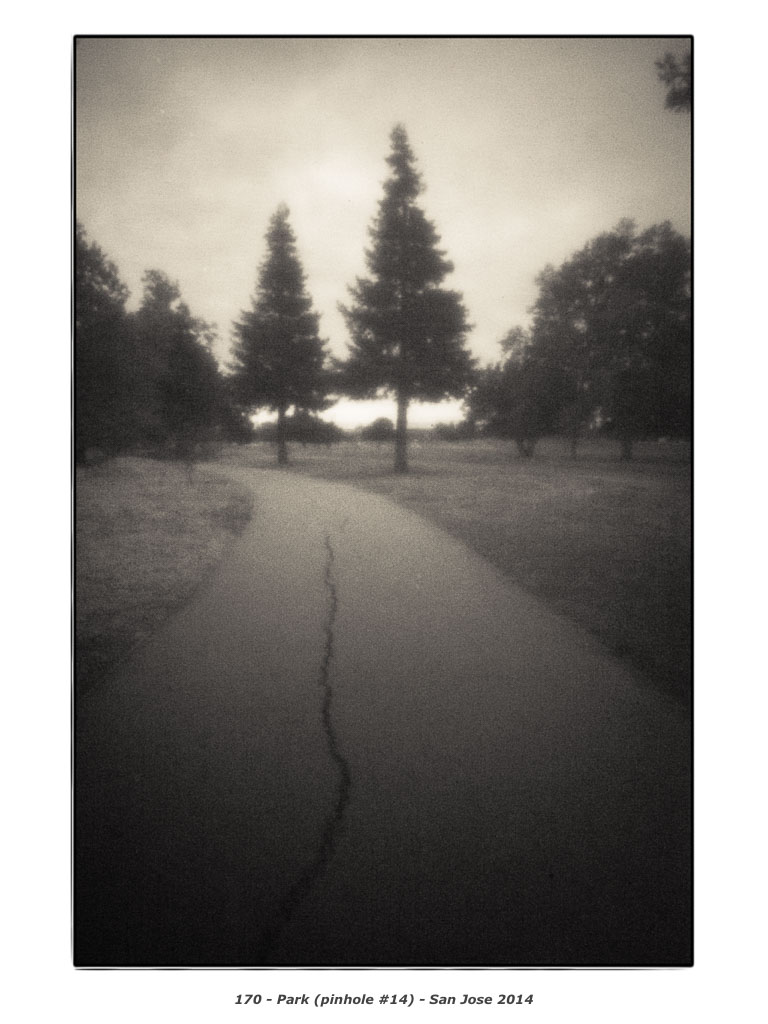
I have finally found a use for such stratospheric ISO settings: hand-held pinhole photography. 🙂


Sony A7 + Skink Pinhole Pro (Zone Sieve disk, 24mm focal length)
ISO 25600 @ f/71 @ 1/60 second


G
 
Thanks, but I'm linked to chemical prints also from file. may be that in the future I will think differently.
anyway thanks for the advice
 
Back
Top Bottom
