jlw
Rangefinder camera pedant
Stephanie Brim said:I'm trying to figure out how to take the best photos of my food for showing on my website. I'm not quite sure how to light them. I pretty much have to use the bright kitchen lights and I'm actually pondering shooting in black and white to avoid problems, but part of my food is the color and presentation. Does anyone have any advice for this?
I do a lot of food shooting in my work as a graphic designer for a very large food company (which I won't name because I'd have to get the lawyers involved.) Most of it is nothing fancy, just trying to show the food in an appetizing way.
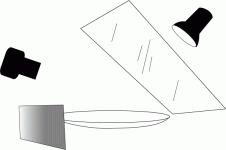
The most important thing for lighting food is to bring out the texture, and a really easy setup for doing this is to use rear diagonal lighting. To make this setup, you get a fairly large translucent diffuser (white plexiglass, frosted mylar on a frame, or even tracing paper or chiffon fabric) and slant it over your shooting area from the back at a 45-degree angle. You position a light above and behind this diffuser so it shines down and forward; this causes soft light to fall on the food from the back.
You can vary the amount of front light vs. back light by moving the food plate toward or away from the camera. The farther back (toward the light) you push it, the more front light and the less texture you get, because light is falling on the food from the front/upper edge. The farther forward (away from the light) you push it, the more backlight and more texture you get.
For some foods with strong texture, you may want to pull the plate so far forward that the front face of the food begins to look too dark. An easy way to fix this is to use one or two silver fill cards near the camera. (The silver-backed cardboard lids that come on institutional frozen food trays make GREAT fill cards!) Position them to bounce light back toward the front face of the food. The fill cards also help make shiny or reflective foods look "livelier" -- reflective surfaces only look bright if they have something to reflect, so position your cards so you pick up bright reflections where you want them.
You can light this back-diagonal setup with almost any light source you want, but I strongly recommend an electronic flash unit. Tungsten lights will put off enough heat that the food will go "off" very quickly. Color-correct fluorescents won't have this problem, but they don't put out much light; you'll have trouble balancing them with the surrounding light in the room.
Natural light is very nice IF you can get it to be when and where you want it! Actually, a lot of the "natural window lit"-looking shots you see in food magazines were actually lit with a diffusion setup like the one described above; if a window is shown, it may be just a prop or may have been Photoshopped in! (Don't laugh, I had to Photoshop an entire backyard into a studio-lit "picnic" setup just a couple of weeks ago!) If you do want to simulate a more naturalistic-looking window-type light with the sort of setup described above, try moving it around to one side rather than having it come straight from the back. You'll probably need to bounce a little fill into the opposite side to keep it from getting too dark.
If you get the hang of using this basic setup and then want to play with something a bit more "stylish," an easy addition is a small hard light you can move around to highlight areas and pick out textures. This can be a small electronic flash unit or even a tungsten light, if you don't get it too close. Putting a warming gel over it is a nice effect.
I'm attaching several things here. The first is a diagram showing roughly how to build this back-diagonal light setup. The diagram shows roughly a side view, but with a slight perspective; if it's confusing, let me know and I'll try to explain further. You can see the camera at left, the diagonal diffuser with light above it at the right, and a fill card in the lower left corner.
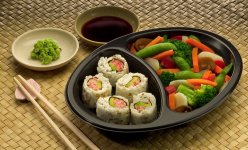
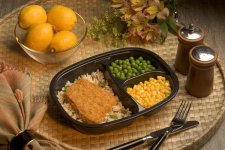
The other attachments are some simple food photos I shot with setups similar to this. The sushi photo was absolutely nothing except the back diagonal. The plastic tray shot (which proves that propping is half the battle!) had basic back diagonal lighting, but I supplemented it with the small hard light at the front with an amber gel over it, to add a little warmth to the food in the tray.
They're nothing you'd see on the cover of 'Bon Appetit' (I've done shots like that, but it takes all day and you probably don't have that much time!) so I'm trying to stick to something simple that you can actually USE around your kitchen!