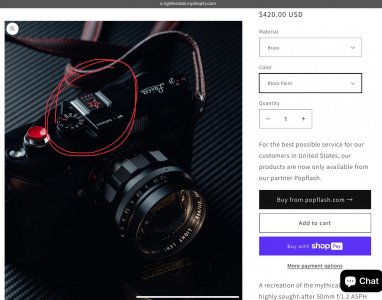
LLL 50mm f/1.2 ASPH "1966"

Hand polished aspherical elements should not have onion rings unless the grinding medium is too coarse and leave radial furrows in the elements. Canon pioneered precision grinding of aspherical elements for camera lenses: (50th anniversary) Aspherical lens elements: Transcending challenges in ultra-high-precision processing - Canon Camera Museum and the typical ~50nm tolerance of the process doesn’t leave onion rings. The onion ring bokeh is usually a sign of a moulded element and the radial marks are from the machined mould that the molten glass is pressed against https://lenspire.zeiss.com/photo/app/uploads/2022/02/technical-article-depth-of-field-and-bokeh.pdf
Very interesting indeed.

I know that the Noct-Nikkor was made for a long time…and it’s possible that the aspherical element was molded in later production runs, but Nikon claims that it was ground:


And yet, in this image, a strong onion ring pattern is evident:


Similarly, the canon K35 lenses might have had molded lenses in later runs, but based on when they were produced, my guess is that they were hand polished:


The onion rings in the K35 18mm and 35mm are similar to what I’m seeing in the LLL ‘1966.’

So, perhaps it’s like you’re saying and the grinding medium is too coarse. If LLL continues to make this lens, I wonder if their technique will improve or they will have the aspherical elements made off-site.
 
Very interesting indeed.

I know that the Noct-Nikkor was made for a long time…and it’s possible that the aspherical element was molded in later production runs, but Nikon claims that it was ground:


And yet, in this image, a strong onion ring pattern is evident:


Similarly, the canon K35 lenses might have had molded lenses in later runs, but based on when they were produced, my guess is that they were hand polished:


The onion rings in the K35 18mm and 35mm are similar to what I’m seeing in the LLL ‘1966.’

So, perhaps it’s like you’re saying and the grinding medium is too coarse. If LLL continues to make this lens, I wonder if their technique will improve or they will have the aspherical elements made off-site.
The Noct-Nikkor was hand ground by the standard method in the 70s, using a diamond grinder and rotating the element while grinding only a small part of the diameter at a time. Methods have changed a lot since then. Maybe the elements are hand ground using period techniques. Possible. I have never used Canon’s cine lenses, but Canon knows a lot about making aspherical elements. I am surprised their cine lenses show this effect strongly.
 
The Canon 35/1.5 ltm is now used in movies as a cine lens. It sells for $20,000 at times.
So? Does it produce more onion rings??
(I used to have one of this 35/1.5. Not a bad lens but I won't consider it a stellar performer either.)
 
Last edited:
The moviemakers used the Canon 85/1.5 ltm and 35/1.5 ltm in a movie, and they special optical effects made that movie a cult movie, supposedly. The glass gets removed and then is placed into a custom cine housing. The "new" cine lenses are very costly.
 
My Optical Engineer used to get really worked up on the "Wiggle" (as he called it) of aspheric elements, and the Polynomial used to generate it. The manufacturers did not supply enough precision in the factors used. I reminded him the sensor was 320x200.
I kept one lens that he designed for an optical computer, cost $40K to fabricate over 35 years ago.
 
My Optical Engineer used to get really worked up on the "Wiggle" (as he called it) of aspheric elements, and the Polynomial used to generate it. The manufacturers did not supply enough precision in the factors used. I reminded him the sensor was 320x200.
I kept one lens that he designed for an optical computer, cost $40K to fabricate over 35 years ago.
Hm, when I saw the word "polynomial", it reminded me on my first experiences with Kodak color infrared transparency film. Nobody seemed then to offer useful advices on how to expose this sensitive film other than "bracket as much as you can". The film was expensive and the film developing was expensive. To a budget minded college student it was too costly to be practical. I then cretaed my own experimental design and I wrote down each setting and resulting slide. It "cost" my one roll of film with developing. I then created a regression model by which I predicted the "right exposure" from aperture; shutter speed; filter used; surroundings when I took the shot. The polynomial worked! I was able to get 32~34 excellent slides out of a 36 exposure color IR film. Statistics rules. I still have these notes saved somewhere in a small notebook.
 
My first job included generating polynomial fits for converting film density to radiometrically calibrated data.
All the data was taken using Pin-Hole lenses for recording X-Rays. We were the Soft X-Ray Branch. I bought a Nikon F2 Titanium body for the work, it was placed in a vacuum chamber, and had a custom pin-hole lens. We had some exotic lenses.
 
Hm, when I saw the word "polynomial", it reminded me on my first experiences with Kodak color infrared transparency film. Nobody seemed then to offer useful advices on how to expose this sensitive film other than "bracket as much as you can". The film was expensive and the film developing was expensive. To a budget minded college student it was too costly to be practical. I then cretaed my own experimental design and I wrote down each setting and resulting slide. It "cost" my one roll of film with developing. I then created a regression model by which I predicted the "right exposure" from aperture; shutter speed; filter used; surroundings when I took the shot. The polynomial worked! I was able to get 32~34 excellent slides out of a 36 exposure color IR film. Statistics rules. I still have these notes saved somewhere in a small notebook.
Love your work Raid. Being similarly minded, back in the day I built colour and B&W IR meters from dissected Sekonic meters with filters added. It also worked with IR modified flash.

But statistics are cool.
 
Thanks. I wanted to become a civil engineer when I was still young, but my fate turned out to be statistics.


Attachments

  • IMG_0688.jpeg
    IMG_0688.jpeg
    204.1 KB · Views: 113
There are lenses that are bought due to their place in history, being the first of a type, pushing bleeding-edge of technology, being unique, owned by a famous individual, other reasons than outright performance. The novelty of an item to make it collectible. The Leica 50/1.2 Noctilux hits most of the marks for being valuable to collectors. As far as optical performance- the Voigtlander 50/1.2 Nokton is superior.

I suspect in 20 years after production ceases, the LLL lenses will be valuable to collectors. Many of these low-production lenses with fast-aperture will go up in value. The 7artisans 50/1.1 is getting more attention now, that it is out of production. At under $400, fun to own and shoot with.
With a price of over $2K: The LLL 50/1.2 is more expensive than the 50/1 Nokton, and not as good optically. Some high-cost production techniques are required to produce the lens, so it is not over-priced. Just that improvements in optics and manufacturing techniques have been made in the last 60 years.

Am I tempted? It's not a Sonnar. I've dropped more in Sonnars in the last year than this lens cost. But with those- I convert them to LTM and can always get an immediate increase in value. I was informed that one of my lenses was sold in Europe for about the price of this one.


So- in the US, visit Popflash to reserve a copy. Figure about a year for shipment, as per Popflash. $500 deposit, and only a 5% cancellation fee on the deposit, $25 to change your mind.
 
Last edited by a moderator:
I guess most viewers miss the point. In the hot/cold shoes, there is CCCP log. China is a place where mixed feudalism capitalism and communism. The LLL, the Polar are all profit on the name of Leica.
 
  • Like
Reactions: Dan
Back
Top Bottom