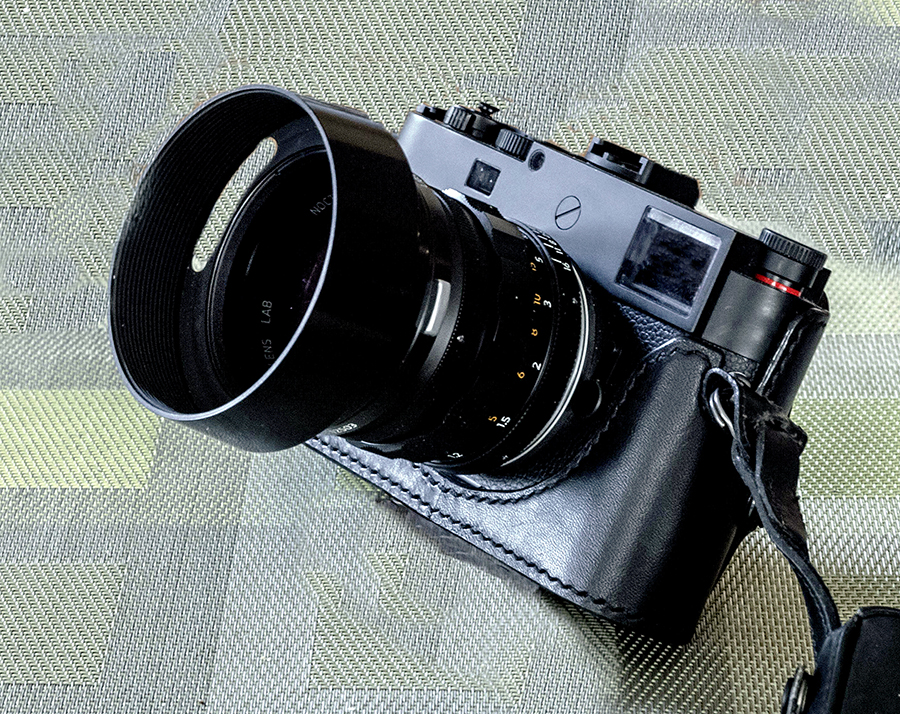
LLL 50mm f/1.2 ASPH "1966"

No grandma bashing please, I love my grandma .😀
There are more modern LTM options from Cosina as well as from these artisans. They were complaining the price is too high for such a domestic made lens. Chinese people are smart, they always want the best bang for the buck, the LLL 35mm collapsible is $1000 a copy, collapsible for a low profile 35mm is kind of overdone and unnecessary.
I already know about the Vogitlander products, but they also have released more slower F2.8 lens. The fast Nokton 1.5 and the 35 F1.7 are also now 20 years old and they haven't gotten updated for LTM mounts. The 40mm is something I'd use, but the new 28mm is nice, but I haven't been able to get on with 28mm focal lengths

But that same mentality of wanting best bang for the buck leads to constant complaining about price to the point its irrational. And yes I feel I can say it because I grew up around it. I guess the point I am trying to make is Chinese people are kind of already self-biased against their own products, and while yes some of it is justified. Maybe the analogy is how some Americans feel about American cars due to the malaise era.

I didn't pay 1000 for my LLL collapsible and it in LTM mount at the time last spring 2023 was significantly cheaper than the rigid version in LTM,. The People are paying what the market will bear so I don't fault them at all. If sales start to drop a lot then yeah they priced themselves out.
 
Last edited:
Cosina should release a limited edition 50mm F1.2 Nokton in LTM. Or a 50/1.5 Nokton v2- the small size would be nice for an LTM camera. The M-Mount version, at home on a Leica CL.

I am very happy with the 50/1.5 Nokton LTM and 35/1.7 Ultron LTM, like the handling much better than the "retro-Styled" M-Mount versions.

I posted this on the other thread as well:


Shows the problem of the aspherical design having non-uniform performance across the field. This, and sample-to-sample variation, was among the reasons that Leica replaced it with an all-spherical 50/1 in the 1970s. Somewhere I have the article about the 50/1 replacing the 50/1.2. The 50/1.2 is a classic 6 element in 4 group design, following the TTH Opic of 1920. The use of the aspherical optics allowed an aperture to F1.2 without adding more elements. Most manufacturers added an extra element, split an element of the 6/4 to 2 of lesser power. The latter is what Canon did in 1956 for the 50/1.2.
 
Last edited by a moderator:
I love the Nokton 50/1.5 LTM but never warmed to the Ultron 35/1.7 LTM (this is a discussion Brian and I have had). Not sure why, may just have been an issue with me and that specific lens. I also like 28 better than 35 so that may have contributed it to it. Perhaps I need to find a fast asph 28 that I can actually afford!
 

The above review has an interesting interview with Mr. Zhou, where he talks about aspherical surfaces, methods used, "grooves" made, and how this affects the rendering.
 
I once tried out the LLL ELCAN that Ed Schwartzreich received from LLL, and Ed mentioned me in his report on that lens. Thanks Ed.
It seems like a good lens if you like the 50/1.2 by Leica. I am content with the CV 50/1.0.
 
Very interesting indeed.

I know that the Noct-Nikkor was made for a long time…and it’s possible that the aspherical element was molded in later production runs, but Nikon claims that it was ground:


And yet, in this image, a strong onion ring pattern is evident:


Similarly, the canon K35 lenses might have had molded lenses in later runs, but based on when they were produced, my guess is that they were hand polished:


The onion rings in the K35 18mm and 35mm are similar to what I’m seeing in the LLL ‘1966.’

So, perhaps it’s like you’re saying and the grinding medium is too coarse. If LLL continues to make this lens, I wonder if their technique will improve or they will have the aspherical elements made off-site.

Over the last weeks I have spent most of my spare time looking at photos from the original Noct-Nikkors on the internet and in my archive. I am sceptical of the photos on Ken Rockwell’s site. Some Noct-Nikkor photos show slight ringing in the out-of-focus highlights, but not like those or that strongly. I can’t show mine because they are photos of other people’s children, but my early Ai Noct-Nikkor does not produce rings like those. It’s possible the aspherical lens element manufacturing method was changed, but . . .
 
The onion rings on digital look quite distracting to me. All the while they are hardly visible on film. A great showcase of why vintage (-style) lenses are best used with the medium they were designed for. Digital sensors are too telling in many cases, their sharpness and contrast hightlight flaws and distract from the beauty and character. I respect digital cameras but I love film. Hope they'll never stop making it.

Either way, nice photos. @Slumgullion


@Freakscene you always impress with your well-founded knowledge of optics and cameras. Always an interesting read.
 
The onion rings on digital look quite distracting to me. All the while they are hardly visible on film. A great showcase of why vintage (-style) lenses are best used with the medium they were designed for. Digital sensors are too telling in many cases, their sharpness and contrast hightlight flaws and distract from the beauty and character. I respect digital cameras but I love film. Hope they'll never stop making it.

Either way, nice photos. @Slumgullion


@Freakscene you always impress with your well-founded knowledge of optics and cameras. Always an interesting read.

Contrast of digital sensors can easily be pulled back in post. Resolution artefacts are different. I love film but have got to a point where I can’t afford it in the sort of volume I’d like to use, can’t travel with it and don’t have time to work with it.

It is largely trivial to select a mask by luminance to cover specular highlights, remove anything not relevant, smooth the selection to remove the rings, feather the edges and then merge it back down. But who has time to do it on every photo with specular highlights, particularly when manufacturers could just polish their aspheres properly.

I’d make some photos to demonstrate but I don’t have a camera that takes the Noct-Nikkor at the moment. Therein lies my Zf weakness.

Glad to be of some assistance @lukx; I grew up in a lens swamp (see: Your thoughts on Nikkor 50/1.8 AI-S Japanese pancake version), and only waded out in my 20s. Thanks for your comment, the acknowledgement is greatly appreciated.
 
Last edited:
The Leica reissue has a molded aspherical element and is close to the best that an implementation of this design can be. There is almost no wiggle in the mtf. I haven’t seen the LLL.

Coming back to this, one thing digital photography has done is increase the resolution of which systems are capable and at which they are assessed. It occurs to me that the Noctilux f1.2 probably has some wiggle in the mtf at 50 and 75 lp/mm. But I doubt it matters much except in lens tests against more modern designs. My perennial concern about the obsession with resolution is that tonality has been forgotten as a concept. The 28 Summilux, for example, has extraordinary tonality; it separates close mid values almost like you used the clarity slider, but without using it. But the reviews only talk about resolution, distortion and evidence of aberrations.
 
Coming back to this, one thing digital photography has done is increase the resolution of which systems are capable and at which they are assessed. It occurs to me that the Noctilux f1.2 probably has some wiggle in the mtf at 50 and 75 lp/mm. But I doubt it matters much except in lens tests against more modern designs. My perennial concern about the obsession with resolution is that tonality has been forgotten as a concept. The 28 Summilux, for example, has extraordinary tonality; it separates close mid values almost like you used the clarity slider, but without using it. But the reviews only talk about resolution, distortion and evidence of aberrations.
Great point, but reviews of the Zeiss 35mm f/1.4 ZM often talk about its 'sparkle'...which as I perceive it (with my own copy) is the way in which it separates similar close mid values. At least that's what I fixate on. But yes, not enough talk about tones. I have a Sigma 35mm f/1.4 art. It's great to use on my F6. It's sharp with minimal distortion. The autofocus is fast. That being said, it delivers flat images that don't really pop. But, then again, I use it on film...which, it probably was not really designed for.
 
Great point, but reviews of the Zeiss 35mm f/1.4 ZM often talk about its 'sparkle'...which as I perceive it (with my own copy) is the way in which it separates similar close mid values. At least that's what I fixate on. But yes, not enough talk about tones. I have a Sigma 35mm f/1.4 art. It's great to use on my F6. It's sharp with minimal distortion. The autofocus is fast. That being said, it delivers flat images that don't really pop. But, then again, I use it on film...which, it probably was not really designed for.
I had a 35/1.4 Art on my old K1d. When it worked the combination could deliver brilliant images. Unfortunately, in the end, I couldn’t get the body to reliably focus anything I wanted it to and so it went. That was my last slr.

Still think the zf looks great, it largely takes away size from my (less expensive and paid for) S1r
 
Here is a post from a Chinese photographer regarding chinese made lens. It matched some Sonnar Brain's impression.
In essence, the Chinese industry is in the same position as the Japanese about forty- to thirty-something years ago, has understood the task at hand and with the increased speed in lens-development will probably catch up within a much shorter timespan.
 
In essence, the Chinese industry is in the same position as the Japanese about forty- to thirty-something years ago, has understood the task at hand and with the increased speed in lens-development will probably catch up within a much shorter timespan.
However, to be in the PC gray zone territory, Japanese and Cheese has different approach to craftsmanship, these are built into gene. I am hoping the Chinese lens makers will follow the Japanese trajectory from junk to well respect.
 
Chinese manufacturers are producing lenses aimed at enthusiasts in a fringe market, also considered a luxury market. They've designed the lenses with a price/performance that makes them affordable by enthusiasts. The lenses are priced much less than similar featured lenses on the used market. The current lenses are not be as good as the top-tier Leica and Voigtlander lenses, but are a fraction of the price. They are not junk. At some point a Chinese company will bring out a top-tier lens - it will not be cheap, and is questionable how many would be sold if priced the same as a Voigtlander lens.

Post-war Japan produced goods that were high-price, required small amounts of raw material, and was labor intensive. This basically was to rebuild the economy.

I would have preferred LLL bring out an original design rather than the 50/1.2 "1966". Leica discontinued that lens long ago due to sample-to-sample variation. It's just not that good of a design. One of those lenses best left to collectors. Which is why LLL is producing it. The effort would have been better spent bringing out a top-notch 50/1.2 with aspheric optics and a floating element.
 
Last edited by a moderator:
Back
Top Bottom