mercury battery adaptors

Suddenly this thread is relevent. I scored a Luna Pro on ebay for $12.50 just now but it needs batteries and auction says "appears to be working normally" which may come back to haunt me. Anyway, time to find a battery solution so thanks for the thread.
 
Last edited:
Just had a thought, after reading one of the linked articles about making battery adapters. If a diode can be used to drop the voltage of a 1.5v silver-oxide cell down to the required 1.35v, why can't I put the diode into the meter itself, and just use straight silver-oxide cells?

The Gossen meter takes two cells, so I'd need two diodes in series, right?

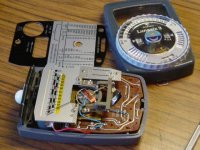
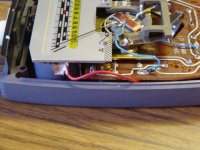
I took the back off the meter, and the red wire from the battery compartment is easy to get to - see pics. Can I just put the two diodes in series in the red wire?
 

Attachments

  • DSC03381 (Small).JPG
    DSC03381 (Small).JPG
    61.6 KB · Views: 0
  • DSC03382 (Small).JPG
    DSC03382 (Small).JPG
    54.6 KB · Views: 0
Chris,

I think your right. Although I am a mechanical engineer and my single EE 101 class was taken over 15 years ago now. I think others can chime in and confirm but I will review it with the EEs I work with on Monday. At that point all that is needed is just an adapter to increase the outer diameter for the SR44 cell.
 
Last edited:
Chris,

You are right. This is possible. Look at Option 5 on page three of this PDF: click here for PDF

This is Frans de Gruitjer's long PDF article on PX625 replacement solutions. Option 5 is exactly the solution you describe.

The article states that you can solder 2 Shottky in series or you can use Qty 1 of a 1N4148 silicon-diode. You can buy 50 of these 1N4148 diodes at radioshack.com for less than $3.00 !! I hopefully can pick up one at a RadioShack store or free at work at one of our EE lab benches.
 
Last edited:
I tried soldering a diode into my QL17 and weakened the battery holder to the point of it breaking into a few pieces. I can live with that, but a worse danger is accidently desoldering a nearby connection.

It's possible to bend the diode leads and apply hot glue/tape in such a way to avoid soldering and still have a solid connection, at least in my cheap CDS meter. I discovered this after soldering in the diode. And I'd be able to use mercury cells when they lift the ban! Times like these, one never knows... 🙂
 
RicardoD said:
Suddenly this thread is relevent. I scored a Luna Pro on ebay for $12.50 just now but it needs batteries and auction says "appears to be working normally" which may come back to haunt me. Anyway, time to find a battery solution so thanks for the thread.


Gossen sells an adapter for the Luna-Pro thru USA retailers. Mine works great.
 
Bill58 said:
Gossen sells an adapter for the Luna-Pro thru USA retailers. Mine works great.

I approached Gossen in Germany a few years ago about their adapters - never got a response. Criscam were too expensive in their shipping quotes and at the time didn't offer direct online ordering so i left the meter in the UK. It was only through ordering up some batteries for something else from Speedgraphic that i noticed the Wein Air Cells.
In reply to Frank's orignal question, thanks to the contribution of other RFF members, i followed up the Criscam link and made a purchase.

Helpful threads like these are what RFF is all about 🙂
 
hi Bill
i'd have nerver thought of B+H for Gossen adapters. Gossen (Europe) have been the only company never to have responded to a question re their products.

OT a bit: Through a Pnet member i was able to contact the original suppliers of the Leitz Focomat's 1 and 2 enlargers. Leica long stopped selling them years ago but the original supplier still exists. So now i have a full list of spare parts to refurbuish my worn Focomats - when the need arises - thanks to a member from a Photo forum.
 
Simon:

There are several Gossen dealers here in Korea, but at least two told me the adapters weren't available anymore, even though I showed them one -week old emails from Gossen's HQ to the contrary. The short answer is customer service here sucks big time. I gave up and ordered from B+H, a company that makes them piss ants (tiny) by comparison in size.

How do you become a bigger retailer? Take care of the customer. You'd think a country w/ 5,000 yrs of history would learn something--they didn't.
 
Some info here http://www.smallbattery.company.org.uk/index.htm

Kim


drmatthes said:
... besides, has anyone used the V27PX adaptor that takes four 386 silver-oxide cells? Does it contain a micro-circuit to reduce voltage (original V27PX contained four mercury cells of 1.4 V each, silver-oxide 386 has 1.55 V)?

My preliminary solution (for my Minox 35 GL P&S) was to get my hand on every V72PX available when they had just run out of business, now I store ten of them in my fridge. Given the enormous life-span of these, my own life-span might be the limiting factor rather than vice versa...

Jesko
 
RicardoD said:
Chris,

You are right. This is possible. Look at Option 5 on page three of this PDF: click here for PDF

This is Frans de Gruitjer's long PDF article on PX625 replacement solutions. Option 5 is exactly the solution you describe.

The article states that you can solder 2 Shottky in series or you can use Qty 1 of a 1N4148 silicon-diode. You can buy 50 of these 1N4148 diodes at radioshack.com for less than $3.00 !! I hopefully can pick up one at a RadioShack store or free at work at one of our EE lab benches.


Well, it worked! I found one of the 1N4148 diodes (actually a pack of 5 was 30 cents!) and put it into the red wire. The meter seems to work although the battery-test moves the needle to just outside the red zone - I might need a fresher set of batteries. FrankS - you should try this!
 
Hilm3 said:
I can second the Bogen adaptor. I bought mine at B&H a few years ago - for my Luna Pro and another for my M5. They are hard to locate in the B&H website. Here is the link. $40

Hil

Hil,

I think I should add this to my range of products - would it be possible for you to send me some details of the device? I'm thinking dimensions and what material it is made from.

I already make adapters for the 625, 640 and PX1a mercury cells, this one would be a natural to extend the range.
 
ChrisN said:
Just had a thought, after reading one of the linked articles about making battery adapters. If a diode can be used to drop the voltage of a 1.5v silver-oxide cell down to the required 1.35v, why can't I put the diode into the meter itself, and just use straight silver-oxide cells?

The Gossen meter takes two cells, so I'd need two diodes in series, right?

I took the back off the meter, and the red wire from the battery compartment is easy to get to - see pics. Can I just put the two diodes in series in the red wire?

Chris, have you got an "after" picture to show what you did?
Thanks, Frank
 
I am aware of the Gossen adapters. But the solution that ChrisN implemented is dirt cheap especially if you have solder and soldering iron in your basement already. All I need is just a bit of heat shrink tubing to surround the diode once it is soldered in series (electrical tape wrap would work as well though not as clean looking as heat shrink tubing. I am looking to do this for a few dollars.

ChrisN, did you solder in line with the red wire? Also what is the technique to determine the direction of the diode?
 
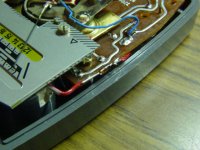
OK - here's the pic.

To get it to this stage, first remove the aluminium panel from the back, the one with the table on it, by slipping a thin pocket-knife blade under it. It's only held on by a few dabs of contact adhesive, but work carefully to avoid bending it.

When you have that off, you'll see the four cross-head screws that hold the case together. Remove them.

Then flip it back over so it's right side up, and carefully lif the top half (with the dial) away from the bottom half. The circuitry stays attached to the bottom half.

You'll see the red wire that leads from the battery compartment forward along the edge and under the circuit board. You can carefully prise this upwards - it is stiff wire (solid, not multi-strand).

The diode itself is only a couple of millimeters long. Snip the red wire and trim a couple of mm of the insulation from the end. On my diode the end with the black stripe goes away from the battery positive. Trim excess wire from the tag on the diode - leave about 5mm.

With your soldering iron and electrical solder, tin the exposed ends of the wire (ie give them a coat of sloder in preparation for joining). Then solder the diode in place, one end at a time. Try not to apply more heat than is absolutely necessary - ie work quickly.

I didn't bother with heat-shrink tube over the diode as the red wire is stiff and won't move around, and you can push it back down into the space along the edge of the case. If you have some small diameter tube that would be better.

To determine which way the diode goes - I asked the man in the shop! Failing that, test with a battery and a multi-meter, if if you don't have that, just try it one one and see if it works - change it if it doesn't work - you can't damage it even if it is the wrong way.

To reassemble, line up the two halves of the case, being careful for the two bits at the front with the incident dome and the sliding panel that adjusts for the two lighting scales - this is the fiddly bit. Screw the case back together, and test with good batteries. When you are happy that all is ok, stick the aluminium panel back in place with a few dabs of contact adhesive.

Good luck! 🙂

 

Attachments

  • DSC03384.JPG
    DSC03384.JPG
    146.9 KB · Views: 0
Back
Top Bottom