Mother of All 50mm Tests

Hi Raid

Hi Raid

I did a quick test with my DSLR and wrote it up on my blog. Note that with full-frame 35mm, and f1.4 etc., you may want to use intervals smaller than the 4" I used. Check my latest blog entry.


raid said:
ampguy: Thanks for the tips. Once I get started with the testing,I will take your suggestions into account. I am still looking for my Summar lens. I can't find it.


edited: I may do the test tomorrow without the Summar.


Raid
 
Raid is there any chance you could also take a shot or two of all the lenses alongside each other, to give us a better idea of how they rank in terms of ergonomics, size and weight?
 
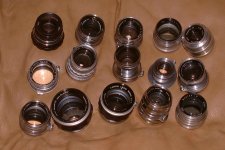
Bosk: Here is a "family photo" of fifteen lenses on a leather sofa .... only the Summar is still missing. The differences between the lenses in craftmanship and weight are significant. I eventually found a suitable lens hood for each lens, except the Elmar where the Walz square lens hood may vignette.

Later on I may have the time to weigh each lens and then rank order the lenses by weight.

Raid
 

Attachments

  • DSCF0003.JPG
    DSCF0003.JPG
    435.9 KB · Views: 0
Last edited:
ampguy said:
I did a quick test with my DSLR and wrote it up on my blog. Note that with full-frame 35mm, and f1.4 etc., you may want to use intervals smaller than the 4" I used. Check my latest blog entry.

Thanks. I will take a look at your write-up.

[edited]: I have done so; I suggest to you to use a tripod to stabilize the camera and to allow criticial focusing.

I am still unsure how to keep a 3.5 year old girl still throughout 72 exposures in such a set-up. How many photos did you take of your boy like that?

Raid
 
Last edited:
Bosk said:
Regarding DOF, I'm not sure how you planned on doing the tests but one possibility would be to perform them next to a brick wall.
I don't mean the typical front-on brick wall shots, but rather have the wall stretching from the right hand edge of the frame towards the centre, going as far towards infinity as the wall will allow. (depending on it's length)

This would make it a little easier to see and judge the transition between focus and OOF.


Bosk: Take a look at (Ted) amguy's blog. He is suggesting the use of a table with markers on the table, reflecting the distance from the focus point.

Raid
 
Last edited:
Hi Raid

Hi Raid

Yes, a tripod would have been good.

But even with a tripod, whether by eye or scale focus, the only way to tell if your subject is at the center of focus is by examining test shots with an RF. All MF lens have some degrees or mm of play where the subject can be in perfect focus at slightly different rotations of the focus ring.

SLR's give you stop down DOF previewing, but it's difficult to determine relative to a still print or image.

My son is twice your daughters age, but still impatient for more than a couple photos at a time. I took about 6 for that small test.

I recommend you put a line on the table with one of your daughters favorite books and something for her nose to align to, and while she's reading or looking at the book you snap away.


raid said:
Thanks. I will take a look at your write-up.

[edited]: I have done so; I suggest to you to use a tripod to stabilize the camera and to allow criticial focusing.

I am still unsure how to keep a 3.5 year old girl still throughout 72 exposures in such a set-up. How many photos did you take of your boy like that?

Raid
 
another thing to consider

another thing to consider

Raid,

Another thing that would be interesting for me is if for each lens you pointed directly at an indoor light source at f2 or f2.8 whatever all the lens can do (or the group thing), and note if any are dirty or hazy enough to cause the meter to need a slower shutter speed, I would make note if any needed say more than 1/3 stop than the others (in the group).


raid said:
Bosk: Here is a "family photo" of fifteen lenses on a leather sofa .... only the Summar is still missing. The differences between the lenses in craftmanship and weight are significant. I eventually found a suitable lens hood for each lens, except the Elmar where the Walz square lens hood may vignette.

Later on I may have the time to weigh each lens and then rank order the lenses by weight.

Raid
 
brick walls can work

brick walls can work

Bosk's idea works well, but I usually see it for subjects standing or further than I thought you were going to use indoors.

If you have any textured surfaces or toys that would work the same, showing relative in front and behind focus, that could work.

raid said:
Bosk: Take a look at (Ted) amguy's blog. He is suggesting the use of a table with markers on the table, reflecting the distance from the focus point.

Raid
 
I am in the process taking photos of still objects, with markers in front and beyond the object. I am still not sure how this will help us with how the lenses render a face, which is the original goal of the test. Anyways, I am doing this test, and then I will move on to taking photos of Dana as in the previous tests.

Raid


[edited] I have completed the first part of the test. I placed on a dining table some objects [two Zeiss Paper Boxes] in the middle of the table. I had prepared a printed paper strip for each exposure with information on the lens used and the set aperture. This will allow easier comparisons and it reduces the headaches in figuring out from the negatives how each photo was taken. I measured distances or 2, 3, and 4 inches before and behind the focus point, and I had markers with labels to make comparisons easier.

I did this test for Ted [ampguy]. He will explain to us why this test is needed.


I am very impressed with Kiu's Nikon S2 with the Nikkkor 50/1.4. The viewfinder is amazingly clear, and I found focusing to be a snap.

I found the Canon lenses the easiest to use as the aperture clicks were very well marked. The old Zeiss Sonnar was a pain in the you-know-what. Rotating the focusing ring was impossible once an M adapter was used with this lens and the infinity setting was locked in. I had to remove the M adapter, then remove the distance setting away from infinity,and the attach the M adapter again. Else, no focusing was possible.

The Elmar 50/3.5 had no matching lens hood,and I improvised. The same goes for the Nikkor 50/1.4

Overall, using fifteen vintage 50mm lenses is a tedious thing to do.

Raid
 
Last edited:
Hi Raid

Hi Raid

Thanks for using the markers. I hope you use them with the photos of your daughter too.

The markers are to indicate where the actual point of focus is in each exposure, which theoretically would have the subject at 1/3 of the in-focus distance determined by common calculators and the DOF scale on your lens, and 2/3 of the in-focus space behind your subject.

In reality, this is rarely the case, our eyes, lens, and pairing of RF/VF and lens is rarely this accurate, especially wide open and with a close subject. Where the point of focus is within the "in-focus" range can have effect on image rendition.

raid said:
I am in the process taking photos of still objects, with markers in front and beyond the object. I am still not sure how this will help us with how the lenses render a face, which is the original goal of the test. Anyways, I am doing this test, and then I will move on to taking photos of Dana as in the previous tests.

Raid


[edited] I have completed the first part of the test. I placed on a dining table some objects [two Zeiss Paper Boxes] in the middle of the table. I had prepared a printed paper strip for each exposure with information on the lens used and the set aperture. This will allow easier comparisons and it reduces the headaches in figuring out from the negatives how each photo was taken. I measured distances or 2, 3, and 4 inches before and behind the focus point, and I had markers with labels to make comparisons easier.

I did this test for Ted [ampguy]. He will explain to us why this test is needed.


I am very impressed with Kiu's Nikon S2 with the Nikkkor 50/1.4. The viewfinder is amazingly clear, and I found focusing to be a snap.

I found the Canon lenses the easiest to use as the aperture clicks were very well marked. The old Zeiss Sonnar was a pain in the you-know-what. Rotating the focusing ring was impossible once an M adapter was used with this lens and the infinity setting was locked in. I had to remove the M adapter, then remove the distance setting away from infinity,and the attach the M adapter again. Else, no focusing was possible.

The Elmar 50/3.5 had no matching lens hood,and I improvised. The same goes for the Nikkor 50/1.4

Overall, using fifteen vintage 50mm lenses is a tedious thing to do.

Raid
 
Ted:
So basically this test is used to make more sense of the "actual" test later on.
I don't want to take a photo of my daughter sideways [as you have done with your boy] since there is no way possible to keep her still in the same exact position throughout a roll of film. Since all photo will be taken by the same camera with the same rangefinder, I doubt it that the lack of markers will be important.


Raid

Raid
 
Hi Raid

Hi Raid

Yes, the markers, brick wall or other known identifiably focused thing running the depth in front of and behind the subject is to determine if/where you were focused during the actual test shot.

Though from the test shots you've made without a live subject, if you develop them first, you might find that your eye and/or a specific lens is front or rear focus biased.

It's not the end of the world if you don't do it, but IMHO, wide open, close up test shots to be used for comparison with the same lens stopped down, or with other lenses, will be easier to compare results with if we know the shot is in focus or out by xx distance units, etc.

Just go with your gut, you're doing a tremendous undertaking already.

raid said:
Ted:
So basically this test is used to make more sense of the "actual" test later on.
I don't want to take a photo of my daughter sideways [as you have done with your boy] since there is no way possible to keep her still in the same exact position throughout a roll of film. Since all photo will be taken by the same camera with the same rangefinder, I doubt it that the lack of markers will be important.


Raid

Raid
 
Last edited:
raid said:
Bosk: Here is a "family photo" of fifteen lenses on a leather sofa .... only the Summar is still missing. The differences between the lenses in craftmanship and weight are significant. I eventually found a suitable lens hood for each lens, except the Elmar where the Walz square lens hood may vignette.

Later on I may have the time to weigh each lens and then rank order the lenses by weight.

Raid
Thanks very much Raid!

It's amazing just how small the 3.5 Elmar is, I can see one in my future regardless of how they perform on the test just for the sheer fun factor. 😀
 
Bosk: The Elmar 50/3.5 is a classic by itself. I use it on my Standard Leica from the 30's. Supposedly, the new Elmar 50/2.8 is a great lens.

Raid
 
Hi Raid,
I only have one suggestion, keep the test parameters such as they could be replicated again in case I decide to send you more lenses!!
I have a millenium Nikkor and a 1.1

Anyone wish to donate a Canon .95 or a Leica 1.0???

Kiu
 
Kiu: My tests are straightforward and repeatable. I can easily add results down the road if I get additional 50mm lenses. Maybe I should post the results in the old thread on testing twelve 50mm lenses so that the results stay together in one thread.


Raid
 
Hi Raid,
In my opinion its better to start a fresh thread...makes it less tediuos to find the results. You can always include a link to the old thread in your initial post.

Kiu
 
Back
Top Bottom