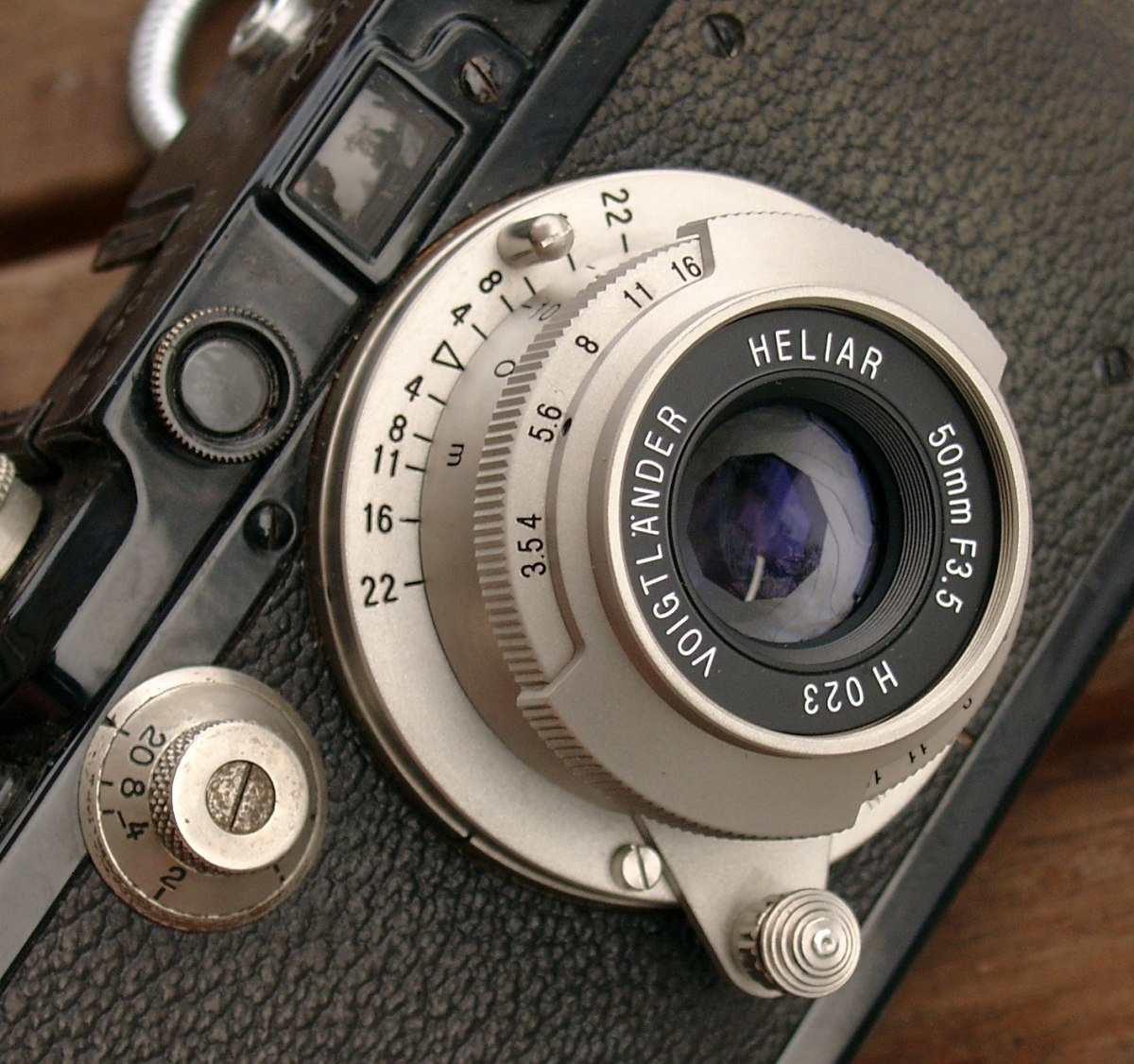
To be honest, even the older Color Heliar on my folding camera (circa first half 1950s) produces quite modern looking photographs. The Heliar design was quite a good one and did a really good job of controlling most lens aberrations. Since those lens aberrations, or flaws, are the real source of that "vintage" look than the Heliar probably didn't show much of that even in the early days. Once corrected for color shifts and with modern glass and coatings I would expect any Heliar design to be quite sharp, with excellent resolution.
That is actually one of the reasons that this design became so legendary. Unlike today's photographers, our predecessors were actually more interested in sharp lenses with good corrections, with the possible exception of the pictorial crowd. They had plenty of lenses with the "vintage" look.
There is no doubt that the handling of the newer lens is certainly a bit odd, but in my humble opinion the image quality is 2nd to none. I am certain there are several leicaphiles out there who will find fault with it but it is equal to anything Leica has ever produced with regards to its image resolution and quality. Certainly an f3.5 aperture doesn't hurt and, unless you are using Ilford Delta 3200, you won't be using it in low light situations. But for typical, everyday use it is very good from f3.5 on to about f6.3. After that will be some diffraction but I seriously doubt you will notice it in most of your prints.
If you want to see how good this little lens really is, shoot it with some Adox CMS 20 II in a 1933 Leica II sometime. It will put your modern digital camera to shame.
EDIT - If you want vintage, shoot the 50/3.5 Elmar. It is pretty good in the center but, like most Tessar designs, it gets a touch soft around the edges.