
No meter, no big deal

Been old fartino myself I remember taking slide pictures with FED-2. No meter, no iPhone, just exposure chart which was included with each film. I guess, it was the norm, back then...
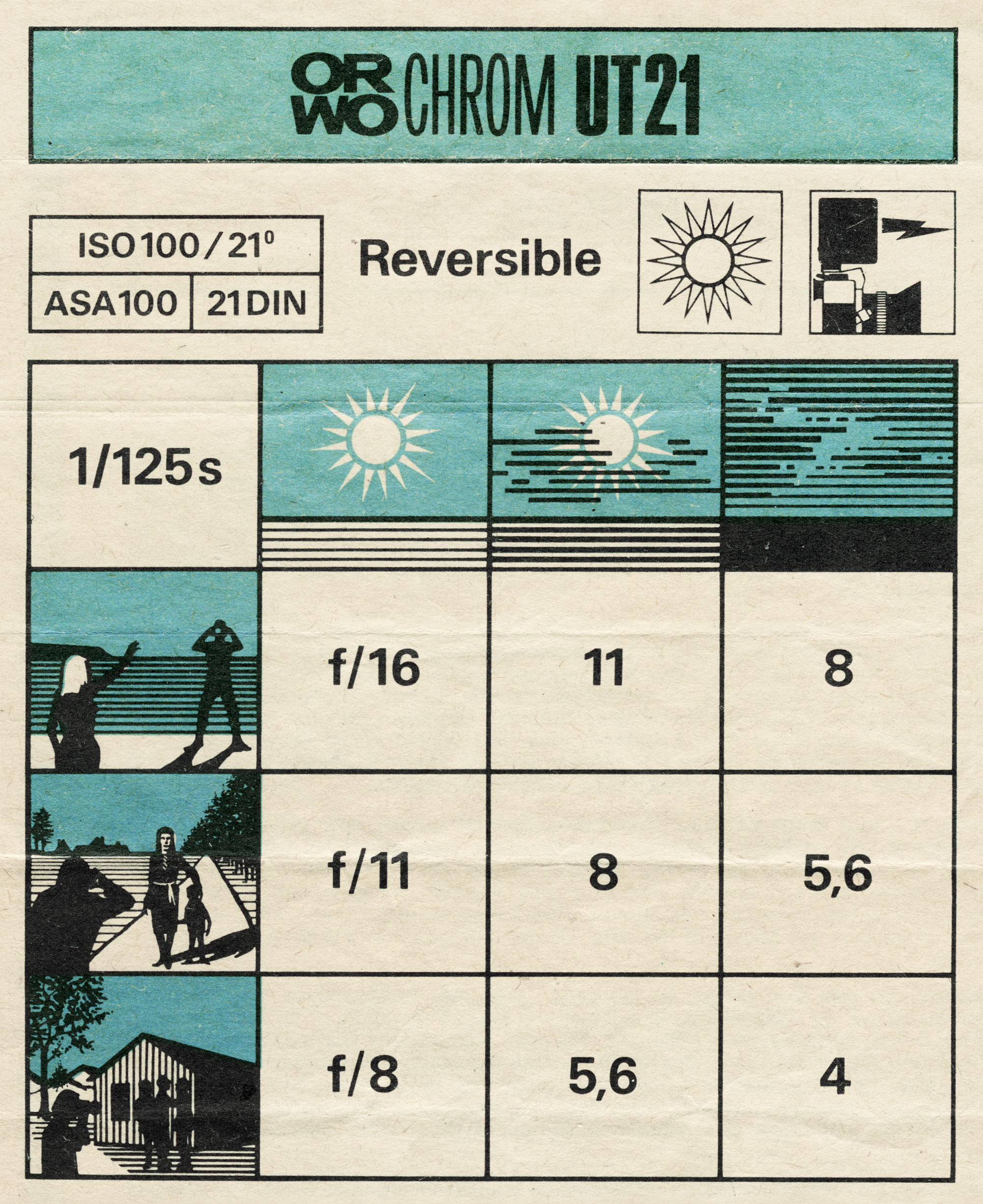
sunny-16-rule-orwo-chrom-ut21.jpg

Sorry, Sasha Krasnov has only big picture.
http://skrasnov.com/blog/sunny-16-rule/

I've a collection of these that I've found in old camera bags from auctions etc.

Oddly enough, the last one I actually paid for was inside the cartoon of a 120 film, I guess pro's need them...

Regards, David
 
My correct/incorrect exposure ratios are pretty much the same when shooting manual or auto. I just bugger up different scenes to what my meter buggers up.

My OM1 is perfect for me because I can use Sunny 16 until I'm unsure, when a flick of a switch gives me confirmation of exposure without taking my eye from the camera.
 
This is interesting and timely for me as I recently acquired a non metered Rolleiflex. I got my start on my dad's Minolta SRT 201 with match needle metering. And almost every camera I have since (many) have built in metering with the exception of some pinholes, Dianas, Holga, and my 4x5. With my 4x5 I always use a pentax spot meter and I mostly shoot transparency film. Even then I'm not always successful, but I chalk it up to not enough consistent experience. I shoot my 4x5 sporadically and sometimes it's years in between.

That being said, I don't understand not using a built in meter if it's available. It's quick and convenient, and I don't see it slowing me down any more than having to change aperture or shutter speed (which I would need to do even without metering). I don't always give the exposure the meter tells me, but at least I have a base for starting. I also don't like bracketing, and do it very little.

I can however see it being a bit cumbersome to use a hand held meter while shooting handheld cameras (like the rolleiflex), so I think I will need to start getting good and judging exposure.
 
My go to film camera these days, is my old but sturdy Nikon F with a meterless Prism. I keep an app on my iPhone (Lux), but usually just eyeball the situation and change aperture and shutter speed on the fly. A whole different experience which I highly recommend. Why? Because if you want to be fully in the creative process, then learning to expose with your eye and your mind increases the process many times over. And besides you never have to worry about batteries. 😀 My two cents. 🙂

Yes, or maybe, but only after good 10 to 20 years of experience. Until then it will remain lottery, and after still in one out of 50 exposures.
 
Yes, or maybe, but only after good 10 to 20 years of experience. Until then it will remain lottery, and after still in one out of 50 exposures.
You answer focuses on exposure results, something the OP doesn't address. It is OP's position that not using a meter puts you more fully in the creative process many times over, which is preposterous. Use a meter or don't use a meter selon votre gout, just don't rationalize your choice with the creative process argument.
 
You answer focuses on exposure results, something the OP doesn't address. It is OP's position that not using a meter puts you more fully in the creative process many times over, which is preposterous. Use a meter or don't use a meter selon votre gout, just don't rationalize your choice with the creative process argument.

I believe using a meter or not is not definition of any creativity in photography. Sorry, but this is my definitive conclusion.
 
You answer focuses on exposure results, something the OP doesn't address. It is OP's position that not using a meter puts you more fully in the creative process many times over, which is preposterous. Use a meter or don't use a meter selon votre gout, just don't rationalize your choice with the creative process argument.

A person figuring their own exposure is definitely more involved in the creative process. In the sense of creating the photo. That doesn't necessarily mean they're being more creative in the sense of being original though. Many times over though? It's arguable, but perhaps as many as 36 or so times per roll. 🙂
 
Definitely? How so?

Listed in descending order of engagement with the process:

1: You decide exposure for the photo
2: You passively let a meter decide exposure automatically for the photo
2: You passively leave it to chance, don't even look at the shutter or lens settings

Next we're going to debate who's putting more effort into moving the tandem bicycle, the person pedaling, or the person letting the other guy pedal.
 
Listed in descending order of engagement with the process:

1: You decide exposure for the photo
2: You passively let a meter decide exposure automatically for the photo
2: You passively leave it to chance, don't even look at the shutter or lens settings

With respect to item 1, you can actively decide exposure with or without a meter.

In the same way blindly following a meter doesn't make you any more creative, so too simply memorizing and applying the Sunny 16 exposure matrix in posts 33/41 doesn't make you any more creative. To borrow your metaphor, in both cases doing so is letting the other guy pedal.
 
In the same way blindly following a meter doesn't make you any more creative, so to simply memorizing and applying the Sunny 16 exposure matrix in posts 33/41 doesn't make you any more creative.

(If any mods are thinking of criticizing me for responding to one post twice in a row, this part was not there when I first read it).

I have to ask, do you work in any mediums outside of photography? Drawing, painting? Anything else? You don't seem to place much value on making aesthetic choices when creating a work, nor have any apparent understanding of how these choices would reflect on the creator.

If you went out and made such choices every time you went taking photos, you'd understand how having the choice be entirely up to your experience and your taste means being more involved in creation of a photo than moving a needle back and forth by turning a thing or another thing back and forth. Not simply in a practical sense of just getting an image made, but in having to see, think, judge, and make a decision.

And if you do not do this, and are not speaking from experience in doing this, you don't know what you're talking about. You may argue that in theory, somebody looking at their meter and then making their own judgement about which settings to use is basically on the same level. But in practice it's not.
 
My go to film camera these days, is my old but sturdy Nikon F with a meterless Prism. I keep an app on my iPhone (Lux), but usually just eyeball the situation and change aperture and shutter speed on the fly. A whole different experience which I highly recommend. Why? Because if you want to be fully in the creative process, then learning to expose with your eye and your mind increases the process many times over. And besides you never have to worry about batteries. 😀 My two cents. 🙂

Not to different from what Eisenstaedt expressed here.
"...I don’t use an exposure meter. My personal advice is: Spend the money you would put into such an instrument for film. Buy yards of film, miles of it. Buy all the film you can get your hands on. And then experiment with it." Alfred Eisenstaedt
 
Has everybody saying the OP is wrong tried it?

I've tried and have even done it correctly. I just don't see much advantage since I know how to use my camera's built in meter properly. I'd rather concentrate on framing and content. I see no issue with doing it, but I don't feel that my process is less creative.
 
Well thank you! What works for you is what's important. I use an incident generally, but I definitely felt more engaged with a photographic awareness when I was guessing or trying to decipher cloudy bright.
 
If you went out and made such choices every time you went taking photos, you'd understand how having the choice be entirely up to your experience and your taste means being more involved in creation of a photo than moving a needle back and forth by turning a thing or another thing back and forth. Not simply in a practical sense of just getting an image made, but in having to see, think, judge, and make a decision.
This is the usual romanticization of memorizing and applying the Sunny 16 exposure matrix. Goethe's young Werther with a camera.
 
Back
Top Bottom