photographing people and posting

I'm immediately reminded of this moment:

1767882536032.png

"Street photography" has always sat somewhat uneasily with me. Do I need photos of random people in my negative folder and in my Lightroom? What is a grabbed photo of a stranger in the street really achieving or saying?

I took this photo back in 2011. This low-res copy is still on my Facebook page in an album somewhere. I don't know who this girl was.

1767882776159.png

Is it a "good" photograph? I thought it was at the time. I'm not sure now. And I know I wouldn't take that today.

I love the work of Cartier-Bresson, Doisneau, Kertész, and so on. By the time we get to Winogrand I'm less interested, and when we finally get to guys like Gilden, I'm completely out.

I think part of it is that the internet has changed things; not only can images be published and reproduced quicker, they can also spread much further and much faster than they ever have before. When I'm looking through the viewfinder, I don't know what the person on the other side of the lens is thinking, the context of their lives, or if showing someone that photo might cause them issue. What if I photograph a woman on the run from a domestic abuser and my photograph I was so proud of is the thing that helps him realise she's now in Nottingham or Norwich?

Also, pre-internet, street photography at least gave you a view into a world you'd never otherwise be able to see. I'll never be able to visit the Paris of Cartier-Bresson, nor will I ever know the NYC of Winogrand's photos. But now everything is documented by everyone; I don't need more photos of random people in Tokyo. I've already seen enough.

Of course, there's a long tradition of street photography, and that's what its participants and fans cling to. I just don't think I want to be part of that tradition now.

 
I'm immediately reminded of this moment:

View attachment 4884757

"Street photography" has always sat somewhat uneasily with me. Do I need photos of random people in my negative folder and in my Lightroom? What is a grabbed photo of a stranger in the street really achieving or saying?

I took this photo back in 2011. This low-res copy is still on my Facebook page in an album somewhere. I don't know who this girl was.

View attachment 4884758

Is it a "good" photograph? I thought it was at the time. I'm not sure now. And I know I wouldn't take that today.

I love the work of Cartier-Bresson, Doisneau, Kertész, and so on. By the time we get to Winogrand I'm less interested, and when we finally get to guys like Gilden, I'm completely out.

I think part of it is that the internet has changed things; not only can images be published and reproduced quicker, they can also spread much further and much faster than they ever have before. When I'm looking through the viewfinder, I don't know what the person on the other side of the lens is thinking, the context of their lives, or if showing someone that photo might cause them issue. What if I photograph a woman on the run from a domestic abuser and my photograph I was so proud of is the thing that helps him realise she's now in Nottingham or Norwich?

Also, pre-internet, street photography at least gave you a view into a world you'd never otherwise be able to see. I'll never be able to visit the Paris of Cartier-Bresson, nor will I ever know the NYC of Winogrand's photos. But now everything is documented by everyone; I don't need more photos of random people in Tokyo. I've already seen enough.

Of course, there's a long tradition of street photography, and that's what its participants and fans cling to. I just don't think I want to be part of that tradition now.
Oeph, yes that’s a good example of how people don’t want to be in photos. I always try to keep in mind whether I’d like to be in a photo like that myself, and whenever I can, maybe ask people afterward. Thanks for your reply!
 
The two photos you took are good and it is hard to see the owners of those faces being unhappy about it. Except if she breaks up with him and your photo is stolen for a light pair of snow boots ad and it's all over town, on walls and bus shetlers, while she's courting Mr Right, then maybe not. Apparently it's stuff like this which has taken Mr and Mrs Clooney to France to preserve the privacy of their children.

Like @Coldkennels I am photographing people on the street hardly at all in recent years. I don't post online anywhere pictures of my children, now grown. That's an extreme position to take. Others may have photogrpahed them and put pictures online and there's always the risk of appropriation and proliferation. Oliver Sacks was accused of mistaking his patients for a literary career. A recent article in The New Yorker suggests it may have been worse than that. A doctor publishing the details of a remarakable case, supposedly anonymised, is still in breach of his duty to preserve private information, if the mere outline of the case identifies the patient. "Oh Harry, isn't that what you had? You did say it was rare. This must be you. But you said the rash was only on your chest....???"
 
Last edited:
Having moved to Haifa recently it's a discussion I get into with my wife whenever she sees my iPhone raised as we ride the bus together. I got questioned the other day by a very young IDF soldier I believe was worried about being pictured in uniform. I explained I was among other things a retire photographer and showed him that he was not in the frame. He thanked me and went on his way. While the light on the riders face was intriguing the end result wasn't and so all of them went to the digital cutting room floor. Lots of my "Street" stuff gets set back to low values (erased to nothing) these days.

W1980's stuff though are keepers, at least IMHO. It's a challenging question, that 40 years ago we didn't worry about as much. Today with the potential for instant worldwide distribution, AI bots defrocking people left and right, and the fragility of self/reputation at very least it's worth a pause. I'm sure if I was captured with walking with a beautiful young woman on the streets of NYC decades ago I would not be happy (it was not my wife). Does the fact that W1980's image of the couple is one that any couple would love to have of themselves mean anything? They loved it until they broke up, is it any less a lovely picture of a beautiful moment then?

If you draw the line, where do you draw it?

B2 (;->
 
There are lots of things that are legal that are unethical. Similarly, there's lots of things other people or governments do which I would personally consider unethical.

Just because the law says you can do something, or just because everyone else is already doing it, it doesn't mean you shouldn't stop and think about whether it matches with your own personal code of ethics.
 
I'd love to do more actually and always try, and on the rare occasion I do these days, to make sure no one is really identifiable and only yesterday could have taken a lovely shot of someone reading in a community space and framed by a bookcase but felt I would have been intruding and taking away the intimacy of her own personal moment as she looked so peaceful and in her own world, so I walked away.

I did take this though which is where I don't mind being.

P1160491.jpg


Number 1, what is the local law on street shooting? If it is legal, blaze away. We are videoed constantly by cameras both personal and state.

Depends on where you live, in the UK you are pretty free to take what you want in a public space but as CK says, doesn't mean you have to.
 
Last edited:
The hypocrisy is that I only post photos of strangers, never people that I know. I respect the privacy of those close to me but that of strangers.

A year or two ago, there was a woman in the middle of a busy City street, talking to a phone on a tripod. Probably making a vlog or something. I took a photo of her because of the novelty but used the extremely slow Sigma DP1, so I had to wait for it to acquire focus.

She saw me and said, 'did you just take a photo of me? Don't do that.' Come on, you're in a public street filming yourself and you expect privacy? The narcissism of the social media class knows no bounds. I mentioned this to a friend who shoots Leica M from the hip, he said he would have had that photo and been away without her even noticing.

My street photography is littered with people, not to invade their privacy (of which there is none in a public area) but because they are compositionally in the right place at the right time, or there is something distinct about them that I find humourous or interesting. They probably don't want this, but to be honest, I'm more interested in my photographic work than their feelings. I'm not doing anything unethical or morally wrong, and the results are often aesthetically pleasing or funny.

I took this photo because the woman was wearing a coat very similar to the paving:

Camouflage by Archiver, on Flickr

This hit flickr explore and is one of my most viewed images:

GM1 - Beats [explore 2014 07 05] by Archiver, on Flickr

I feel that photos with someone in them can be more interesting than if there were none. Imagine this one without anyone in it.

SL2-S - Bartender by Archiver, on Flickr
 
I hate to sound like "that guy". But the fact is I don't take pictures to please other people. I take pictures for my own personal satisfaction and I share them with others because I think they're worth seeing. Once I've made a photograph, it becomes my property. It is considered under my copyright here in the US. I don't take kindly to people telling me how to take pictures and what I can and cannot photograph in a public place. That sounds harsh but the simple fact is that my photography is pretty damn important to me. Plus I consider candid photography/documentary photography important. The photographs will become documents of our lifetimes. History is important to show where we came from and how we got to be where we end up. Having these photos will be more important as time goes by. Having them continue to exist in cyberspace or published in a book or magazine ensures factual representation exists. I'm not arrogant enough to expect my photos to be seriously considered as important historical artifacts but who knows.

Now I do have restrictions I place on what I do. I won't make someone look like an idiot--that is unless they are an idiot and I'm just being honest. I don't hold people up to ridicule--that's insulting and we have a president who does that for us. I won't take photos of homeless people, mentally compromised people, victimized people or people acting up just to be photographed. If someone asks (not demands) me to not take a photo of them, I probably won't. But don't tell me to delete a photo. I won't. I may end up getting my ass kicked--that's likely since I'm old and can't run anymore to effect an elegant getaway.

I have no control over what other people think. If they don't like the concept of unposed photos of people being themselves, that's not an issue for me.


.............................................................
 
The hypocrisy is that I only post photos of strangers, never people that I know. I respect the privacy of those close to me but that of strangers.

A year or two ago, there was a woman in the middle of a busy City street, talking to a phone on a tripod. Probably making a vlog or something. I took a photo of her because of the novelty but used the extremely slow Sigma DP1, so I had to wait for it to acquire focus.

She saw me and said, 'did you just take a photo of me? Don't do that.' Come on, you're in a public street filming yourself and you expect privacy? The narcissism of the social media class knows no bounds. I mentioned this to a friend who shoots Leica M from the hip, he said he would have had that photo and been away without her even noticing.

My street photography is littered with people, not to invade their privacy (of which there is none in a public area) but because they are compositionally in the right place at the right time, or there is something distinct about them that I find humourous or interesting. They probably don't want this, but to be honest, I'm more interested in my photographic work than their feelings. I'm not doing anything unethical or morally wrong, and the results are often aesthetically pleasing or funny.

I took this photo because the woman was wearing a coat very similar to the paving:

Camouflage by Archiver, on Flickr

This hit flickr explore and is one of my most viewed images:

GM1 - Beats [explore 2014 07 05] by Archiver, on Flickr

I feel that photos with someone in them can be more interesting than if there were none. Imagine this one without anyone in it.

SL2-S - Bartender by Archiver, on Flickr

Bartender is remarkable in color, light and composition. If I had shot that one I would have then put the camera away in the closet and never brought it out again. ;o) It's a great shot.
 
When living in Mexico I learned that while shooting in public may be legal the usual "Con permiso?" "With permission?" was always a good idea and I was never refused. When up close in the US I ask, also. But it is a courtesy, and a good idea. Some folks feel flattered to be asked if you have their permission to take a photo of them. It's a dance. If it is not up close, as if it were a portrait, I just shoot.

When I am feeling better I hope to do a mini photo essay on the coffee houses in this small town and of the people who are in them, con permiso. ;o) We are all vain. Being asked if we could be photographed appeals to that vanity.
 
Last edited:
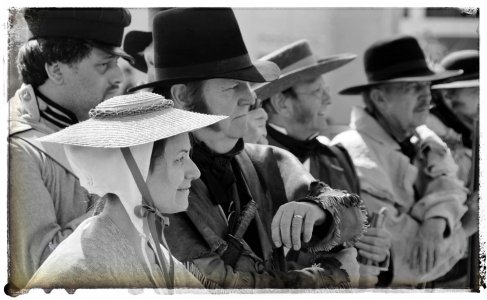
Hi everyone, I sometimes take photos in the city, often with people in them. I would love to show them to everyone, but I sometimes hesitate: do the people in the photos actually want this? It still feels a bit strange to just do it like that. Feedback welcome 🙂 Two Examples below


View attachment 4884755View attachment 4884756
Our interest in such photos is with the human form and the type of situation, rather than the particulars. That this is so can be evidenced by the abundance of street photographs with faces obscured by shadows or distance. Both of the photos above are also examples. One examines the mood or the composition or the type of situation but not the particular people in them. (You don't ask yourself "Is this Jack and Jenny? Or Bob and Alice?" Because you don't care who they are. ) That said, it is a rather fine point to have it explained to someone who disagrees with having their photo taken.

Practically, I find easier showing photos of strangers after quite some time has passed from the moment of photographing. Time helps me dissociate from that moment -- and I imagine that so would the people photographed.
 
Privacy is a concern even in public spaces, even when local laws permit photography. I may take photos, but most of them are for my own personal review, and I rarely share them on public forums where you lose control over how they are used. That said, I believe photos of public performances are generally acceptable to post.
 

Attachments

  • IMG_3054.jpeg
    IMG_3054.jpeg
    395.6 KB · Views: 17
People largely have a skewed idea of privacy, such that they feel emboldened to do things on their smartphones which would/should be an embarrassment, yet they walk out in public and expect there to be no trace of having done so. It's illogical, and I think people need an adjustment. Sometimes this happens when they realize someone took a photo with them in it, in a public place. It raises ire at first. But I like to think that, eventually, when they've pondered the realities of freedom of expression, they'll come to terms with the fact that this happens. Now, it's a different story, obviously, if the photograph showed them in a disrespectful or compromising way. So it's up to us as responsible photographers to think carefully about how our actions affect the greater understanding of public photography. I don't want to be mistaken for a creep; some creep just wants to get his jollies without being caught. These are two diametrically opposed ways of being.
 
We are social animals. We dress for ourselves, and to be seen. I complimented a very old visitor to my building, a subtle dash he had about him, not formal, but a nice coat and hat, no tie, sensible shoes. We had a little conversation. He was a retired history professor. I’m sure if I’d asked for a photo, had I a camera with me, he’d have accepted. So street photographs are fair game and very often help the world go round.

At the interface between public and private are the Uber delivery confirmation photographs. My wife drew my attention to how carefully composed so many of these are. We have a modest double fronted timber Edwardian house with roses and box hedges. I photograph it often. But these photographers manqués from all over the world often show me up.

Behind the front door is where my problem begins. Friends, siblings and others whipping out their phone for a snap of an untidy work table, ot a velvet couch. “Hey! Wait a minute” I don’t say. With cameras on chairs and lenses behind glass and tripods not well hidden behind doors, can I really put up a sign “No photography allowed”?
 
Back
Top Bottom