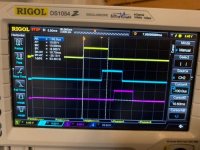
If you have an oscilloscope and sensor assuming you have an appropriate light source it ought to be possible to measure 1/30. I seem to recall the IIIf red dial versions had a 1/50 sync speed though?
A good 1/30 time is only a starting point, it certainly does not guarantee that faster times will be good. And there's not much point trying to adjust the mechanism unless it has been cleaned and lubricated and the curtains are in good repair. A IIIf is old enough now that there's a fair chance its curtains are no longer serviceable anyway.
The starting point for getting accurate speeds is a clean, lubricated mechanism, running curtains that exclude light satisfactorily and are supple enough to spool onto their drums willingly. Given this, curtain tension can be incrementally adjusted to get exposures reasonably even. Decent 1/30 or 1/50 times are a good starting point because although the second curtain release, (obviously) has to trip the curtain to end the exposure, the entire gate is fully exposed. It's easier to isolate the effects of curtain run time on exposure at one of those speeds because you're not dealing with slit width as well as curtain speed, hence, it is not a bad setting to begin tensioning curtains from scratch. So if you don't have access to a sophisticated tester with the ability to measure the curtain velocities, getting a decent "full gate" time out of the shutter gets you, if not in the ball park, then, at least, heading down the right street, to get to the ball park...
The goal, in the first instance, is to get consistency of exposure across the film gate. The 1/30 or 1/50 (depending on model) is merely a stepping stone. If that measures good, you can try 1/100, 1/200 or even 1/500. As each time shortens, the tolerances for precision tighten. Depending on the resolution of your tester, you might have the mechanism giving 0% tapering at 1/50. But when you set 1/200, you're still off a bit. And so on. All this means is that the curtains are starting to run together, which is good: but they're still not quite right.
The process is incremental. So you are less likely to wander off the garden path and get each curtain hopelessly out of range, this way.
The Leitz manual, using their drum tester, stipulate starting at 1/500 and adjusting the slit
patterns. My suggestions above, do not contradict their instructions in any way and are not set in stone. They're simply based on years of experience in getting good results using less sophisticated equipment.
What
is non-negotiable (repeating my comment above for clarity) is that there are two aspects to an accurate focal plane shutter: curtain run time
and slit width. You can't correct a mechanism that needs release timing correction with only tension adjustments. Similarly, you can't correct the times of a shutter whose curtains are not running at the right speed by changing the release timing.
Both have to be optimum.
The
sequence, then, is to get the curtains running in harmony at the correct velocity (aka travel time). Once this is achieved, if the effective exposure is long or short, 1/50-100 to 1/500 times can be dialled in by correcting the second curtain release, and 1/1000 may then be further calibrated, in isolation, if needed. Slow times are adjusted via the escapement.
I've written about this in some detail recently in this discussion.
https://www.rangefinderforum.com/forums/showthread.php?t=173917
Hi - thank you both for replying. Is there any test method to measure 1/30 of the moving shutter? If my camera is accurate at 1/25, can I assume that they are correct? How do I adjust curtain gap if that's the case. Thanks.
With respect: Given the sorts of questions you are asking, I'm doubtful you are ready to do these sort of adjustments to your Leica. It's essential to have a sound understanding of the basic concepts involved in adjusting the shutter. This forum certainly has a few members who have become skilled in servicing Leicas and various other vintage rangefinders, so, yes: you may be able to learn to do this. I'm not trying to discourage you. But if you do not understand how the curtain gap is set, it sounds like you may be in over your head at this point. You may wish to consider getting an experienced technician to service your IIIf. It's a fine camera that's surely worthy of the investment.
Cheers
Brett