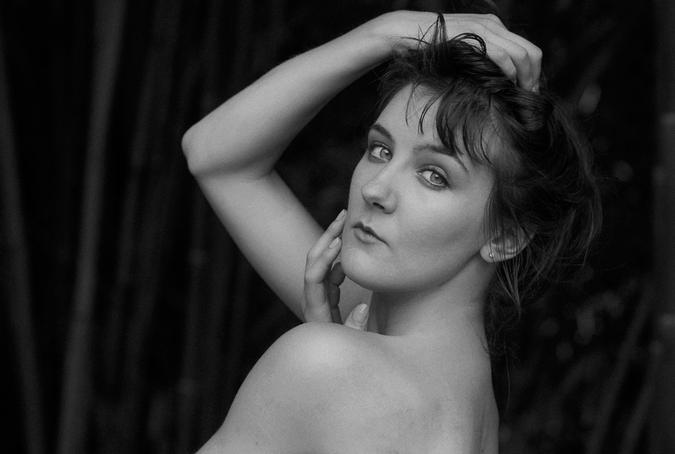
The thing about rangefinders used for portraits is that it is more difficult/risky to attempt to isolate the subject from the background using a narrow area of focus... like focusing on the subject's eye with your aperture wide open and hoping the foreground and background go soft. It is very easy to introduce an error here, either through your movement or the subjects', parallax, or a mechanical factor. So most people who use rangefinders for portraiture tend to use wider angle lenses and concentrate on environmental or fuller-figure portraiture rather than coming in tight and doing classic head shot type photos.
So even though I once had a 150mm lens for my Mamiya 6 rangefinder, it was not a practical portrait lens.
I'll argue that the tight head shot with a narrow band of focus - what most people consider traditional portraiture - is best done with SLRs, either small or medium format. 35mm SLRs with fast 85mm to 135mm lenses, like the Nikon F with the classic 105/2.5. Or the Hasselblad with the 110/2 or 150, Mamiya RB-RZ with 180, etc.
The TLR Rolleiflex is sort of in-between these two camps - skilled photographers like Irving Penn and Richard Avedon achieved close, intimate, narrow depth of field portraits and also further away, more informative portraits with just their Rolleis.
Note however that they sometimes used Tele-Rolleis with the 135mm lens and close up filters ;-p
The later model Rolleiflex TLRs have a hood design that allows you to use a sport finder by folding down the panel in the top of the hood - this creates a way to use the camera at eye level with accurate focusing - it takes some practice. Many people do not like the Rollei prisms and substitute a Hasselblad prism with an adapter device.
Some people confuse the shape of the aperture with having an effect on the bokeh. It does not but if you have backlit flare you can get sunstars and ghost reflections in the shape of the aperture opening - so pentagonal and hexagonal openings usually look ugly. Unfortunately, most later Rollei and Hassle-bad lenses have sharp hexagonal openings but I guess the designers thought that professional photographers would know how to light and never intentionally introduce flare... Leica lens designers used many aperture blades because they knew their customers would shoot into the sun, whether by intent or incompetence we don't know ;-p (Actually reducing the number of blades was a cost cutting decision.)
I found through experience that if I want to shoot a backlit flare image with nice background rendering, whether or not you want to call it bokeh, or whether or not I was using a prescribed lens that was sanctified as having good bokeh... it was simple to shoot it wide open so the round opening of the lens barrel defined the shape of the aperture. In this way I could use a camera like the Fuji GW690 with its sharp as a tack 90mm and still get pleasing round orbs floating in the background and enough flare and muddy garbage to shut the bokeh queens up. This also works with cheap plastic Nikon AF-D lenses too.