rangefinders take pictures; SLRs make pictures. Agree?

sirius

Well-known
Local time
8:39 PM
Joined
Jan 20, 2006
Messages
1,000
The title over-simplifies an interesting premise in the following article by Bill Pierce called, "The Leica, the SLR, and theEye of the Photographer ", from the digital journalist.

http://www.digitaljournalist.org/issue9801/nutsandbolts9801.htm

I thought this would be an interesting place to have a discussion around this topic. I do find that I think differently when I have a digital SLR in my hand as compared to when I have my Canon rangefinder. I actually enjoy both thought processes.

With my rangefinder I have to analyse the scene and think how to arrange myself in relation to telling the story through that fixed lens, aperature, and shutter speed.

With my DSLR I think a lot about how the scene enfolding makes me feel and how I can tell that story through the many creative tools that the camera offers. I certainly think about the camera a lot more. It is easier to experiment with a DSLR because you have instant feedback.

Both have taught me more about image making. I never really grasped exposure until I had a rangefinder and exposure meter. I have learned many facinating way to push creative image-making with my DSLR.
 
article makes sense...

My DSLR is great. I like my Leica too, but it is only a specialist in my arsena of gears. Who knows... but I can definitely see myself selling off my Leica kit one day if I ever get over that "Leica" novelty. I can use the money to fund that AlienBees kit I've wanted.. Trade in the Leica for AlienBees? Sounds ridiculous doesn't it? 🙂
 
Ok, second attempt to post this. 🙁

I see the rangefinder and the (35mm film) SLR as more alike than they are different, when compared to all of the other kinds of cameras. These two are both 35mm film cameras, about the same size, more or less the same shape, and have more or less the same features (I said more or less here, you know what I mean). 🙂

Process for taking a photo is just about the same. Find your subject, wind (assume you loaded film) 🙂 compose and focus thru the viewfinder, then shoot.

Either one can take or make a picture, depending on circumstances and semantics.

These two are very different from the other kinds of cameras such as the box, the folder, the modern P&S (either film or digital - and I include most DSLRs here since most people seem to use them as P&S), the disposable, the 120/220 SLR and TLR, or the press, view, subminiature, etc., etc., etc.

Probably not the most popular view here, but you asked. 🙂
 
Last edited:
Technically, in terms of the hardware, what you say is correct (except shouldn't all 35mm cameras be in the same class then?), but do you think that the mental process you go through when you take pictures is different between a rangefinder and a DSLR? Yes, they all take pictures but I'm waxing poetically about the hermeneutics of how they take pictures.
 
sirius said:
The title over-simplifies an interesting premise in the following article by Bill Pierce called, "The Leica, the SLR, and theEye of the Photographer ", from the digital journalist.
http://www.digitaljournalist.org/issue9801/nutsandbolts9801.htm
I.


Quote from Bill Pierce:
..watch a Leica and an EOS photographer at the same event. The Leica photographer will rarely have his camera to his eye. He will scan the event and, at the right moment, raise his camera to his eye and capture the madness in front of him. The EOS photographer will keep the camera at his eye, trying this framing, this viewpoint, pushing the button when he makes some sense of the madness.
Quote end

The choice of the camera depends on purpose and environment solely. The photo tho must ALWAYS be ready to get taken BEFORE the photog presses the button.

If the RF photog works with anticipation and the EOS photog doesn't, this has nothing to do with the cameras, it is rather that the EOS photog does not know how to photograph.

Staring through a SLR finder wile playing trombone with th 11- 400 zoom , hoping to "find" a pic this way is simply a silly newbies fault, nothing else.
That he claims this would be a system inherent style of shooting lets me doubt
that he is competent enuff to write such articles.🙄

Fitzi
 
fitzihardwurshd said:
Quote from Bill Pierce:
The choice of the camera depends on purpose and environment solely. The photo tho must ALWAYS be ready to get taken BEFORE the photog presses the button.

That is an interesting statement. It reminds me of many old school photographers (i.e. Cartier-Bresson) who would just take one or two shots of a moment. They knew their equipment and their skills so well as to know that they had the shot they wanted. This is in comparison to some amatures who shoot like a machine-gun. Practice and awareness are the way those skills develop, I guess.

Oh, I think Bill Pierce is very qualified to write articles like that. If you look around the site you should be impressed by what is there! I think it is full of fantastic stuff but photojournalism is what winds my clock, and I know that's not same for everyone. http://www.digitaljournalist.org/

Don't you think that DSLRs have a huge tool box of ways to tell stories and you have to always keep those in mind as you try to tell the story of an event. When you shoot with a rangefinder it is much more a confrontation between the photographer and the event? As a painter would describe it, there is a limited pallete. Limitations are an excellent spring point for creativity. Many artists self-impose limitations.

Thanks for the interesting discussion. I'm enjoying this.
 
Last edited:
Oh, that quote you pulled-out of Bill's article is one of the most memorable for me as well---the reason that I keep thinking about these ideas. The article does not denegrate either type of equipment.
 
To me the difference between taking and making a photograph has to do with where you are doing it. Not what kind of camera.

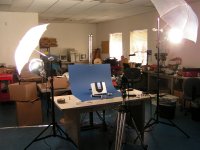
In the studio I am starting with a blank page as it were. There is nothing there until I put it there and then place lighting to illuminate the subject in the manner I choose for the photo. This to me is making a photograph.

If I am out with camera in hand (no matter what type) and I see something I like or want to capture I am taking a photograph.
 
So, are you saying that in the studio you are more proactive with your creativity while on the street you are more reactive?
 
sirius said:
So, are you saying that in the studio you are more proactive with your creativity while on the street you are more reactive?


I guess you could put it that way. "Making" a photograph means just that. Starting with zero. A black or white screen and filling it with what is desired and lighting the subject(s) in the manner one prefers.

In the "field" I am looking at what is already there and making
framing,composition and exposure decisions but I am not "creating" the scene I capture. It will exist whether I photograph it or not.
 
With my other fine art work I have noticed a pattern in how I work. At least, that is, a pattern for when I work successfully. The beginning seems to have little of "me" and a lot more just an eye and hand working together. As time passes there comes a switch. It is not about the subject, what the eye sees but more about what is being created? I being to follow where the artwork wants to go rather than follow the original intentions I had when first looking. I move beyond the literal. I wonder if this can be applied to photography as well. You know, this might more apply to the editing process in photography.

I read that National Geographic photographers take on average 300-400 ROLLS of film for each story, and sometimes they take 1000 for the more complex pieces. They use the camera as a tool to "sketch".

Here is where I read that:
http://www.nationalgeographic.com/photography/qanda/index.html

It appears I switched topics from an DSLR/rangefinder debate to questions about creativity.
 
Last edited:
SLR vs RF

SLR vs RF

I think we'd all agree that it's the photographer and not the camera that does the making or taking of pictures, so it would be inappropriate, I think, to claim that one type of camera "makes" and another "takes" pictures. The original article (or my interpretation of it, anyway), suggests that the process of making/taking differs from one type of camera to another, and it's hard to disagree with that.

As someone who's worked extensively with SLRs and increasingly with RFs, I can agree that it's certainly a different experience to shoot with the different types of cameras. I couldn't say, however, that I think more about using the camera more with one type than another--at least once I've established familiarity with it.

I'll finally add that there's a certain but intangible something about shooting with a rangefinder that has started to lure me away from the SLR in the first place. I don't think the RF has caused me to necessarily think differently when composing a photo (or waiting for the right moment), but I do somehow feel more "connected" (to what I'm not sure) when using the rangefinder.

Anyway, that's my two cents on the subject!

Cheers,
Jeremy
 
sirius said:
Don't you find the terms "making" and "taking" a photograph interesting? It talks about this very subject.


I always thought the two terms described the different activities quite well. My first job in photography was as a combat photographer with the Army in Viet Nam. I "took" photographs of scenes or events during or after they happened. I did not alter what lay before me. I did place myself and the camera where I could "capture" the existing scene in the best manner I could to my understanding at the time.

When I started working in commercial photography I worked with a man with a huge studio which included a 16' "roll back". We started with a blank space and placed the subjects in the frame as desired. We then lit the scene to best display what we had placed there.


Attached are two photos. The first I "made". The second I "took".
 

Attachments

  • sms01sa.jpg
    sms01sa.jpg
    187.7 KB · Views: 0
  • sms02s.jpg
    sms02s.jpg
    192.2 KB · Views: 0
When I read your title I didn't agree. After reading the article you link, I have to say I agree. Atleast for the way I work. I think alot of this assumes a SLR user with a zoom lens. Put a prime on it and the experience becomes more RF like.

Put it this way. Shooting a wedding I want to look in, instantly change, and react within the frame. I use a zoom. For my pleasure I never use a zoom. I find things are just more fun working with what you are given with one focal length constantly. That's how I look at it atleast. I see the SLR as a creative tool that can adapt to my every need. I see the RF as an inspirational tool that can recharge my enthusiasm for photography.
 
My coffee maker makes coffee, and I make coffee. No, I take coffee...so I don't make coffee. So I just take coffee but don't ever make coffee because the coffee maker makes the coffee. So I lie when I say I make coffee. Agree?

Tawk amongst yowselves. I'm keplemt.

(btw, my avatar is not rare; I could keep on picking on language ad nauseaum / good article btw)
 
Last edited:
Yeah, well Gabriel, this was not meant to be a discussion about the semantics of "make" and "take", but rather about the process of photographing and how two different types of cameras effect that.
 
sirius said:
Don't you think that DSLRs have a huge tool box of ways to tell stories and you have to always keep those in mind as you try to tell the story of an event. .

No, I don't think that at all. First comes the imagination, with the finder you only adjust the camera on it. You must know how your photo shall look, and you must be able to take it right then. And in this context a stoneold Russian RF has absolutely no basic limitations compared to a dancing and singing all-auto DSLR.

Thinking that imagination depends on any tools is leading you to the wrong door, a very essential and very common error . No offense meant, just a hint.
I admit it is hard to learn that, and I am myself far from perfect, but I keep on training this process of anticipation. Anything else does not work. Trying to find photos with the finder and trying out the features to see the effects , this way you will get lost in frustration after a while.
All cameras are dumb and stubborn.😉

Fitzi
 
two slightly different ways of accomplishing the same task...that's it., try not to get too wrapped up in the menutiae!

Todd
 
Last edited by a moderator:
I think the difference in the use of the RF and SLR stems from the fact that, with a RF, you can frame the scene you want to capture, but you must visualize in your mind the effects of lens opening and depth of field, while with the SLR, if you use a stop down preview, you see the scene as the camera will capture it on film. There are advantages to each, depending on the task at hand.

Jim N.
 
Back
Top Bottom