

Timmyjoe
Veteran
HCB delt with it enough to go on about his tactics.
Could you share where you found this. I would love to read his thoughts.
Thanks.
Best,
-Tim

HCB delt with it enough to go on about his tactics.
Could you share where you found this. I would love to read his thoughts.
Thanks.
Best,
-Tim


Fight fire with fire. I have had females, never males, approach me in a loud condescending tone that they think will give them some superiority.
I have a standard reply in a louder tone, eyeball them and tell them to p!ssoff and get the f*ck out of my image.
I have no fear of what society thinks of me with a camera in my hand while i walk the streets my taxes paid for.
When shooting out in the street, I have noticed an increase in tension from 3 places.
1. Feel like Police in general are on edge when shooting.
2. Feel like random subjects are less accommodating and sometimes just not accommodating at all.
3. Feel like business owners are more restrictive about photographers.
I have been shooting "the street" for 40 years, so of course, I have seen this before. But it now it seems increased. Recent events over the last 15 years, seems to have changed everything. maybe I am wrong.

It could be as simple as they don't like to have their picture taken by an individual they don't know? It could be someone who isn't doing something they should be doing. There could immigration concerns. I'm not saying these are real, but people are not thinking that we photograph for fun because most people don't care about this aspect of photography. Sure, we are allowed to photograph anything we want in the street here in the US. However, think of the other side of the coin... do you think they are thinking in their heads that we are trying to make great photos / Art? Probably not...the NEWS makes sure people are paranoid. Just try going to a suburban neighborhood and sit in your car outside someone's home you don't know... what will happen?
I like to photograph in public. However, I understand there is another side to it all and try to respect people's concerns whether real or not.

I've been asked which newspaper I work for and whether the pictures will end up online, very often I smile, I say I don't have a facebook and I shoot film which requires dev and scanning. I don't know if they really believe it but for now it works.
If someone reacts angrily or aggressively from the start I just ignore them, no point arguing, otherwise I try to look friendly, confident and calm. If you start believing you're doing something reprehensible people can smell it off you
Complex topic, that I have little to zero experience.
But this one case.
Long long ago, I was taking a photo of a 6th grade class where I had just done some "Mr. Engineer" airplane demos. One boy came up and said his mom told him never to let a picture be taken of him "Because her ex-boyfriend said he would kill them if he ever found where they lived".
I agree with the statements above about unfounded paranoia, but once in a very rare while, the fear of photographs is justified.




Dave, what was the justification of the boyfriend's attitude?


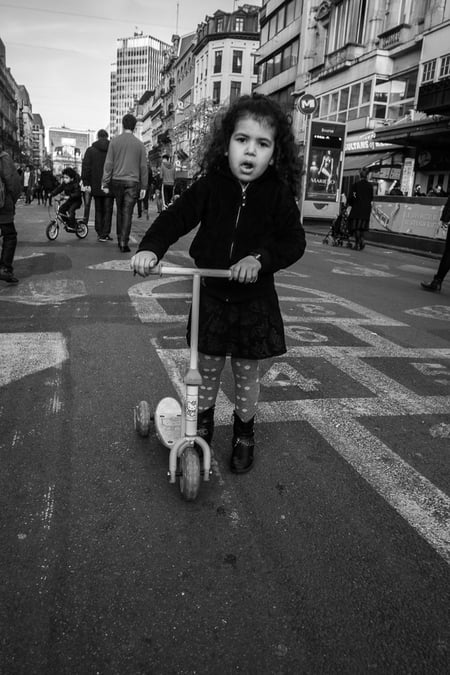
HCB would appreciate the surrealism of this shot where only one kid out of everyone is perfectly in focus.

I do think fear and suspicion is more prevalent now than prior to 9/11. That gave politicians a free ticket to play the fear card in order to have a more compliant population. That's political opportunism for you. Not that fear wasn't an understandable response. I remember full page media adverts showing a large grid of cameras, all identical except for one, with the caption "if you notice anyone taking suspicious photographs, call the police" or something like that. People became more wary of anyone they noticed taking photographs on the street after that.
Soon afterwards there was much media attention given to the sexual abuse of children in institutions and of paedophile rings. High profile inquiries were held, including a Royal Commission in Australia. Arrests frequently mentioned the seizure of large caches of photographs.
The combination of these two factors changed the perception of photographers in public where there appeared to be no immediately obvious explanation for taking photographs, such as being a tourist or taking snaps of your own kids. Most people aren't aware of this thing we call "street photography". They may see historic pictures of life in previous times but they don't make the connection that these were often taken by street photographers. They would probably be surprised to find their public art galleries contain street photography collections.
To add to all this there is the increasing unease about the explosion in public surveillance, mostly by government, in the name of security and public safety. Not just in images but also in tracking our digital signatures and trails, physically and online. People understand this is necessary but far from making them feel safer it makes them feel more threatened; a reminder of unspeakable terror like 9/11, 7/7 and Paris and an invasion of privacy, perhaps future opportunity to control lives by a more authoritarian State. In that context anonymity seems an escape, but advances in face recognition software now means that an anonymous street photo is not necessarily anonymous.
The landscape has changed.


