Using Zone System on 120 or 135 film

Hi Stewart

You'll get many answers on this one, but I'll jump in quick (before Chris C and Roger!).

Yes, especially if you have two bodies or two magazines (eg Hasselblad). Most often though you'll get through a roll in similar light, so the whole roll can have the appropriate (eg N-1 for high-contrast light) processing.
 
Dear Stewart,

Actually, a legitimate question is, Is the Zone system an appropriate technique when applied to ANY film?

And the answer is, of course, "Yes, if it works for you." But it dates from before the introduction of modern Multigrade papers, which reached parity with graded papers in the 1980s and have arguably excelled them since, so the old necessity to make everything print on Grade 2 no longer exists. It was predicated on thick-emulsion sheet film, where water-bath develpment was much more appropriate than with modern films. And it dates from before the ready availability of affordable densitometers. Actually, even the expensive densitometers of that era tended to drift all over the place and needed frequent calibration.

The naming of Zones (especially the original, symmetrical nine-Zone system) was a work of genius, but really, everything else is a somewhat jargon-laden restatement of basic sensitometry. People tend to imagine that because AA was a great photographer, they can become great photographers too if they adopt the Zone System. Frankly, this is about as meaningful as imagining that if they use the same cameras and lenses, they could take the same pictures.

Moving on to the specific question, there are two answers, even if the Zone System does work for you in large format with every sheet individualy developed. One is that you can carry multiple cameras or backs for different development times. The other is that you apply a good compromise development time to suit the majority of whatever is on the 35mm or roll film, but again, that's basic sensitometry.

I typically give at most 50% more development to films shot in Scotland (where dreich, grey days are a lot more common) and at most 15% less to films shot in Greece (where hard, bright light is much more common, at least at the times of year when I go there). To search for much more precision than that is probably meaningless unless your subject matter really is uncommonly consistent.

This will no doubt call down fire upon my head from Zonies, but then again, as Marty pointed out in another post, many of them are a bit confused anyway. It'll also invite "When you're as good a photographer as AA, you can..." but that won't wash. I've known lots of first class photographers who were shaky on theory, or indeed believed things that were flatly untrue. Taking good pictures, and having a sound tecnical grasp of the subject, are by no means always congruet.

Finally, there are at least as many great photographers who don't use the Zone System as who do, so it can't be essential.

Cheers,

R.
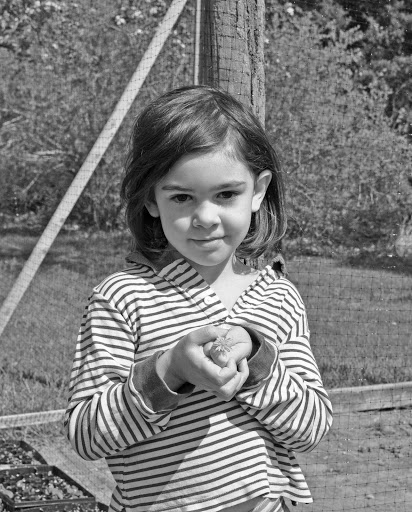
 
HDR for film

HDR for film

I'm not a zonie, but I believe it's a great learning and conditioning tool.

We had blazing mid-day sun (Roger's Greece) this week and this shot metered EV16 and I added +1 for faces. When I finished the roll, it was Tri-x, not E100G. Oops. So, I guessed a 50% 'pull' development (XTOL 1:2, 5:30min) and this shot resulted which has great range. Note the shadowed face and the bushes behind - AA's shadow details.

Gardening5b-sm.jpg


In contrast, with box processing (Tri-x, XTOL 1:1, 7min), the garden gnome looked like this last fall on a far less demanding dark, overcast day (Roger's Scotland). Note that the highs are blowing out on the gnome's sweater and the treeline shadows are black - much more limited range and a 'digital' look.

img254.jpg


The top pic was shot: meter, +1 for faces, SWAG 50% dev time on diluted dev to maintain the min time and quantity.

Adams would say, "meter (zone 5), camera +1 (zone 6), Dev N-2." Tidy and uniform.

He created a language for exposure and light values in a time when there were hardly any meters and dev materials were crude by today's standards.

So, although I don't practice orthodox zone, it influences how I think about light values and gives a basis for exposure and processing modification that is useful.

- Charlie
 
Last edited:
I'm not a zonie, but I believe it's a great learning and conditioning tool.

We had blazing mid-day sun (11am) this week and this shot metered EV16 and I added +1 for faces. When I finished the roll, it was Tri-x, not E100G. Oops. So, I guessed a 50% 'pull' development (XTOL 1:2, 5:30min) and this shot resulted which has great range. Note the shadowed face and the bushes behind - AA's shadow details.

...

The way I shot the top pic was: meter, +1 for faces, SWAG 50% dev time on diluted dev to maintain the min time and quantity.

Adams would say, "meter (zone 5), camera +1 (zone 6), Dev N+2." Tidy and uniform.

...


Should that be Dev N-2?
 
Ugh. Thanks, corrected. I generally push, not pull...

This 'mistake' roll has me excited about pulling highs down in the future, though, as Roger and you tip. The enhanced acutance is helpful too - the top shot was with a scale-focus Ansco Speedex (Agfa Isolette) "Apotar" and it can use all the help it can get.

- Charlie
 
Last edited:
That's a pretty impressive result in your first pic. We get those lighting conditions a lot in Australia, especially in summer of course.

Can I paraphrase you: you shot TRI-X thinking it was an 100 iso film (so 2-stops overexposure) and on top of that you gave that photo +1 exposure, so three stops total, and you reduced the "normal" (for TRI-X) development time down to 50%? Film is wonderfully forgiving! For the light I think you hit the sweet spot with that exposure and development! It took me quite a while to accept the principle of giving a film more exposure in strong bright light - it seemed to defy logic. But reducing the development time keeps the highlights well under control yet still brings out the lovely details in the shadows. This is something that you really need to be doing your own developing to appreciate and employ.
 
Last edited:
I was thinking in terms of the ethos of roll film and miniature cameras, I know it can be done but is it in the spirit of photography with miniature cameras, is it the best use of small negatives?

I can see why one may go to that sort of trouble with LF and somewhat with MF, but on 135? is it really worth the effort?

I tend to have a relaxed "good enough" attitude to exposure most of the time, and anyway I have so little time when I'm taking photos, the pictures would be gone if I started buggering around with speed or aperture.
 
Ah! That's a very different question! If you are not the type of person to meter every shot, then I'd probably agree with an assertion that a zone-system approach would probably not fit your approach.
 
I don't think the Zone system is practical for 35mm. It requires too much calculation for every shot, and 35mm shooting doesn't lend itself to that type of mental work, regarding exposure, because you have 36 frames, and you can't individually hold back on development for certain frames in the way that you can do with large format.

Medium format, I think, is the minimum format and probably only when your entire shoot is on a single roll, rather than a few shots taken today, another taken last month and the rest taken next year.

Of course, it depends on your personality and whether you're a meticulous note taker or have an excellent memory to be able to remember such details.

I no longer am able -- nor do I care -- to remember such minutiae. That's how I view it, and I'm sure that others don't see it as a complex method for setting exposure.
 
Ah! That's a very different question! If you are not the type of person to meter every shot, then I'd probably agree with an assertion that a zone-system approach would probably not fit your approach.

Yes, I'm probably moving the goal-posts there, sorry

It's just it crops up here often and I wonder what advice novices take away from such threads.
 
Chris:

Off topic and a bit of a complex answer, but I'm glad you asked... It really impressed me.

I had loaded the Speedex months ago and thought it had 100 asa slide film in it and opened it to find Tri-X.

There are really 2 processing problems here: make up for the big overexposure and the original problem, dealing with the high contrast lighting.

I have XTOL on hand and a 50% pull would exceed by far the min dev time (5 min). Folks seem to be hesitant to dilute XTOL too much, based on early complaints years ago, but I found this 'unofficial site' that lists the no longer supported 1:2 dilutions/times, then cut that (10:30 min) roughly in half to 5'30" and got lucky. I wanted as much development time as possible to help the highs, so while 5'30" sounds 'short' it's the longest dip possible.

Very attached now to Tri-X and XTOL. The combo seems to be able to do anything asked. I was thinking of trying stand and semi stand developers presycol, etc, but with this result, I'm going to stick with XTOL to explore it's edges.

(Ironically, the bushes should be burnt to isolate the subjects, but I'm so pleased with seeing into the background shadows.) Conditions should be same today and I'm going to try to duplicate the shot with the D90 - I don't think digital can natively come close to this range.

This was trivial to do and I hear aged voices muttering, "I told you so."

- Charlie

PS - I really like Charlie Lemay's way of teaching exposure on his site. He's made real progress in explaining the whole of it.
 
Last edited:
Dear Stewart,

Actually, a legitimate question is, Is the Zone system an appropriate technique when applied to ANY film?

And the answer is, of course, "Yes, if it works for you." But it dates from before the introduction of modern Multigrade papers, which reached parity with graded papers in the 1980s and have arguably excelled them since, so the old necessity to make everything print on Grade 2 no longer exists. It was predicated on thick-emulsion sheet film, where water-bath develpment was much more appropriate than with modern films. And it dates from before the ready availability of affordable densitometers. Actually, even the expensive densitometers of that era tended to drift all over the place and needed frequent calibration.

The naming of Zones (especially the original, symmetrical nine-Zone system) was a work of genius, but really, everything else is a somewhat jargon-laden restatement of basic sensitometry. People tend to imagine that because AA was a great photographer, they can become great photographers too if they adopt the Zone System. Frankly, this is about as meaningful as imagining that if they use the same cameras and lenses, they could take the same pictures.

Moving on to the specific question, there are two answers, even if the Zone System does work for you in large format with every sheet individualy developed. One is that you can carry multiple cameras or backs for different development times. The other is that you apply a good compromise development time to suit the majority of whatever is on the 35mm or roll film, but again, that's basic sensitometry.

I typically give at most 50% more development to films shot in Scotland (where dreich, grey days are a lot more common) and at most 15% less to films shot in Greece (where hard, bright light is much more common, at least at the times of year when I go there). To search for much more precision than that is probably meaningless unless your subject matter really is uncommonly consistent.

This will no doubt call down fire upon my head from Zonies, but then again, as Marty pointed out in another post, many of them are a bit confused anyway. It'll also invite "When you're as good a photographer as AA, you can..." but that won't wash. I've known lots of first class photographers who were shaky on theory, or indeed believed things that were flatly untrue. Taking good pictures, and having a sound tecnical grasp of the subject, are by no means always congruet.

Finally, there are at least as many great photographers who don't use the Zone System as who do, so it can't be essential.

Cheers,

R.

The zone system may not be necessary to make nice prints, but when I was practicing it I had my system geared to the point where I no longer had to make test strips. I knew my print time should be xx exposure on my enlarger with my paper ane my chosen developer at the correct temperature. So I was banging out final prints in a 45 minutes or less.

Thats one big advantage to the zone system.
 
I messed around with the Nikon D90 (same EV16, spot and time of day) and came up with this PS BW conversion and manipulation shot on P auto and AE to try to match the Speedex. The original had poor range and I slid the shadows for this quite a bit. But, Nikon metering proves great - could not manually improve it, in a very difficult situation and that answers the original question. Zone is largely obsolete for producing images with these great 135/DSLR cameras. People use auto; correction with sliders is always available. Maybe not as obsolete for you on 120.

Again OT: Aside from the better tonality of medium format film but also factoring favor to the Speedex/Isolette for a bit of degradation from an uncoated lens and the Epson V700 scan, I'd say film still does better - natively - than digital, but it's academic when you can move a slider to make it so close. This is the best I can do with either type in the same situation. I'll take film... there is often a 'tension' in digital b&w.

dandy.jpg
..
Gardening5b-sm.jpg


To do this correctly, I'd like to race the N80 v. D90 to compare small format using the same glass, but I've already stretched this thread too far. Thanks for your tolerance, Sparrow.

- Charlie
 
Last edited:
I was thinking in terms of the ethos of roll film and miniature cameras, I know it can be done but is it in the spirit of photography with miniature cameras, is it the best use of small negatives?

I can see why one may go to that sort of trouble with LF and somewhat with MF, but on 135? is it really worth the effort?

I tend to have a relaxed "good enough" attitude to exposure most of the time, and anyway I have so little time when I'm taking photos, the pictures would be gone if I started buggering around with speed or aperture.

I don't see how film size has anything to do with it; no matter what camera or film size you use I think you'll find that having more accurate exposure and proper development for the lighting conditions will make life MUCH easier for you when you print or scan the film.

As Roger says above, VC paper lets you fine tune contrast at the printing stage. That said, it is a lot easier to get a good print from a good negative. VC paper gives grade 00, 0, 1, 2, 3, 4, and 5. You'll find that the grade 00 looks pretty crappy, even with a neg contrasty enough to need that low of contrast paper. Grade 0 and 1 are usable, good quality. So, you have 2 grades of reduced contrast (grade 2 is normal contrast) and 3 grades to allow increasing. Where I live, the lighting conditions are such that you almost NEVER need to increase contrast, and often need to reduce it. Reducing it in development of the film gives better quality and if you need a BIG reduction, then a combination of reduced film development and a lower paper grade will be very useful.

You'll see a lot of people throwing names of famous photographers who guessed on exposure, didnt care about technical issues, etc. True, but those negs were often hard to print and those famous photographers often paid others to do that dirty work. Can you afford a master printer to rescue your poorly exposed negs? I can't, so I just do it right to start with and make life easy for myself. I shoot 200 rolls or more of film a year, I simply don't have time to screw with bad negs fixing contrast and exposure in the printing process.

The zone system or some variant of it makes life easy in the printing stage, which is the time consuming hard work part of photography.
 
I brought digital into the question (my apologies) which dulls the question; I assume the OP means to keep it on film.

- Charlie
 
Last edited:
I was thinking in terms of the ethos of roll film and miniature cameras, I know it can be done but is it in the spirit of photography with miniature cameras, is it the best use of small negatives?

I can see why one may go to that sort of trouble with LF and somewhat with MF, but on 135? is it really worth the effort?

I tend to have a relaxed "good enough" attitude to exposure most of the time, and anyway I have so little time when I'm taking photos, the pictures would be gone if I started buggering around with speed or aperture.
Dear Stewart,

In that case, I'd say that anyone who is going to agonize over every single exposure would do well to stop piddling around with small formats where technical quality is inevitably less than they'd get with a bigger neg.

And in response to Chris Crawford, I'd agree that yes, it's a lot easier to print well exposed negatives, but that there's a big difference between getting a good, printable negative that will go on grade 2 or 3 (or 1 and 4 in desperation) and using the full weight of the Zone System. The only times one should ever need 0 or 5 are mistakes; or VERY special effects; or extremely aberrant subjects surrounded by others that are more 'normal'.

It's a question of absolutism. I completely agree with Chris that surprisingly many good or even great photographers did, in fact, rely on master printers because they were useless at exposure. But there's a big spectrum between 'all but useless at exposure' and 'rabid Zonie'. Some understanding of sensitometry is very useful indeed, but any more than a modest understanding is probably unnecessary.

Cheers,

R.
 
I don't see how film size has anything to do with it; no matter what camera or film size you use I think you'll find that having more accurate exposure and proper development for the lighting conditions will make life MUCH easier for you when you print or scan the film.

As Roger says above, VC paper lets you fine tune contrast at the printing stage. That said, it is a lot easier to get a good print from a good negative. VC paper gives grade 00, 0, 1, 2, 3, 4, and 5. You'll find that the grade 00 looks pretty crappy, even with a neg contrasty enough to need that low of contrast paper. Grade 0 and 1 are usable, good quality. So, you have 2 grades of reduced contrast (grade 2 is normal contrast) and 3 grades to allow increasing. Where I live, the lighting conditions are such that you almost NEVER need to increase contrast, and often need to reduce it. Reducing it in development of the film gives better quality and if you need a BIG reduction, then a combination of reduced film development and a lower paper grade will be very useful.

You'll see a lot of people throwing names of famous photographers who guessed on exposure, didnt care about technical issues, etc. True, but those negs were often hard to print and those famous photographers often paid others to do that dirty work. Can you afford a master printer to rescue your poorly exposed negs? I can't, so I just do it right to start with and make life easy for myself. I shoot 200 rolls or more of film a year, I simply don't have time to screw with bad negs fixing contrast and exposure in the printing process.

The zone system or some variant of it makes life easy in the printing stage, which is the time consuming hard work part of photography.

Well, film size matters to the extent that with roll film there are more than the one frame on the roll and developing for easy printing of one may make others more difficult, no?

I tend to shoot for the body, for the average. Only with a small percentage of frames do I seem to need to reason, think through the settings ... and even then the latitude of these modern film covers almost all contingencies
 
Back
Top Bottom
