
Sparrow
Veteran
Is the Zone system an appropriate technique when applied to roll film?



I'm not a zonie, but I believe it's a great learning and conditioning tool.
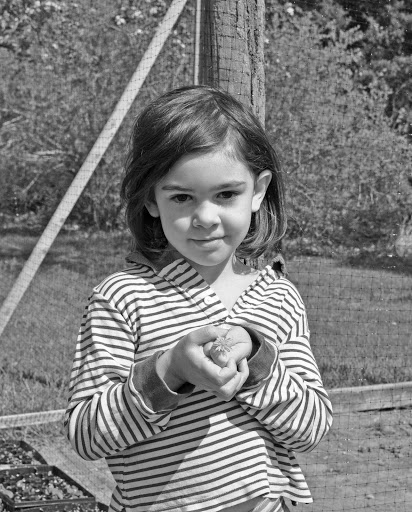
We had blazing mid-day sun (11am) this week and this shot metered EV16 and I added +1 for faces. When I finished the roll, it was Tri-x, not E100G. Oops. So, I guessed a 50% 'pull' development (XTOL 1:2, 5:30min) and this shot resulted which has great range. Note the shadowed face and the bushes behind - AA's shadow details.
...
The way I shot the top pic was: meter, +1 for faces, SWAG 50% dev time on diluted dev to maintain the min time and quantity.
Adams would say, "meter (zone 5), camera +1 (zone 6), Dev N+2." Tidy and uniform.
...
Ah! That's a very different question! If you are not the type of person to meter every shot, then I'd probably agree with an assertion that a zone-system approach would probably not fit your approach.
Dear Stewart,
Actually, a legitimate question is, Is the Zone system an appropriate technique when applied to ANY film?
And the answer is, of course, "Yes, if it works for you." But it dates from before the introduction of modern Multigrade papers, which reached parity with graded papers in the 1980s and have arguably excelled them since, so the old necessity to make everything print on Grade 2 no longer exists. It was predicated on thick-emulsion sheet film, where water-bath develpment was much more appropriate than with modern films. And it dates from before the ready availability of affordable densitometers. Actually, even the expensive densitometers of that era tended to drift all over the place and needed frequent calibration.
The naming of Zones (especially the original, symmetrical nine-Zone system) was a work of genius, but really, everything else is a somewhat jargon-laden restatement of basic sensitometry. People tend to imagine that because AA was a great photographer, they can become great photographers too if they adopt the Zone System. Frankly, this is about as meaningful as imagining that if they use the same cameras and lenses, they could take the same pictures.
Moving on to the specific question, there are two answers, even if the Zone System does work for you in large format with every sheet individualy developed. One is that you can carry multiple cameras or backs for different development times. The other is that you apply a good compromise development time to suit the majority of whatever is on the 35mm or roll film, but again, that's basic sensitometry.
I typically give at most 50% more development to films shot in Scotland (where dreich, grey days are a lot more common) and at most 15% less to films shot in Greece (where hard, bright light is much more common, at least at the times of year when I go there). To search for much more precision than that is probably meaningless unless your subject matter really is uncommonly consistent.
This will no doubt call down fire upon my head from Zonies, but then again, as Marty pointed out in another post, many of them are a bit confused anyway. It'll also invite "When you're as good a photographer as AA, you can..." but that won't wash. I've known lots of first class photographers who were shaky on theory, or indeed believed things that were flatly untrue. Taking good pictures, and having a sound tecnical grasp of the subject, are by no means always congruet.
Finally, there are at least as many great photographers who don't use the Zone System as who do, so it can't be essential.
Cheers,
R.

I was thinking in terms of the ethos of roll film and miniature cameras, I know it can be done but is it in the spirit of photography with miniature cameras, is it the best use of small negatives?
I can see why one may go to that sort of trouble with LF and somewhat with MF, but on 135? is it really worth the effort?
I tend to have a relaxed "good enough" attitude to exposure most of the time, and anyway I have so little time when I'm taking photos, the pictures would be gone if I started buggering around with speed or aperture.
The zone system or some variant of it makes life easy in the printing stage, which is the time consuming hard work part of photography.
Dear Stewart,I was thinking in terms of the ethos of roll film and miniature cameras, I know it can be done but is it in the spirit of photography with miniature cameras, is it the best use of small negatives?
I can see why one may go to that sort of trouble with LF and somewhat with MF, but on 135? is it really worth the effort?
I tend to have a relaxed "good enough" attitude to exposure most of the time, and anyway I have so little time when I'm taking photos, the pictures would be gone if I started buggering around with speed or aperture.
I don't see how film size has anything to do with it; no matter what camera or film size you use I think you'll find that having more accurate exposure and proper development for the lighting conditions will make life MUCH easier for you when you print or scan the film.
As Roger says above, VC paper lets you fine tune contrast at the printing stage. That said, it is a lot easier to get a good print from a good negative. VC paper gives grade 00, 0, 1, 2, 3, 4, and 5. You'll find that the grade 00 looks pretty crappy, even with a neg contrasty enough to need that low of contrast paper. Grade 0 and 1 are usable, good quality. So, you have 2 grades of reduced contrast (grade 2 is normal contrast) and 3 grades to allow increasing. Where I live, the lighting conditions are such that you almost NEVER need to increase contrast, and often need to reduce it. Reducing it in development of the film gives better quality and if you need a BIG reduction, then a combination of reduced film development and a lower paper grade will be very useful.
You'll see a lot of people throwing names of famous photographers who guessed on exposure, didnt care about technical issues, etc. True, but those negs were often hard to print and those famous photographers often paid others to do that dirty work. Can you afford a master printer to rescue your poorly exposed negs? I can't, so I just do it right to start with and make life easy for myself. I shoot 200 rolls or more of film a year, I simply don't have time to screw with bad negs fixing contrast and exposure in the printing process.
The zone system or some variant of it makes life easy in the printing stage, which is the time consuming hard work part of photography.


