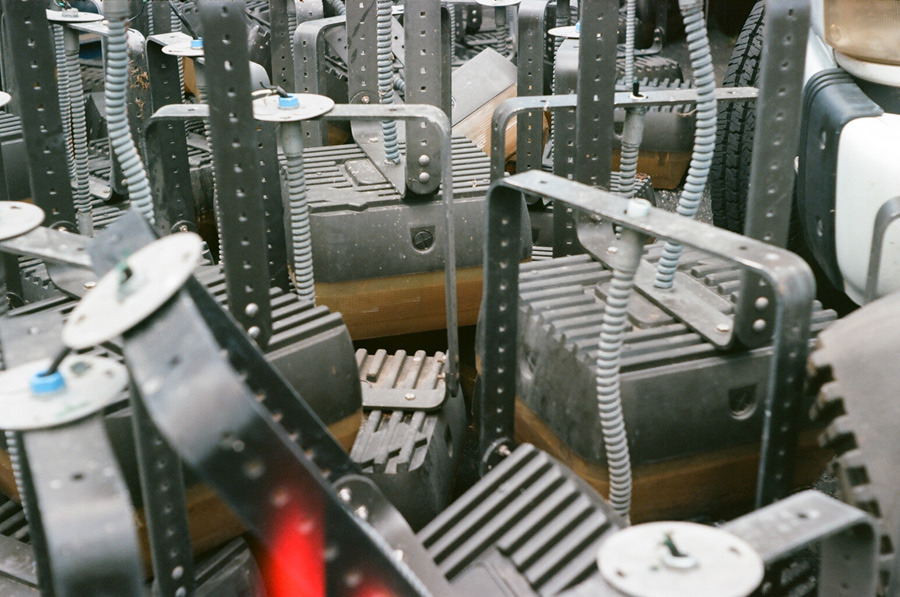
Thanks Tunalegs, That’s helpful, personally i feel my own ideas are leaning more to the conceptional, but if the photo itself adds nothing to the concept, can it truly be Wabi Sabi? Can we ever get past a photograph being anything more than a document of a Wabi Sabi subject matter?
I found this passage in Wabi - Sabi and Understanding Japan
“As a worldview, attention is paid to transience, harmony with nature and attention to the tiniest of details.”
Is it possible to depict these traits in a photograph so that the image itself is Wabi Sabi rather than the subject matter?
By the way I had a quick look at your flickr page and that little yellow Daihatsu Midget is amazing; if ever there was a subject matter crying out to be included in our debate it is this.
Yokosuka Mike.. your photograph is beautitful, I love it, but your argument “A picture of something that has the attributes of wabi-sabi is not a picture that is a wabi-sabi photograph.” brings me back to what I said above; Can we ever get past a photograph being anything more than a document etc.
Oh and Mike, your opinion does matter, I’m interested to hear more.
I think it's important to point out that wabi sabi as an aesthetic
in Japan is highly curated. Not created. I read quite a bit about history and architecture, and recently read a bit of an interview of Ohno Hidetoshi where he comments on a misunderstanding of the Japanese love of nature. The Japanese have a long history of seeking out interesting bits and pieces to build into their homes - a strangely knotted piece of wood, or a part of an old shipwreck, etc. and in modern architecture there are plenty of examples of buildings which interact with/frame their surroundings. From an outside perspective this is often seen as showing a reverence for nature and the natural environment - but as he points out, the forests, mountains, and beaches where these items are retrieved from were viewed as just as inhospitable and dangerous by the Japanese going into them to find beautiful
pieces as they would have been to Europeans living amongst similar environments. And with the Japanese habit of walling up rivers etc. he points out the Japanese love of and respect for nature doesn't run as deep as is popularly conceived. What the Japanese love is to curate nature. To find and display the best.
Like the Meiji era crafstman who transformed an old ship rudder into a rustic gate for a garden, a photographer is not creating wabi sabi, but curating it.
 Ukishima Corner
 by
Berang Berang, on Flickr
We could take this Daihatsu midget that you mention. It was built in factory, as were hundreds of thousands of others. Then it had who knows what kind of history, but the effects of age are readily apparent. Then somebody decided it'd be fun to incorporate it into their noodle stand. So is the noodle stand wabi sabi? Or has its builder simply chosen to incorporate and display a particularly interesting bit of the aesthetic?
 Midget
 by
Berang Berang, on Flickr
It's hard for a person to
make wabi sabi I think. It's a bit like manufacturing "antiques" - you can't really, because age is what makes an antique an antique and we don't control time. Could a photograph itself be wabi sabi? I think so, but I don't think it could be done on purpose.
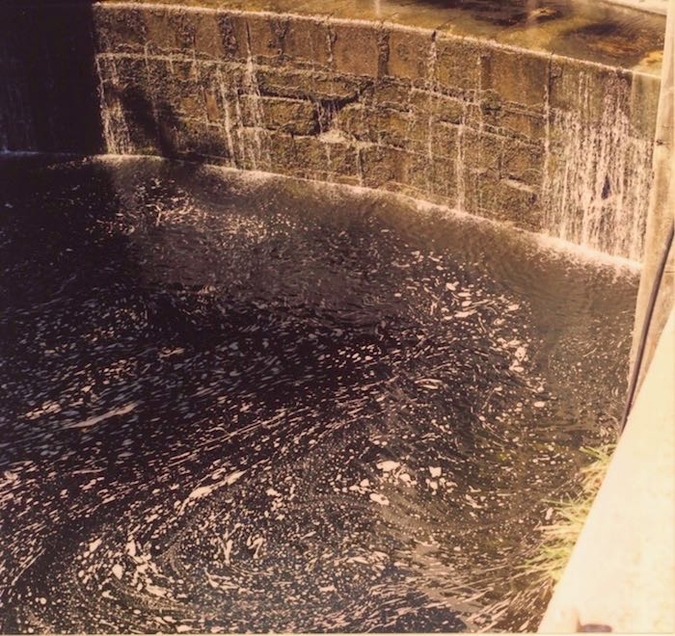
I was going to post a few of my own photographs, but my doubts as to what Wabi Sabi photography actually is has discounted most of them from inclusion here. I’m going to go with this one though, if only to give everyone a chance to throw my arguments back at me. in the end maybe i'm overthinking things and none of this really matters, but i am finding it interesting.
The photograph was taken late on a winters night and depicts a waterfall, with spray and ice. It involved a short hike into the woods with the sole purpose to take the shot and although it may not be the best photograph ever i feel it does include some Wabi Sabi traits;
"an aesthetic sensibilty that finds melancholic beauty in the impermanence of all things" -
Andrew Juniper
Olympus Trip 35 + Olympus T18 flash @f11. Focus at 3m Kodak ultra 400asa... Waterfall with ice
 Water and Ice
 by
john millar, on Flickr
I would also like to point out that Japanese exceptionalism is a very peculiar thing, with all sorts of ideas coming out of Japan purporting to show that Japanese are different from everybody else, their brains are different, their rectums are different (I can't even make this up) and so on. So I take it with a grain of salt whenever I see somebody write about how "only" the Japanese are capable of this or that. The truth is, just about any photograph is going to have some sort of fleck of wabi sabi about it, as photographs are locked to a tiny fleeting moment that only becomes further removed from the present every time one views the image. You have curated a bit of natural beauty here, but I think like my own photos it's a document of rather than a thing in and of itself.