Well , here's another nice mess you've gotten me into...

nikonosguy

Well-known
Local time
2:47 PM
Joined
Sep 25, 2012
Messages
935
so, i had a really low bid on a piece of gear, and i won it -- now, I'm not sure where to go from here...

Leicina Super -

tell me all about it, things to check,where to get super 8, where to get it processed....

how long of filming do i get off a roll of super 8?

I've got some film ideas -- just implementing them might be tough -- anyone want to go be a filmmaker with me?
 
I've read different things about that camera, though I've never actually seen one or held one in my hand. I've read a number of places that the Leicina Super is a regular 8 camera, not Super 8. If it is Super 8, one of the places folks use is:

Pro8mm

They can sell you the film and process it for you.

Also B&H sells some Super 8 film, and one type of B&W regular 8 film. There was some guy we all used to use years ago (2002-ish) that sold many variations of regular 8 film, but I can't find him now, so maybe he's stopped. Do a google search and you should come up with good info on the camera and film.

Good luck with it. Filmmaking is a lot of fun.

Best,
-Tim
 
These days most users go direct to video. Film is not cheap, but even B&H sells it. Dwayne's I believe, still processes Ektachrome. But don't hold me to that.

The camera you have is not sound, and had no provision for external sync. As I remember the Leicana only takes 3 inch reels, so it is about 3 min.

If you go to video it can be fun, but add in projectors, editors, and you will have to be highly motivated.

There is a lot of help out there. I have friends who archive it onto video all the time, so it is very doable.
 
Back in time, I shot some home-grade 8mm movies, and loved the experience enormously. There is magic in a projected movie.
I hope you get to use your new toy, and hope that I don't get stupid and buy myself the Bolex I long deprived myself of.
(bad syntax there, but so what).
 
Shot a lot of film with an old Bolex H8 many years ago, and back in the 1960's, my buddies and I made a whole film shot with an old Kodak regular 8 spring wound camera one of my buddy's mom had. Those were the days. 🙂
 
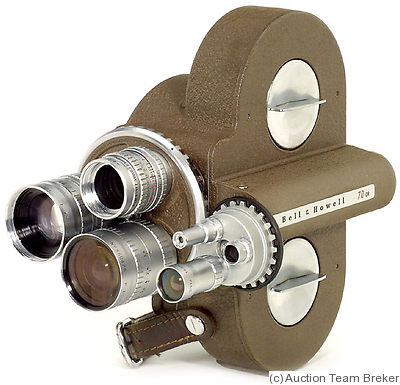
When I was in photo school, we used Bell & Howell wind-up movie cameras. They were called "combat cameras" and we had to learn how to make basic movies with them. There was an entire advanced school devoted to motion pictures though... the "MoPic C School."

Bell-&-Howell-Filmo-70DR.jpg
 
That was early 1974, and while I'm pretty sure that the Navy used Arriflex and Bolexes for the actual work of making documentary films by then. But surprisingly, the B&H cameras were still widely used in the fleet and in VietNam for reportage footage, hence the "combat camera" designation. They were compact, required no other support, and were (figuratively speaking) bullet-proof.

Of course, the photo school got all of the fleet hand-me-downs. I shot a KS-15 M2-R kit there, and the Speed Graphic kits we used were from the stone age, complete with a gray fiberboard Graphlex case. I have NO idea how old the B&H mopic cameras we used in "A" school were even then. I'm sure they were Korean War vintage anyway.
 
I got one when my daughter was very small. Magical films taken at the beach and in the courtyard of the beach house. I have the zoom lens. The electronic zoom is too quick. I use the manual lever and zoom in and out very very slowly, and sparingly. I also learnt from the greats to set up the idea and record long takes, sometimes the whole 50 feet of Kodachrome. Yes, it is Super 8.

It will actually take ordinary 35mm lenses M mount too. It has automatic exposure. You hold it with the battery housing plastered to your forehead for stability. I must try the Optovarion on my Monochrom.....
 
There's an informative Wikipedia article on Super 8:
https://en.wikipedia.org/wiki/Super_8_film
A Super 8 cartridge will give you 3 min. 20 sec. at 18 fps, 2 min. 30 sec. at the professional 24 fps.
If you're halfway serious, you will also need a film editor and of course a projector and screen, but this equipment can now be found very cheaply.
I have a good camera with a 10:1 plus macro lens and all the other equipment. I'd love to use it again, but film and processing have now become just too expensive. Too bad: I like projected film better than video, but that's just me.
 
I had a Canon super 8 for a few years, back in the aughts. Shot some Tri-X reversal and projected it in a Bell & Howell. It was indeed magic to see freshly developed film, with yet no flaws or scratches, projected for the first time. The thing that came to mind is the silver screen.

Yet, despite the "look" of super 8, there are so many other video options today that are more practical, like mirrorless cameras (especially micro-4/3) with adapted film camera lenses.

IMO, the place where super 8 makes sense is in the context of a completely non-digital film making project, where you edit the footage via a splicing jig and tape, and project the results in the setting of a micro-cinema.

~Joe
 
. . . . . . . .

IMO, the place where super 8 makes sense is in the context of a completely non-digital film making project, where you edit the footage via a splicing jig and tape, and project the results in the setting of a micro-cinema.

~Joe

This is a rewarding process, and I agree - there is magic up there on the silver screen.
Years back I edited 13 hours of my dad's 8mm film movies. A wall filled with film clips in plastic snack bags. On the screen it was wonderful. The digital conversion ? ... meh ....
 
I've read different things about that camera, though I've never actually seen one or held one in my hand. I've read a number of places that the Leicina Super is a regular 8 camera, not Super 8.

The Leicina Super (and Special) were Super 8, the Leicina 8 series were Normal (Double) 8. Their outer shape was fairly similar, and few people know any more that there was another 8mm film prior to Super 8, so misunderstandings sometimes happen...

Back when I studied cinematography, we still used Super 8 for low budget projects, but the Leicina Super was not popular among us. It was essentially a glorious consumer camera, expensive even used, and getting on in age, nowhere as sophisticated as the then current semi-pro Super 8 cameras by Beaulieu, Bolex or (Single 8) Fuji, with which it competed price-wise, while it was much heavier and less ergonomic than the far more affordable Bauers and Brauns that were technically equal.
 
Back
Top Bottom