what ƒ-stop = "reality" ??

As mentioned the eyes are continuously focusing, and will instantly bring whatever you are looking at into sharp focus if it can, making everything in a scene appear to be in focus. So I think the natural aperture should be a small one like f/22.
 
f-stop depends on how much light there is! shutter speed is about 1/16 sec, not sure which version of Photoshop the brain uses to bring it all together, a cat’s shutter is around an 1/80 so there is no point taking one to the movies.
 
The eye pupil can open up or close down. This way the f/stop of your eye can change alot. This happens not only when you take drugs, tyhis happens naturally when you go from a bright place to a dark one.

You CAN see the bokeh of your eyelens. Just make sure there's not too much light around, so the DOF will be short. Then look at something very close to your eye. Close one eye for easier tricking of your autofocus mechanism, and then, with some self control you can keep your one eye unfocused i.e. the background out of fous, and examine the bokeh.

After some practice, you can just look on anything anytime and "defocus" your eyelens. Or, better said, I can do it (dunno if everybody can). I can look "in front of" the real object or "behind" it. I can even go fron infront through in-focus to behind. I'm better with my right eye in this, although generally i use my left eye more.

The background OOF of MY eyelens looks horrible. Very close to a mirror lens' donut-bokeh, actually, with some image doubling, ringing etc..

 
I was thinking about a related topic this morning. I was wondering whether it's coinsidence that a wide aperture portrait can create a feeling of nostalgia or romance, and we often introduce low light into romantic situations. A candle lit dinner requires the use of fully dilated pupils, thus rendering all but the person opposite us as out of focus and irrelevant.
 
Well, good point, but it might have 2 more reasons, Robin.
1: When we have a romantic dinner with someone, everybody else is unimportant around, and brain is a strong device behind the eye. So it might seem they are out of focus whilke in fact, oiptically they are in focus...
2: If the dinner gets too romantic, and our eyes get wet, then the whole image can get blurry with special "halo" around a candle-lit subject. 🙂

Another interesting thing: Biking in slow rain with opene eyes gave me the following experience. When very small raindrops hit your eyelens in the correct position, say once a second or in two seceonds, not more often, then you can clearly see in-between but at the moment of impact you get a bright halo around everything bright on the street. Best is when it's dark outside and you have street lamps etc around. It really is a fantastic image that results.
 
Of course, another factor is that away from the cone-rich fovea (the most sensitive bit of the retina in terms of resolution and color discrimination), the cone spacing widens and rod population increases. This means that even if you had a perfect optical system focusing an image there, it would appear less sharp than if it was focused at the fovea. So your out of focus stuff away from your object of regard is physiologically blurred as well as optically blurred. Not a true bokeh, then. You may also want to have a look at the "Stiles-Crawford effect" in Wikipedia or the like which explains why more peripheral light rays will not be as perceptible.
 
My eye's bokeh betters even that of the Minolta TC-1's. It is in fact, the definition of butteryness. If you guys can see what I can see now, I'll be the envy of this forum.
 
I imagine the optics and sensors in the eye have less effect than the brain has when it perceives the data stream, how many times have things shown up on a print that you hadn’t seen when you took the picture simply because your brain had airbrushed out that tree growing out of someone’s head
 
The thing I always wondered was what ISO are the rods and cones in the human eye? I imagine they must be pretty darn fast. Couple that with a pretty good depth of field at any aperture, and you have yourself a great vision system.

Drew
 
Just like photography, depends if the object is close or further away, bright or dim. The human eye is the most accuarte exposure meter, focusing system and auto white balancer.
 
Dracotype said:
The thing I always wondered was what ISO are the rods and cones in the human eye? I imagine they must be pretty darn fast. Couple that with a pretty good depth of field at any aperture, and you have yourself a great vision system.

Drew

Don't forget the built-in image stabilization.
 
Yeah, but the eyes don't really capture "reality", do they? I mean, you don't see infrared and ultraviolet, so going by the makeup of a "normal" human eye, using it as a standard for "capturing reality" may not be quite ideal. Infrared and ultraviolet are real, right?

I wonder...what's the f-stop of a Jaguar's eyes (or an owl) in "normal" conditions?
 
Gabrielma-
All true, if actual reality is what we're after.
I think what most of us "ultrarealists" are after is to place on paper, as nearly as possible, what it looked like to be at the scene as a person. Sort of "antiphotography" if photography is to be strictly art.
So I think "all sharp" is important if we want the viewer's eyes to scan the picture, and "selective sharpness" is useful when we wish to restrain the viewer's eyes to where they'd have been focused at the moment the shot was taken.
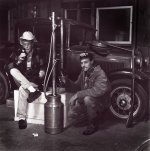
The attached shot isn't a rangefinder photo, or anything close; I spent hours with lighting setup, etc. to put this together. I chose to compromise, it's not all sharp, but the OOF areas are still recognizeable. Have I fooled the eye to buy this as reality or no? Comments appreciated.
Mamiya TLR, 80mm lens at F/4. Lit by diffused flash (2x Vivitar 285 reflected from foam core sheets) and direct fill flash. The print was selenium toned to beat the damned.
 

Attachments

  • Miscreants3.jpg
    Miscreants3.jpg
    147.3 KB · Views: 0
I looked at the photo before I read your post, and immediately thought it looked more like a museum set than "reality." I mean, obviously it is "reality" because those people and things exist, but something about it screamed "simulation." I'm guessing it was the swept concrete floor or the lighting, but nothing about it really looks "right." I can't say what, or how to "fix" it, but it might be better if one of them had some motion blur, like the guy's beer bottle perhaps. Maybe the fact that you spent so much time setting it up is somehow telegraphed. I think the lighting just doesn't look natural. Nice photo either way.
My mind knows things I do not.
 
Last edited:
[LEFT said:
Dracotype[/LEFT]]The thing I always wondered was what ISO are the rods and cones in the human eye? I imagine they must be pretty darn fast. Couple that with a pretty good depth of field at any aperture, and you have yourself a great vision system.

Drew
To compare the exposure wouldn't you have to define a shutter speed? But the eyes don't have a shutter speed, instead continuously capturing video. So a comparison would be hard, wouldn't it?
 
Back
Top Bottom