Dust

BTW, I have bought lately the Tiger cloth and anti static wick, in order to keep my scans cleaner, and it seems to work a bit, but this is already "after the fact" of drying film. I think, the cheapest way of avoiding dust on drying negs, is to moisten the air in the room, where you dry your film ( obviously, you have to keep the water particle free).
 
- Demineralized/filtered water for the final rinse
- Photo-flo or similar mixed w/demineralized water
- Hang in a low-traffic area
- Hang in bathroom and steam it up just slightly. I think it's more of a static issue instead of "pulling the dust out of the air" but that's just my own theory. It works great if nothing else is helping.

Good luck! Dust is frustrating as heck!

This what I do as well and it keeps the dust down, although nothing eliminates it entirely here in central CA. I also wipe or brush the negs gently before scanning, which I find is essential. Even so, I spend time removing remaining dust spots in PS before doing any thing further with a digitized image from a neg.
 
We built a new house a few years ago, and the dust was absolutely terrible, and is still occasionally bad due to forced air heating. I tame it by running the shower just long enough so that the mirror and window start fogging, and spray the walls of the shower with water as well, then keep the door closed. Since then I rarely have any dust at all. It is also the guest room shower that I use for drying, which is a low traffic area, and we need to occasionally run some water down the drain anyway or else it dries up and emits quite a terrible odour. Two birds, one stone.

Cheers,
Rob
 
...

1- Can dust/ fine deposit stuck in the gelatin be cleaned an how (please! save my film! I have a couple of keepers there 🙁 )
...

thanks!

Best thing you can do there is learn how to spot prints. It requires pencils, inks, and several different size brushes and lots of trial and error. I was never really good at it but did manage to save some prints that would have looked horrible and un-viewable without spotting. Its not fun but you can do it. It wouldn't be needed for dust, but bleaching and other chemicals used to be used to improve or correct prints. Something I never did myself.

I remember a photographer I once knew who stated his teacher had him set up a negative for a large print, then crushed up a cigarette and dropped the tobacco on the print. He was told to print it, spot it, and show the teacher. He said when he got done, he was OK with spotting. I sure don't recommend that way of learning.

I never tried it with negatives, but anything from at least 6x6 (6x7 better) on up used to be reported as doable; naturally the bigger the better.
 
I do my own B&W and seem to get by with little dust by using many of the above tips. But what really gets me is C-41 (which at least, you can use D-ICE on) is covered with dust. Not only covered it is imbedded in the film during the machine drying process. I've asked the lab to change their filters but they still stretch the change time out.
 
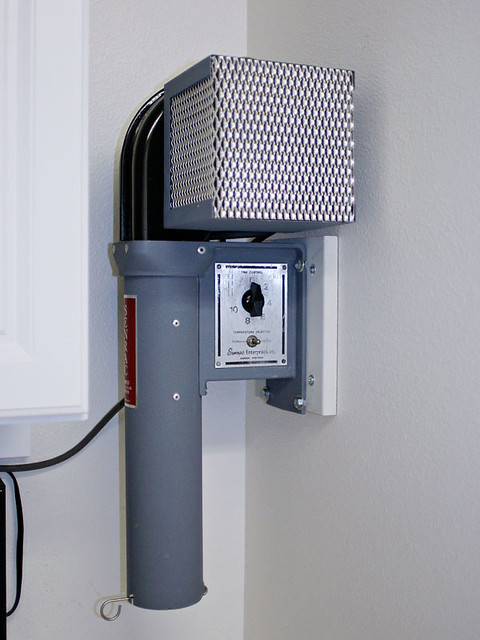
I can't emphasize enough how much a difference it has made using a film dryer (a Senrac Rapid Rollfilm Dryer to be specific), instead of hanging rolls out to dry. With this workflow my film goes directly from the development tank into the dryer, and once dry (which is less than 15 minutes) gets tucked immediately into storage sleeving. There just isn't much opportunity for exposure to dust with this workflow. 🙂

Of course, dust can still find it's way to the film after removing it from its sleeving, in preparation for either scanning or printing with an enlarger. But that is a far more manageable part of the equation compared to the problem of dust embedding in the film while drying.
 
Thanks to all for you advises.

You can re wash film although not for hours.
One thing though is this a chalky fine dust? Or is it just grit and other detritus?

If it looks chalky it could be from the fixer, not the wash or the dryer.
I have been told that calcite's can form in acid based fixer in chalky areas, if so mix fixer with pure de mineralised water.
In tests also we found that if the fixer p.h dropped the aluminium based hardeners in some fixers caused a precipitate to form, if you suspect this you can shine a light though the fixer to see if it has any of the fine white aluminium particulates in the solution.

My fix begins to be old, next time I'll use demineralized water for the solution and filter after prep.

I can't emphasize enough how much a difference it has made using a film dryer (a Senrac Rapid Rollfilm Dryer to be specific), instead of hanging rolls out to dry. With this workflow my film goes directly from the development tank into the dryer, and once dry (which is less than 15 minutes) gets tucked immediately into storage sleeving. There just isn't much opportunity for exposure to dust with this workflow. 🙂

ok, I'm with you , a (filtered) air dryer seems like a great idea. But I'm using Patersons, and I understand that there might be a problem drying the film on the reels (contamination? emulsion deposit on the reel?)
What type of reels are you using?

Thanks and a fantastic new year to everybody!
 
Here's a bit about my homemade drying cabinet:

http://joevancleave.blogspot.com/2012/09/it-took-about-month.html

7978207461_79377ca1a8_b.jpg
 
ok, I'm with you , a (filtered) air dryer seems like a great idea. But I'm using Patersons, and I understand that there might be a problem drying the film on the reels (contamination? emulsion deposit on the reel?)
What type of reels are you using?

Good point - I should have mentioned that the roll film dryers (well my Senrac anyway) are designed to fit metal reels.

On the other hand, with a little creativity they can be adapted for plastic reels. Below are pictures of my Senrac and an extension I made to accommodate a Patterson reel. This was made from a plastic peanut butter jar which had an i.d. just the right size for plastic development reels. 🙂 In addition to cutting the bottom off the jar off and adding some holes for the metal rod that holds the reels in, I also had to file down the lid threads slightly so that end would be a good fit into the bottom of the dryer tube.

11756388593_447bded53d_z.jpg
11756262065_9f8eaaae4c_z.jpg
 
I forgot to mention that in addition to better contamination control, another positive effect I find with the roll film dryer is that I never get the "monstrous curl" problem people complain about with some films, presumably when hung in the normal manner for drying. Even films like Efke 25 come out quite manageable off the reel. My experience here is primarily with 120 rolls, but I would imagine that 35mm would be similar.
 
Good point - I should have mentioned that the roll film dryers (well my Senrac anyway) are designed to fit metal reels.

On the other hand, with a little creativity they can be adapted for plastic reels. Below are pictures of my Senrac and an extension I made to accommodate a Patterson reel. This was made from a plastic peanut butter jar which had an i.d. just the right size for plastic development reels. 🙂 In addition to cutting the bottom off the jar off and adding some holes for the metal rod that holds the reels in, I also had to file down the lid threads slightly so that end would be a good fit into the bottom of the dryer tube.

11756388593_447bded53d_z.jpg

11756262065_9f8eaaae4c_z.jpg

Thanks!!

these guys are kind of out of reach for me (international shipping of a 15 or so pounds is not something I was thinking about), but I think that it should's be too hard to DIY them. That's me plan anyway.

So have you noticed any negative effect of drying on plastic reels? (for the film, or the reels?)
 
I used to get that, but I don't anymore. 2 things i did:

1. Wash the negatives for MUCH longer in warm water (25 minutes or so) and keep changing the water.
2. Dry very thoroughly - I use a hair dryer on the non-emulsion side.

After doing these two things my tri-x curl is gone 🙂

I don't think that a hairdryer is a good idea. Open it and you see how dirty it is inside. You blow the dust from the hairdryer directly on the wet film.
 
I don't think that a hairdryer is a good idea. Open it and you see how dirty it is inside. You blow the dust from the hairdryer directly on the wet film.

I would blow air through a fine filter.
I have bought some tubing today to try this solution.
I'll update when I finish and test it...
 
Regular drywall over stud darkroom. Suspended ceiling. Tile floor.

Tile floor can be mopped occasionally. Dust ceiling and walls. Swiffer is wonderful.

Filter over air intake, none over exhaust

HEPA air filters from Menard. 3 micron in line water filter.

POOF problems gone


Oh and do not reuse film fix. Silver precipitates and goes to the bottom and sticks like glue to next film.

Use glass bottles dedicated to developer, fix, and wash. I do not use short stop or rinse after developer.

My spot brushes were repurposed for watercolor art.

I suppose you could make a wood drying cabinet and seal the wood like furniture.
Real ones are super expensive.
 
The transparent soft drying cabinet is a german JOBO. I have two of then. I put a plastic tray under it and spray water inside it to take all dust away. I don`t use the blower or heater, just hang the films overnight. I use an automotive fuel filter (large aluminium one)
in tap water line to take out all sand and other particles. Then I cook the water in a tea water heater. when cool, I put a few drops Rollei RWA anti static concentrate and draw my negatives thru it. I keep the mix in a Tupperware with a lid, so no new dust can settle on the final rinse water. the moment I spot some emulsion or other pieces, I change the final rinse. I get no dust specs or any other marks on the negative. The RWA is so effective that I can drop thenegative on floor and use a rubber ball to blow any dust that might be there. The point is to have NOTHING stuck in the film when it is dried.
 
Thanks!!

these guys are kind of out of reach for me (international shipping of a 15 or so pounds is not something I was thinking about), but I think that it should's be too hard to DIY them. That's me plan anyway.

So have you noticed any negative effect of drying on plastic reels? (for the film, or the reels?)

Yeah, it is probably only economical if you can pick one up locally, avoiding any shipping fees (they are rather heavy!). I picked mine up after finding it for sale on my local Craigslist, purchasing it for something like $50 or $75 (USD) if I remember correctly.

No, no problems with drying the plastic reels. If you think about it, as long as your your final wash is good enough it shouldn't really matter whether you let the reel just dry naturally or use the dryer to do it faster. I suppose that if your final rinse was insufficient and you use the heat setting, it could have a tendency to "bake on" any residual chemicals. But you may never need the heat anyway - for me using the maximum ~15 minutes time has always been sufficient to dry the film, even just on the cool setting.
 
You can dry on a plastic reel. You can not Photoflow on the plastic or it gets sticky and will not load over time. It can not be removed.

Other than that, it is fine if heat is kept low.
 
You can dry on a plastic reel. You can not Photoflow on the plastic or it gets sticky and will not load over time. It can not be removed.

Other than that, it is fine if heat is kept low.

That's what I recently read on the web.
Yet, I've been using patterson reels for years, using photo-flo or ilfotol or any wetting agent for years now.
I've used acetic acid and sometime bleach to clean the reels and remove emulsion remains. I have no idea if this was smart or really really stupid, but it kind of worked so far.
 
Back
Top Bottom