ELCAN replica lens posts

I have many excellent 50mm lenses in Leica mount, and I am only interested in getting a special lens that I do not have or I don’t have anything similar to it. I got the CV 50/2 APO because I wanted to try out such a lens. I have no regrets:
 
Referencing post #39 above -- no one seems to have commented on this, and I don't know if the translation is accurate, but if it is, the comment about lower image quality is very interesting:

" the military specifications required an image quality lower than that guaranteed by the contemporary Summicron-M 50mm f / 2 type 11817"

I've never used or even seen an Elcan lens, but I remember some comparisons many years ago to modern Leica 50 (Summicron I think) and being impressed with the image quality of the Elcan.

I'm not seeing anything particularly noteworthy in the most recent image examples of the Elcan replica posted in the links above, but that doesn't mean the lens is incapable of great images. It may be a remarkable lens in the right hands and I'm looking forward to seeing more examples.

I saw an interesting article by Marco Cavina covering 50mm Leica lenses. There's a small chapter on Elcan as well:
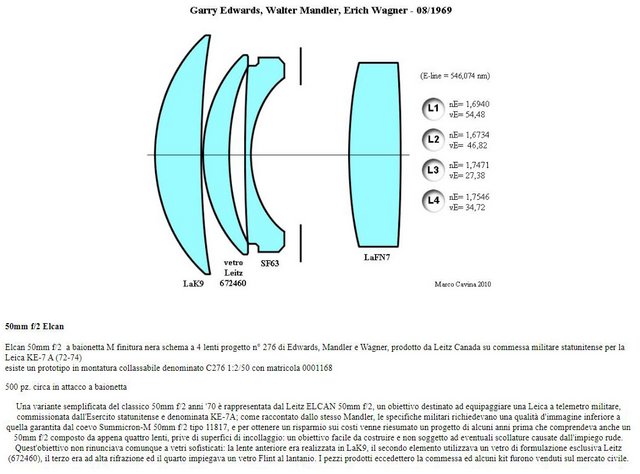


The description (via translator, I don't speak Italian), says:

"A simplified variant of the classic 70s 50mm f / 2 is represented by the Leitz ELCAN 50mm f / 2, a lens intended to equip a military rangefinder Leica, commissioned by the US Army and called KE-7A; as told by Mandler himself, the military specifications required an image quality lower than that guaranteed by the contemporary Summicron-M 50mm f / 2 type 11817, and to obtain cost savings a project of a few years earlier was resurrected which also included a 50mm f / 2 consisting of just four lenses, with no gluing surfaces: a lens that is easy to build and not subject to any cleavage caused by rough use. However, this lens did not renounce sophisticated glass: the front lens was made of LaK9, the second element used a glass of exclusive Leitz formulation (672460), the third was highly refractive and the fourth used a Flint glass with lanthanum."

 
I can already tell I don't think I'll be getting an LLL Elcan. More likely the CV APO if I get a 50 anytime soon.

Not that it isn't an interesting lens and all -- it just doesn't offer anything special that I'm after, And for the price, etc. it just doesn't push all the buttons. I wish much luck and happiness to everyone who gets one, and the whole effort in general.

Of course, now that I've made this statement....
 
Referencing post #39 above -- no one seems to have commented on this, and I don't know if the translation is accurate, but if it is, the comment about lower image quality is very interesting:

"the military specifications required an image quality lower than that guaranteed by the contemporary Summicron-M 50mm f / 2 type 11817"

I've never used or even seen an Elcan lens, but I remember some comparisons many years ago to modern Leica 50 (Summicron I think) and being impressed with the image quality of the Elcan.

I'm not seeing anything particularly noteworthy in the most recent image examples of the Elcan replica posted in the links above, but that doesn't mean the lens is incapable of great images. It may be a remarkable lens in the right hands and I'm looking forward to seeing more examples.
I took that translated comment to mean that the lens specs didn't require image quality to be as good as the Summicron... but didn't mean it would not be as good.
 
Yep. It's very possible that the Elcan is less good in areas that don't matter much to any particular user and superior in areas that are more important. Wish we knew what the specific design compromises were.

I took that translated comment to mean that the lens specs didn't require image quality to be as good as the Summicron... but didn't mean it would not be as good.
 
I just tried to post but the message was apparently lost.

Dr. Mandler designed an entirely new lens here, based on his earlier work with the Leitz Colorplan 90/2.5 projection lens, and the first 90/2.8 Elmarit-R. He simplified these further, such that only 4 lenses elements were needed. The performance was all that the military contract required. The design was quite different from the contemporaneous 50/2 Summicron, which was aGauss-derived design. This new formula was stretched to cover the 50mm format, so that performance fell off a bit at the edges of the field.

What people have been excited about is the performance of this design in the center 2/3 of the field, were renderings are luminous and 3-D like.

Ed
 
I just tried to post but the message was apparently lost.

Dr. Mandler designed an entirely new lens here, based on his earlier work with the Leitz Colorplan 90/2.5 projection lens, and the first 90/2.8 Elmarit-R. He simplified these further, such that only 4 lenses elements were needed. The performance was all that the military contract required. The design was quite different from the contemporaneous 50/2 Summicron, which was aGauss-derived design. This new formula was stretched to cover the 50mm format, so that performance fell off a bit at the edges of the field.

What people have been excited about is the performance of this design in the center 2/3 of the field, were renderings are luminous and 3-D like.

Ed

Yes, excellent center field performance, while "letting the photons fall where they may" at the edges and corners is, to my understanding, the Mandler design philosophy. It does seem to be the case for the Mandler designed lenses i've owned.

I agree with Raid and others who question why we should want this one. I have always thought of it as the GEFGW (Good enough for Government Work) Leica lens. My 180mm APO, designed for the Navy, is another story; it's worth having. But this one? Ho Hum.

The 35mm f/2.8 Summaron would be a better choice to reproduce, no?
 
We don't really need another 50mm lens, do we?

Not really. I still love my Zeiss Sonnar 5cm 1.5 and 2.0 versions from the 1930's and 1940's in their different versions. It is hard to beat such lenses for their characteristics.

This is how I feel about it as well. My 50mm Elmar-M was exciting; so was my 50mm Zeiss Planar. My 50mm Collapsible Summicron, my tabbed Summicron, these lenses are all keepers. A four element 50mm meant as a low cost lens for the government? Ho-hum.
 
yes we are talking about Chinese replica, the 16mm f8 has different design

I have a 16/8 in M mount. It is great with a film camera. No distortion at all. It gets messy with a digital Leica. There is a purple smearing on the edges, and also vignetting even when used with a custom gradated ND filter. It looks "OK" when you remove all colors. It is borderline "nearly OK" on the M8, with the 1/3 crop.

Why get a replica for it or the 15/8 lens? The design and the glass of the original Zeiss lenses make this lens special.
 
A replica of a very rare and expensive Leica lens with special performance is maybe a good target to have. The 50/1.2, as it has been mentioned many times before, would have been a tempting offer. Another "micro Nikkor" would be great. A Summaron 35/2.8 too! I missed this lens somehow.
 
For the ultimate wisdom, I looked up Wikipedia. 🙂

A "curate's egg" is something described as partly bad and partly good. In its original usage, it referred to something that is obviously and entirely bad, but is described out of politeness as nonetheless having good features that redeem it.

Some more wisdom:
Where does the expression curate's egg come from?
It can be traced back to a cartoon published in Punch magazine issue November 9, 1895, drawn by George du Maurier. In the cartoon, a nervous curate is eating an egg at the bishop's table. The bishop expresses concern that the curate has received a bad egg.
 
We use the expression all the time, humorously. Usually we use it, not in the early original sense that something is all bad but the poor wretch is trying to ingratiate himself with the Bishop, but where there is actually some good in the mix. FWIW.

Ed
 
I do not see any real need to replicate any 1950s-70s Leica M lens. Why make a new Summaron when the newer Summarits blow them away and would end up costing roughly the same? If the point is to use old optical formulas with "modern" lens coatings, that is an interesting idea, as the most significant drawback of single-coated 50s/60s optics is their tendency for flare and coma at wider apertures -- which really show up bigtime on color. But because newer lens designs are far, far better in nearly all traditional metrics, why revisit? Just buy the old lenses.

There are some potential "replica" ideas that would be niche, but would be useful. How about introducing new goggled lenses? The ability to use a 50mm M frameline as the 35mm frameline is absolutely great on either an M3 or a 0.72/0.85 M, but we are all limited to using the obsolete single-coated 3.5 or 2.8 Summarons or the bat****-insanely-expensive V1 35mm f/2. Or how about a new multi-focal M lens like the 28-35-50 Tri-Elmar or the 21-35 Konica Dual Hexanon? Or how about bolt-on helicoid adapters to use third-party lenses with Leica Ms with full RF coupling? How about a multi-focal length wide angle viewfinder that has both horizontal AND vertical leveling (unlike the current Leica one)? I really do not care about replicating the past, but good ideas from the past can have useful modern applications.
 
" the poor wretch is trying to ingratiate himself with the Bishop"

The poor LLL guy is trying to ingratiate himself with Leica?
 
I do not see any real need to replicate any 1950s-70s Leica M lens. Why make a new Summaron when the newer Summarits blow them away and would end up costing roughly the same? If the point is to use old optical formulas with "modern" lens coatings, that is an interesting idea, as the most significant drawback of single-coated 50s/60s optics are their tendency for flare and coma at wider apertures -- which really show up bigtime on color. But because newer lens designs are far, far better in nearly all traditional metrics, why revisit? Just buy the old lenses.

There are some potential "replica" ideas that would be niche, but would be useful. How about introducing new goggled lenses? The ability to use a 50mm M frameline as the 35mm frameline is absolutely great on either an M3 or a 0.72/0.85 M, but we are all limited to using the obsolete single-coated 3.5 or 2.8 Summarons or the bat****-insanely-expensive V1 35mm f/2. Or how about a new multi-focal M lens like the 28-35-50 Tri-Elmar or the 21-35 Konica Dual Hexanon? Or how about bolt-on helicoid adapters to use third-party lenses with Leica Ms with full RF coupling? How about a multi-focal length wide angle viewfinder that has both horizontal AND vertical leveling (unlike the current Leica one)? I really do not care about replicating the past, but good ideas from the past can have useful modern applications.

I have the feeling that the Summarit line was/is too good and not expensive enough for Leica users and collectors. The vintage Leica lenses add a touch of history that newly made lenses do not have. It has more to do with "owning such a lens" than "using the lens".
 
A replica of a very rare and expensive Leica lens with special performance is maybe a good target to have. The 50/1.2, as it has been mentioned many times before, would have been a tempting offer. Another "micro Nikkor" would be great. A Summaron 35/2.8 too! I missed this lens somehow.

As Summarons are great lenses but not particularly rare or exorbitantly priced, I don't see how this lens would fit into LLL business model of creating a buzz that leads to buying...
 
[/I]

As Summarons are great lenses but not particularly rare or exorbitantly priced, I don't see how this lens would fit into LLL business model of creating a buzz that leads to buying...

If sold for $400, LLL will make lots of money, maybe. 😀
I mentioned the Summaron because I don't have it.
 
Raid it seems to me that LLL is more into uncommon or rare lenses that are very high priced or unobtainable as originals. Lenses that most people will not have ever seen in a shop....ones that make people speculate " Oh, that would be cool." As for the $400 Summaron, in a small shop, why would you spend time making an inexpensive product when you could use the same time to assemble an expensive one? Asking for a friend 🙂
 
Back
Top Bottom