NDAv
Member
When shooting wide angle, I try to accentuate the wide angle effect. You have to give a sense of perspective or depth to the photo, try to avoid making the photo look "flat." I mean, all photos in reality are flat, but I think it is good idea to make wide-angle photos look three-dimensional.
There are several ways to add a sense of perspective or the illusion of depth to a photo, all kind of interrelated:
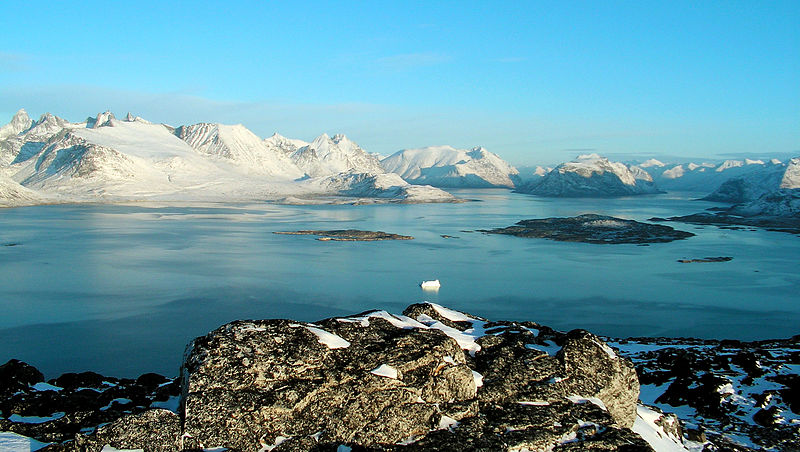
- Try to avoid empty spaces in a major part of the photo. Like a cloudless sky in a landscape. Bare sky is very bad for wide-angle landscape photos. You lose a lot of depth.
- Having a strong foreground element at the edge of the photo (in most cases, at the bottom or the sides)
- Moving closer to the subject, as others have already mentioned. Be as close you can possibly be. You might be surprised how close you can get if you know how to maneuver the camera.
- Raising the camera up as high as possible and tilting downward as much as possible. Generally good for landscape. You should generally avoid lowering the camera and pointing upward, unless you have no choice or the sky is the main focus.
- Diagonal lines or objects arranged diagonally or diagonal patterns seem like a good way to add perspective. Not exactly sure why.
Here is one photo to illustrate some of what I mean:

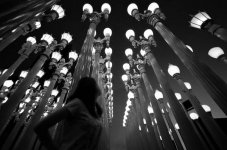
There is a lot of texture in the sky, and the camera raised up and pointed downward sufficient. The concrete and lamp posts adds depth because they create diagonal patterns. Not really any strong foreground element here: the people are too far way, they were trying to avoid the camera, but the wide angle lens defeated them, ha ha!
There are several ways to add a sense of perspective or the illusion of depth to a photo, all kind of interrelated:
- Try to avoid empty spaces in a major part of the photo. Like a cloudless sky in a landscape. Bare sky is very bad for wide-angle landscape photos. You lose a lot of depth.
- Having a strong foreground element at the edge of the photo (in most cases, at the bottom or the sides)
- Moving closer to the subject, as others have already mentioned. Be as close you can possibly be. You might be surprised how close you can get if you know how to maneuver the camera.
- Raising the camera up as high as possible and tilting downward as much as possible. Generally good for landscape. You should generally avoid lowering the camera and pointing upward, unless you have no choice or the sky is the main focus.
- Diagonal lines or objects arranged diagonally or diagonal patterns seem like a good way to add perspective. Not exactly sure why.
Here is one photo to illustrate some of what I mean:
There is a lot of texture in the sky, and the camera raised up and pointed downward sufficient. The concrete and lamp posts adds depth because they create diagonal patterns. Not really any strong foreground element here: the people are too far way, they were trying to avoid the camera, but the wide angle lens defeated them, ha ha!