Is 1.4 really necessary for available light?

BillBingham2 said:
The only bad thing I can say about fast lenses is that they are often BIG. (...) Speed also comes at a price.

Bill, I agree in both. The 40/1.4 Nokton and the preasph 35/1.4 'lux are the only ones being fast, small and affordable. The 40 became a bit long on my R-D1 so I bought a 35 Lux asph, admittedly bigger and not cheap (even if I had it for a good price from a rff fellow). I consider the size of this lens as reasonable (46mm long, 46mm filter thread). Feels and handles like a 50 'cron.

But there's a point I don't agree. I doesn't help me taking a slower/smaller lens with because I believe it will be sufficient for my expected needs. I never know in advance how much light i'll have. Available light situations may happen by daylight at full sunshine - a dark object in a shadowed corner or whatever. Another reason for wide apertures is the bokeh I want. Thats why I prefer going out with fast glass - with one exception my gem the 28 Skopar for alpine hikes.

Didier
 
IMHO, a faster lens is useful mainly for the ability to use a faster shutter at a given light level. When you are pushing Tri-X to 1600 or more, you hate to get home with blurred shots of your friends. I'd like as wide an aperture as possible, to allow the fastest shutter possible in any given lighting. That's not to say I shoot wide open all the time, just that not needing a flash or tripod when out for drinks with friends is much more pleasant for everyone around.
 
Hello All,
I agree with about everything I've read so far. Deed makes a very good point; you never know how -low- the light is going to be. I have recently gone through this myself, I have an excellent VC 1.5 Nokton, yet I just bought a Canon 1.2 . The extra half-stop speed is definately worth it, it's a godsend under certain conditions. When you work the outer edge of the low-light envelope, it's good to have the best tools available.
 
Last edited:
Bingo!

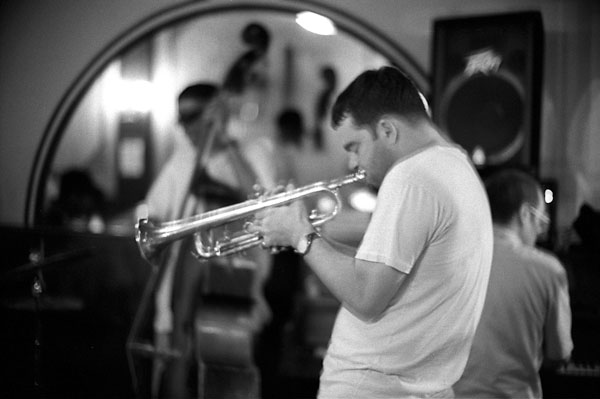
A lot depends on your typical subject matter. I need speed because I like to shoot musicians & performers who move around & in many venues where I shoot the light levels are so low that even f/1 isn't enough to prevent motion blur (but the light doesn't seem particularly dark to the human eye). E.g.., this grab shot was taken @ f/1 & 1/4th sec. on HP5+ (@ ISO 400):

209737889_0734196cc4_o.jpg


If I had gone there w/the intention of shooting, I would have used Neopan 1600 or Delta 3200 to get a decent shutter speed.

But if you're going to be shooting buildings, sitting persons, or other subjects that aren't moving, then f/2 (or even smaller apertures w/a tripod) may be sufficient for your needs.

Pherdinand said:
It's not only about handholding the stuff, or lower grain.
A faster lens allows for less (subject) motion blur. Sometimes motion blur is good but rarely. A shutter speed of 1/60 versus 1/20 (f/1.4 vs f/2.5) can make the difference.

Of course it's always possible to use faster film. But then, using faster film, AND faster lens, you can shoot in even less light😀
Nighttime, in a low-lit local e.g. the faster you can get the better the lens. Vignetting or barrel distortion etc, those are not real issues in these situations, IMO.
 
IIRC, the Summarit is just a 50/1.5 Xenon w/coating, & since the Xenon was generally considered inferior to the uncoated Sonnar, a coated Sonnar (also a Jupiter, Nikkor, or Canon Sonnar copy/variant) is likely to be superior to the Summarit. HCB certainly thought so, anyway. 😉

Pherdinand said:
How does a Summarit compare to a SOnnar 50/1.5?
 
All things being equal ... if you improve your technique and use fast film, a 1.4 lens will always get you an extra stop beyond f/2 ... in a lot of nightime home interiors where I shoot, that's the difference between 1/8 of a second and 1/4. One I can handle more or less reliably, the other I can't.

I've always carried a fast 50/1.4 and I end up using it wide open at least once on every roll of film. I shoot pretty much all my lenses wide open quite a lot of the time. I'm always down t o 1/8th second with my 28/3.5. When that's just too dark still, then I'm down around 1/8th with my 35/1.8. And I shoot the 50 at 1.4 a lot in order to freeze action and isolate the subject's eyes.
 
It's not so much a question of "necessary" or "unnecessary," as one of expanding your options. Your variables in low-light photography are lens aperture, shutter speed, ISO sensitivity, and subject motion (which you control by selection what moments you try to photograph.)

Generally you want to have as much flexibility as possible in choosing the moment you want to take the picture, so the more flexibility you have in the other variables, the wider a choice of photographable moments you get.

For example, if you constrain yourself to an f/2 lens and ISO 400, you'll be able to photograph almost any moment you want if the light is bright. As the light gets dimmer and dimmer, the more you'll have to pass on moments when there's a lot of subject movement (unless you want to make "creative blurs," my personal choice for World's Most Overworked Photographic Effect.)

If you can loosen up one of the other constraints -- increasing the ISO setting, or opening up to a wider lens aperture -- you'll again widen up your range of photographable moments.

That's really all it comes down to: how many possibilities are you willing to give up in order to keep your lens aperture and/or ISO rating moderate? If you're mostly interested in photographing nearly stationary objects, then you can work in rather low light with an f/2 lens. If you want to make sharp pictures of moving objects, then you're going to need all the lens aperture you can get.
 
A month or so ago I was in this old chinese town in the afternoon and it was starting to go a little dark, and with my 20D at 3200 and my 50 1.4 at 1.4 I was getting speeds around 1/10 of a second. For you it might be enough, for me that day it was not.
 
memphis said:
never used a sonnar... I love the summarit --- all of these shot on Beale Street --- most in poor lighting conditions, ilford delta pro 400


Hmmm. Nice. That would be, ah, delta blues? 😀
 
Didier & others,

I’m a minimalist, perhaps that’s why I carry a 15/40/105 kit. My single lens, single body camera (an L or an T with a 25/4) that is with me most of the time comes along as a second body but doesn’t add too much weight.

I became a minimalist after several years of carry several SLR bodies, way too many lenses, flashes, battery backs. Every vacation, I schlep lens from 300mm to 24, a micro, I carried it. Then one day I realized I was not having fun carrying so much stuff. I looked around for options and got the RF bug and sold of lot of my SLR stuff. I got back to a three lens kit and it’s been serving me well for the past 20 years.

I am not as much of an existing light purest as many of the folks who hang out here. I use off camera flash and find it works fine. There are times you can not use it, but I have to admit, I love painting with flash. IMHO, RFs are the perfect camera for flash.

B2 (;->
 
F/1.4 gives very little DOF. I don't like shooting that wide open, but there are times when there are no other alternatives. Tonight I was shooting after the sun set. Had FP4+ with yellow filter. If I didn't have a F/1.4 lens, I would have had to stop shooting. But with it I was able to get a few more shots in before it was too dark. Necessary... no; nice to have... definitely.
 
No. 1.4 is not necessary for available light. I shoot in the evenings, without a flash, at f4. Of course, I am shooting Delta 3200@1600 and have rock steady hands. I find that the shallow DOF and slow shutterspeeds at night are a bad combination sometimes. Especially when combined with a dim patch.
 
BrianShaw said:
F/1.4 gives very little DOF. I don't like shooting that wide open, but there are times when there are no other alternatives. Tonight I was shooting after the sun set. Had FP4+ with yellow filter. If I didn't have a F/1.4 lens, I would have had to stop shooting. But with it I was able to get a few more shots in before it was too dark. Necessary... no; nice to have... definitely.
You could always take the yellow filter off. That's one stop right? 😉
 
shutterflower said:
No. 1.4 is not necessary for available light. I shoot in the evenings, without a flash, at f4. Of course, I am shooting Delta 3200@1600 and have rock steady hands. I find that the shallow DOF and slow shutterspeeds at night are a bad combination sometimes. Especially when combined with a dim patch.

Rock steady hands don't help with subject movement...

f/4, 1600 and say 1/30th makes for an EV value of 5 - good for early evening, not for night-shooting or in dark rooms...
 
Rx for blurry pics

Rx for blurry pics

Depth of field is pretty shallow at f/1.4 with a 50mm lens;
a 35mm is a little more forgiving at the same aperture.

One must have good eyes to focus accurately
in "available darkness"...

"Excelsior, you fathead!"
-Chris-
 
I agree. If your subject is moving, it doesn't matter even if you use a tripod & cable release. 😛

However, I think f/4 @ 1/30th sec. is actually EV 9, which is way too bright to qualify as "available darkness" by my standards. For a real world example, @ ISO 1600, the light level in the underground stations for the Washington, DC Metro subway system is around EV 7 (inside the cars it's about EV 9 or 10).

jvx said:
Rock steady hands don't help with subject movement...

f/4, 1600 and say 1/30th makes for an EV value of 5 - good for early evening, not for night-shooting or in dark rooms...
 
furcafe said:
I agree. If your subject is moving, it doesn't matter even if you use a tripod & cable release. 😛

However, I think f/4 @ 1/30th sec. is actually EV 9, which is way too bright to qualify as "available darkness" by my standards. For a real world example, @ ISO 1600, the light level in the underground stations for the Washington, DC Metro subway system is around EV 7 (inside the cars it's about EV 9 or 10).

1/30th and f/2? My kinda lighting.

You're all brilliantly right, of course. I can hand hold 1/8th and get a sharp shot 75% of the time.. umm.. if my subject is standing perfectly still. That's.. not exactly possible most of the time.

Then again, if you're taking shots that are 5 EV with 1600 iso.. you're in a pretty dark place. Dark enough to warrant.. 12500 iso! Back up to 1/60th at f/2 😀
 
Back
Top Bottom