Most Convincing Digital B&W?

digital that looks like film is not important to me.
i like b&w digital that looks digital.
digital is not film...i think that's pretty simple for most to understand.
they are different...like apples and raspberries...this incessant crap from folks like ned is just ****ing boring as hell.


I always (98%) shoot BW when I shoot digital.
I don`t care if it does or doesn`t look like film .
I have two film cameras for that loaded with either TriX or HP5.

They`re too slow for indoor fast paced stuff ,which is why I turn to digital BW.

If I were shooting the sort of stuff Ned shoots (for example) I`d probably wouldn`t need to use digital BW

So its always BW but the deciding factor for me is what will do the job and not necessarily what it looks like.

I prefer the BW from my Merrills over my GRV but I`ll use which ever is appropriate.

For me the best BW digital files come out of the Monochrome models but ,yes ,the PP seems to make a big difference.
 
I'd also be curious to know what camera, in people's opinion, offers the best out-of-camera BW jpegs. That can be a fun way to shoot, if you know results will be pretty good. Fuji X?

Of course, you can only assess "best" in the context of what you feel "best" might be. Emulating some film+developer+processing combination isn't necessarily "best" ... it's simply a preference for a particular look. Monochrome images have a diverse aesthetic.

So far, for me, the M-P typ 240 is doing a spectacular job of producing excellent "out of camera" B&W JPEGs. So do the Olympus E-M1 and E-PL7 bodies. With any of these three, I can easily create photos that I would post without any post-processing adjustments and be satisfied with their quality.

I haven't worked with the Monochrom (either MM9 or MM246) yet. I suspect it will be a little more difficult to get what you want out of camera in JPEGs at first since you have to learn what to do on optical filtration rather than using the built-in image processing to manipulate the capture, at least with respect to the tonal translation from color to gray scale.

G
 
The varied opinions about what one wants to see in a b&w image is probably the heart of this constant debate.

Personally I am sick and tired of the overly contrasty, grainy mush that a lot of people shoot with 35mm. I get the aesthetic but I don't like it. Shooting 400 speed film in daylight and pushing it to 800 is just inane, to me. But if that's what you want, it'll make a big difference in your post-processing of digital files.

Myself, I was shooting 100-speed 4x5 handheld this weekend! 😀

I want to see that 4x5 stuff!

Funny that you mention your distaste for 400 > 800 push. A photographer i only recently found on flickr is doing exactly that in a lot of images i really like:
https://www.flickr.com/photos/p1r0/14805707727/sizes/h/

But, as you say, it's all about personal tastes. The person attracted to a Monochrom seems to be all about absolute 'fidelity' and the associated statistics. But, i didn't find interest in photography because i wanted to reproduce reality (even as close as B&W 'translation' allows). I like texture in art. Grain in photography. Brush strokes in painting. Stone over marble in sculpture.... I like the Process to be apparent. I'd rather see a photograph that is closer to a soft pencil sketch than a desaturation of a video still.

I'm critical in a very specific way. I don't like TMax, for example.... I don't like 95% of most people's b&w FILM either....

Back to the OP's criteria, though.... What is "convincing?" What is the Monochrom user trying to convince us of? That it's 4x5 or 8x10 Tri-X? It doesn't really look like medium- or small format film. And, part of the problem is that when you spend 10 grand for a camera, you kinda feel the need to extract every ounce of sharpness out of each particular image. And, what is beautiful about film is that it's not that sharp. When i have to shoot digital, the first thing i do is apply a slight softening blur to the image. It may look more 'real' when it's as sharp as is often the case in a digital shot, but too often digital processing starts to look like HDR, and that's just icky. [Says me.]
 
I want to see that 4x5 stuff!

Funny that you mention your distaste for 400 > 800 push. A photographer i only recently found on flickr is doing exactly that in a lot of images i really like:
https://www.flickr.com/photos/p1r0/14805707727/sizes/h/

Interesting, that image is absolutely dreadful to my eyes! Especially a landscape. That grain looks like aliasing from scanning, not smooth stochastic grain like a wet print.

As for the 4x5, here's one. I was running and gunning so I could've framed a bit better. I developed in Rodinal and the midtones are a little flat. My latest bottle of Rodinal is wonky like that. Not sure what the deal is.

civilwar-2109s.jpg
 
Of course, you can only assess "best" in the context of what you feel "best" might be. Emulating some film+developer+processing combination isn't necessarily "best" ... it's simply a preference for a particular look. Monochrome images have a diverse aesthetic.

So far, for me, the M-P typ 240 is doing a spectacular job of producing excellent "out of camera" B&W JPEGs. So do the Olympus E-M1 and E-PL7 bodies. With any of these three, I can easily create photos that I would post without any post-processing adjustments and be satisfied with their quality.

I haven't worked with the Monochrom (either MM9 or MM246) yet. I suspect it will be a little more difficult to get what you want out of camera in JPEGs at first since you have to learn what to do on optical filtration rather than using the built-in image processing to manipulate the capture, at least with respect to the tonal translation from color to gray scale.

G

thanks a lot—haven't tried the 240 yet, didn't realize it had serviceable jpegs! My last digital M was an M9.
 
Okay, most folks already have their take on this, so I guess I can kick this off with mine. Even with 'ever improving' technology I do not believe that newer always equals better, and I also believe that there will be digital camera 'classics'.

Most (but not all) digital B&W imagery is dependent on post processing, so with that in mind I spent an afternoon on this site and Flickr looking for B&W images that I thought looked the most like film. If you think that digital B&W is now its own unique imagery and film is just a past era, then this thread is not meant for you.

From best to common, here are my choices for most convincing B&W digital:

Leica MM
Leica M8
Tied: Leica X1, X2 group, Fuji X100 group, Leica M9
Tied: Sony Alpha Group, Leica 246

So what are your choices?

What film? What darkroom chemicals and process?
Camera JPG's? or RAW=JPG computer programs? Which ones?

You pose an unanswerable question because you left so many options unconstrained.
 
The little Nikon V1. At ISO 800 there is a very nice grain in the images that remains consistent right through to 3200. The more I use this camera the more I appreciate what it is capable of, especially as a b/w camera. That said, digital images are not capable of looking like film, and I don't want them to. Film is wonderful, but there is also a place in my bag for a digital camera. Nothing wrong with appreciating both.
 
I shot, processed and even did custom color and B&W printing. I did the tests for the zone system and shot large format zone system. Shot B&W film for decades and the only B&W digital I have liked is from the MM. It doesn't look exactly like film and to me that's a good thing. Film already exists for the film look. I love the control I now have. One frame 320 ISO the next 3200. The prints I can get from the MM are really spectacular. I still love film and silver gelatin prints. They are just different and both have a place.

Also it is very important with the MM to get exposure correct in regards to highlights. You can't pull them back like you can with other digital files. I believe that proper exposure for what you see the final image to be is important with both digital and film. Capturing the image is part of the process and no more or less important as finishing the process whether in the darkroom by how you process the negatives and then print them or with digital files in the way the are processed and printed. It's all part of getting what you saw into a final piece and the entire process from exposing properly top make the final print is important.

Pushing is underexposing (loosing the toe) and over developing to bring the shoulder back up at the expensive of shadows (toe) and mid tones (increased contrast).
 
I've found the Fuji XT1 and the Oly EM1 give beautiful BW jpgs. You need to tweak the settings a bit (sharpness and contrast on the EM1, and the highlight and shadow settings on the Fuji. I generally shoot raw+jpg with these cameras, with the jpg set to BW. I often keep the jpg and throw away the raw, the BW renderings are that good.

Kirk

I'd also be curious to know what camera, in people's opinion, offers the best out-of-camera BW jpegs. That can be a fun way to shoot, if you know results will be pretty good. Fuji X?
 
thanks a lot—haven't tried the 240 yet, didn't realize it had serviceable jpegs! My last digital M was an M9.

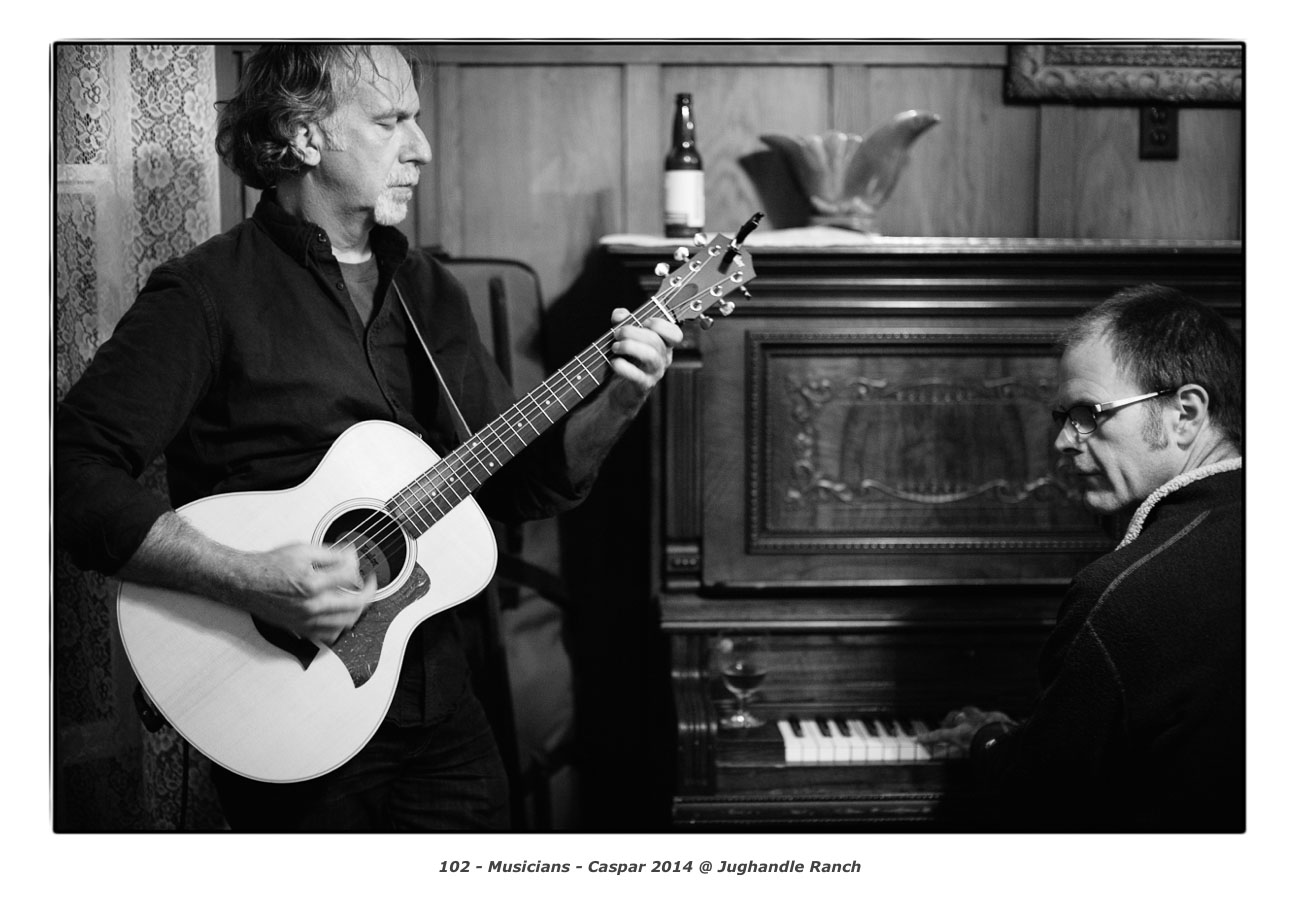
Both of these are straight out of the Leica M-P using the Nokton 50, with only adding the border and resizing as enhancements.


Leica M-P + Nokton 50mm f/1.5 ASPH (LTM)
ISO 3200 @ f/1.5 @ 1/25
OOC JPEG


Leica M-P + Nokton 50mm f/1.5 ASPH (LTM)
ISO 800 @ f/1.5 @ 1/15
OOC JPEG

I see I have a year problem on the Musicians photo IPTC data ... User error. ;-)
G
 
I really don't buy the view that the output from any particular (modern raw capable) camera is any better for digital B&W. You might feel that some files require less effort but thats about all. I've concluded, for my purposes, that the current Sony sensors are extremely good for digital B&W. They allow you to address the highlight issues typically associated with digital B&W. These modern sony sensors are fundamentally ISO-less - any increase in ISO above base is basically exactly the same as shooting at base ISO and pushing in post. You can shoot with a constant -2/-3 EV dialled in with no ill-effects. Yes, a little more work in post but with a lot more headroom for your highlights.

I would hazard a guess that one of the biggest problems with digital B&W is that raw files are so malleable that it can be difficult to get a consistent process that gets the image to a place that is representative of what might be considered "convincing B&W".

Here's an example of the same scene shot on both digital and film. The camera is somewhat irrelevant

Digital (Nex 5n) DxO Labs filmback as a base
12479705594_947827cc55_c.jpg


Pentax 645n + HP5
12878942785_32b85fa310_c.jpg
 
thanks, Craig...you don't see that kind of comparison very often. They both look good...the film shot is maybe a little gentler on the sun coming through the tree in the background...but the main subjects are more tonally subtle in the digi shot.

Godfrey, I like that musicians shot...is there much woodgrain info on the upper bout of the guitar?

KEH, thank you, I'll experiment with the highlight and shadow settings on the XT1...
 

05730008-1-3 by unoh7, GS 645

That's what film does, but with M9 I take it shot by shot. But I rarely covert, and frankly, the digital fascination with BW escapes me. My Jaw rarely drops as with a great color shot.

At least with MM you can plead "no choice": it must be BW LOL

Color is alot harder to make work with alot of shots, but to me, reward is high 🙂

If it looks crap in color no matter what? Then I relent and give conversion a try

L1017051 by unoh7, M9

So much in lens design is about making colors work, I think Mandler must roll in his grave to see all BW hullabaloo today.
 
Appreciate seeing that comparison Craig. From what I've seen, sensors with wide DR and no Beyer array seem to produce the best digi bw pictures (Monochrom, Merrills). However modern sensors are so good that pp skills are usually the determining factor.

Having said that, I really like the bw I can get with the lowly Nikon V1.
 
Taken at the same time

Nikon V1, pp in LR4
U27021I1383825278.SEQ.1.jpg


Nikon F80, AP400 in XTOL, V700 scan and pp in LR4 (I think my scan/pp emphasised grain-like artefacts - this would look smoother as a wet print)
U27021I1385640696.SEQ.1.jpg
 
rd1...can't believe no one has mentioned it.

Neither do I. I was very impressed with the out of the camera B+W images. Even though the options were very rudimentary, it did in fact have an in camera B+W conversion menu with maybe 3 sliders. And with the 2.0 firmware (same as RD-1s) it could shoot RAW and JPEG at the same time. Not bad really for a camera of its age.
 
Back
Top Bottom