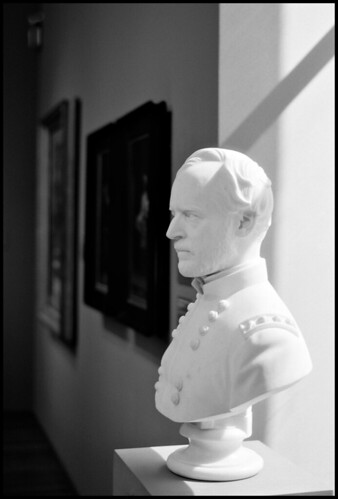
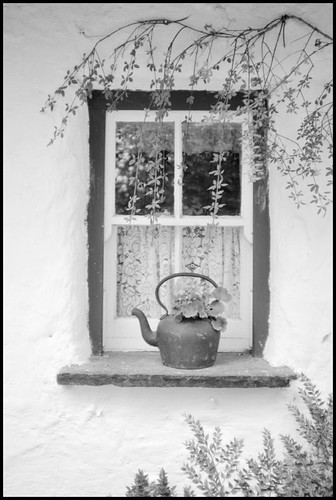
Softer and more creamy.

gholen

Now what!?
Local time
7:53 AM
Joined
Apr 10, 2010
Messages
86
Location
Göteborg, sweden.
Hi y'all!

Sorry 'bout the somewhat bad English, but here goes.
I've been developing at home for about a half year now, and so far, so good. I really like to get more creamy negatives, with more "feel".
A softer look might be a good way to explain it?

6104527364_5ec445ed9a_b.jpg

OM1 and 50/1.8. Ilford Delta 400.

I really like the creamy skintones. Some photo-store clerk told me to change the way and the time in my inversions. Others say "it's all about the film, nothing more" and some say "Change developer".
What to listen to, what to do?
Point me in the right direction please?
 
IMO creamy says nothing because it says lots of different things to different people. Some consider creamy no grain photographs with not too high contrast. Again IMO caring about the scene's contrast and then deciding a development time to get the contrast you want for that photograph, is what gives you control on the tone your image will have on negative. But the placement of the subject is decisive too: you can have a creamy scene because you exposed and developed well for it (say Acros on direct sun with yellow filter, generous exposure and short development) but if you keep the same composition for a creamy scene, you can get creamy skins or not depending on where those skins are and which kind of light (amount, direction) they are receiving... So taking a good look at the light on skins is as important as exposure and development... Film is not relevant: I don't think grain goes against tone or creamy looks... If you want to control tone, you should develop differently sunny scenes and overcast/shades/interiors/low light scenes...

Cheers,

Juan
 
gholen

I used to feel the same way. I liked Tmax developed so that there was minimal contrast. I've changed my mind since I started developing my own B&W. Forget what some "clerk" tells you and make up your OWN mind 😀

I recommend:
1. Pick your preferred film and stick with it for a bunch of rolls.
2. Pick you preferred developer and stick with it for a bunch of rolls.
3. Research techniques/methods/time/agitation for that particular developer/film combo noting what characteristics people are working for with each recipe.
4. Try them all until you find the dilution/agitation/time combo that YOU like, and that gives YOU the "look" YOU prefer.
5. Rinse. Lather. Repeat 🙂

Best of luck Brother!
 
My creamiest combo is HC-110 with Tmax100. It is still sharp but not digital looking, just an even smoothness:


1479614560_bcf5f6a390.jpg

(35mm)

2351372668_c69b683787.jpg

(35mm)

2856864574_2054c412ae.jpg


(35mm)

3131431466_5a12c6950a.jpg


(Kodak DuoFlex 120 with portrait attachment)

If you like this which, I'm not sure you will, I'll be happy to tell you the details.
 
Last edited:
My older sister bought a house a year ago, and the former owner left some of her late husbands photographic equipment. Including a packet of unopened Microdol X powder from the seventies or eighties, which my sister gave me.
I souped some Ilford FP4 in it, and I loved the results!
You will loose some sharpness with this developer, but it sure as hell is smooth!

Microdol X is unfortunately discontinued, but I hear there's still a similar mixture available in the US from another manufacturer.
 
Negatives developed in DDX, especially Delta 100 and HP5 are what i would call creamy.
Anything developed in Rodinal far less so.
 
Don't know if this helps but I print my b&w portraits with fairly low contrast filter on Agfa RC paper. I use Tri-x in Rodinal but those times would not be useful for you as daytime light here is often very contrasty so I have to compensate for that.

Good luck.
 
Thank you all for your tips. As from what I understand (and please, do correct me if I'm wring here), some of the it all lies in finding just what film that you use, what developer and what type of agitation.
I got a Tri-X 400 roll here now, that I'm gonna try later with some other type of agitation in D-76. I'll post some results later.
 
Gholen, I am also a beginner at developing, but to me your sample photo says "high contrast", not creamy. I like the look of your photo, by the way.

John's examples combine high contrast and smooth gradation of tone - really beautiful! I now feel compelled to give that combination a try - so far I have only used Tmax with D76 or Rodinal (I do like Tmax + Rodinal).

Randy
 
John is developing time with HC-110 really sensitive to temperature?

Randy

Sorry, my head is in a fog or something, yes, temperature is very important. I use 68 degrees F or (the same) 20 degrees C. Dilution H for me is one shot 7.8 ml to make 500ml of solution. I hope I haven't left anything out this time. Good luck, Tmax100 at 50 works for creamy, Tmax400 a little less so, but that is me; you may feel differently.
 
Gholen, I am also a beginner at developing, but to me your sample photo says "high contrast", not creamy. I like the look of your photo, by the way.

John's examples combine high contrast and smooth gradation of tone - really beautiful! I now feel compelled to give that combination a try - so far I have only used Tmax with D76 or Rodinal (I do like Tmax + Rodinal).

Randy

That photo, is what my photos mosly looks like. I want to learn how to get the softer look too 🙂
 
Try focusing slightly in front of your subject. 😉

Other suggestions, try shooting medium or large format. Try shooting with Acros in Rodinal. Try over exposing and under developing (or developing normally). Try shooting with a less sharp lens or one which is less sharp wide open. Try playing around with filters to see if additional separation helps hit what you want.
 
Try focusing slightly in front of your subject. 😉

Other suggestions, try shooting medium or large format. Try shooting with Acros in Rodinal. Try over exposing and under developing (or developing normally). Try shooting with a less sharp lens or one which is less sharp wide open. Try playing around with filters to see if additional separation helps hit what you want.

Dear Brian,

To save time for the OP, I'd add, "remembering always that a filter lightens its own colour and darkens its complementary."

Complements (you know them, but not everyone will)

Red/cyan

Green/magenta

Blue/yellow

Cheers,

R.
 
The really creamy skin tones you can only get on chromogenic film. Try Ilford XP2 or Kodak 400BW CN, exposed at EI 200. For silver film, follow the story here:
http://www.luminous-landscape.com/columns/sm-02-04-28.shtml
Personally, I find Fomapan 200 @EI 125 in FX39 a great example of creamy tonality:

http://www.flickr.com/photos/59177039@N00/2762687062/sizes/l/in/photostream/
http://www.flickr.com/photos/59177039@N00/3534660023/sizes/l/in/photostream/
http://www.flickr.com/photos/59177039@N00/2887970072/sizes/l/in/photostream/
 
Last edited:
The really creamy skin tones you can only get on chromogenic film. Try Ilford XP2 or Kodak 400BW CN, exposed at EI 200. For silver film, follow the story here:
http://www.luminous-landscape.com/columns/sm-02-04-28.shtml
Personally, I find Fomapan 200 @EI 125 in FX39 a great example of creamy tonality:

http://www.flickr.com/photos/59177039@N00/2762687062/sizes/l/in/photostream/
http://www.flickr.com/photos/59177039@N00/3534660023/sizes/l/in/photostream/
http://www.flickr.com/photos/59177039@N00/2887970072/sizes/l/in/photostream/

Creamy skin tones is great with TMax100 too. But I do agree Chromogenics work very well. One thing for sure; TMax100 and HC-110 women are going to love it. The luminous-Landscape piece suggests an older lens. I noticed that a plastic lens from an old ColorPack II camera really made women look great, so I bought another. Then I put it on a lens cap for my Pentax 6x7. It really is a great portrait lens without the fiddling of back or front focusing.
 
Back
Top Bottom