ColSebastianMoran
( IRL Richard Karash )
A recent post asked "What's the very best lens for camera scan with my 50 MPx body?"
This got me thinking: What would define "very best?" Best cam-scan image quality when everything else is optimal? Good enough to give cam-scan results equal to the best? Best image quality given the rest of my setup? Best tradeoff of usability, fit to my setup, and cost?
Back story: Earlier in the digital age, I realized I could mount most any lens to my digital body and see quickly what it would do. I set out to buy a number of enlarging, movie, duplicating, macro, and legacy normal lenses plus macro gadgets. Back then, at 6MPx, half the lenses out-resolved the sensor. Things shifted at 12MPx, more at 24MPx, and now I have 50 MPx bodies.
At 50MPx, I have a handful of lenses that all perform at about the same highest level, all give ~80 lp/mm on the sensor (more than most any films). I'm sure that there are optical differences in these lenses, but I cannot see them at 50MPx and I doubt they would make a difference in cam-scan images.
So, what considerations for selecting a "best" lens? Here are some of my reflections after testing a lot of lenses and setups.
Tight Rig - You want your whole rig as close to rock-steady as possible. Any wiggle, looseness, any "play" will make it very hard to do manual focusing and can show movement during exposure. This suggests a lens with native mount to the body (no adapters) and a tripod-mount solidly fixed on the lens. You want a tight mount-camera-lens combination.
AF or Manual? - I have a really tight copy stand. I can adjust focus moving the whole camera-lens combination, find precise focus, pull my hand back and nothing moves at all. And, my Sony bodies have excellent focus-aids. With this rig, I prefer manual focusing, even with an AF lens. But, most copy stands aren't this tight. Everything shakes as you adjust position. MF by turning the focus ring jitters the image. Maybe your body doesn't have good enough focus-aids; the focus-confirmation dot on my Nikon bodies is not precise enough for cam-scan. Ditto a Canon 5DSR I've tried. For all these cases, I think you want AF.
So, with any wobble in the setup, I'm going to suggest a lens with native mount to body and AF. With a really tight copy stand and willing to do MF, then enlarging/copy lenses on tubes and adapters can work, better if tight.
Lighting? and shutter speed? - With any potential for vibration, flash is an easy recommendation but requires more setup. If your rig is really tight, and your body is free of shutter-slap, then ~1/3 sec on a light panel can work. Video lights give about 1/100th.
Film Flatness and aperture? - Film is not flat; the natural curve persists with any holder short of glass-mount. This affects lens choice. The highest resolving lenses are best at f/4. Lens in CoolScan 8000/9000 is f/2-something. Are you willing to do glass mount? Or focus stacking? If so, then a more exotic lens may can give you better results. If not, then I'll recommend f/8 to give better across-frame sharpness.
Resolution? - How much resolution do you want? How much detail is in the film? How big a print do you want to make? If you want ultimate resolution, you'll want to setup for 2x to a 50MPx body and stitch. This will give well over 100 lp/mm. The excellent test negative by Vladimir Serebryany has distinguishable lines to about 80 lp/mm in the center, 60 at corners, and that is with exotic film stock and a lot of care; this makes me think 60 lp/mm in cam-scan is plenty for most film images. Further how big do you want to print?
I'm very happy with 20x30" prints from my 24MPx bodies, even better prints from 42MPx, and processing gives further improvements ("Super Resolution" in ACR, Topaz DeNoise AI, etc.) If you choose a 24MPx body, you'll get fine cam-scan images, and the top dozen lenses in my tests all give the same result. At 50MPx, a half-dozen lenses all give the same top result at f/5.6 or f/8. There are more exotic lenses, but "Best" in my book, with my gear, doesn't go beyond these choices.
Alignment - This is a little nit for ease of use. I use a mirror for alignment. My script: Setup as normal, place a mirror on top of the film holder, move camera and lens back a bit so I can see the whole front of the lens, align until the lens is exactly in the middle of the frame, then move things down into position for 1x. (Thank you, Peter Krogh.) This requires refocusing the lens from 1x to something less. Here's the nit: I cannot do this with an enlarging/copy lens on tubes and adapter. Maybe with a focusing ext tube, but it's just less practical. Setting alignment in this way is far easier with a macro lens (with focusing helical) than with an adapted lens. Once again, this takes me to prefer a macro lens, even better one I can switch to AF.
Net for me: A high quality native-mount macro lens is my go-to choice for camera scanning. With my Sony bodies, that's the 70 f/2.8 Sigma Macro ART with a tripod mount ring (I use it in AF for alignment, then set for 1x and focus manually with the copy stand). Sony 90 is equal, even possibly better, at double the price; will need a tripod mount. I use flash to eliminate any issues of movement.
Also: On Nikon bodies, I use the 50 f/2.8 Sigma EX DG Macro in auto-focus.
A note aobut USAF target testing
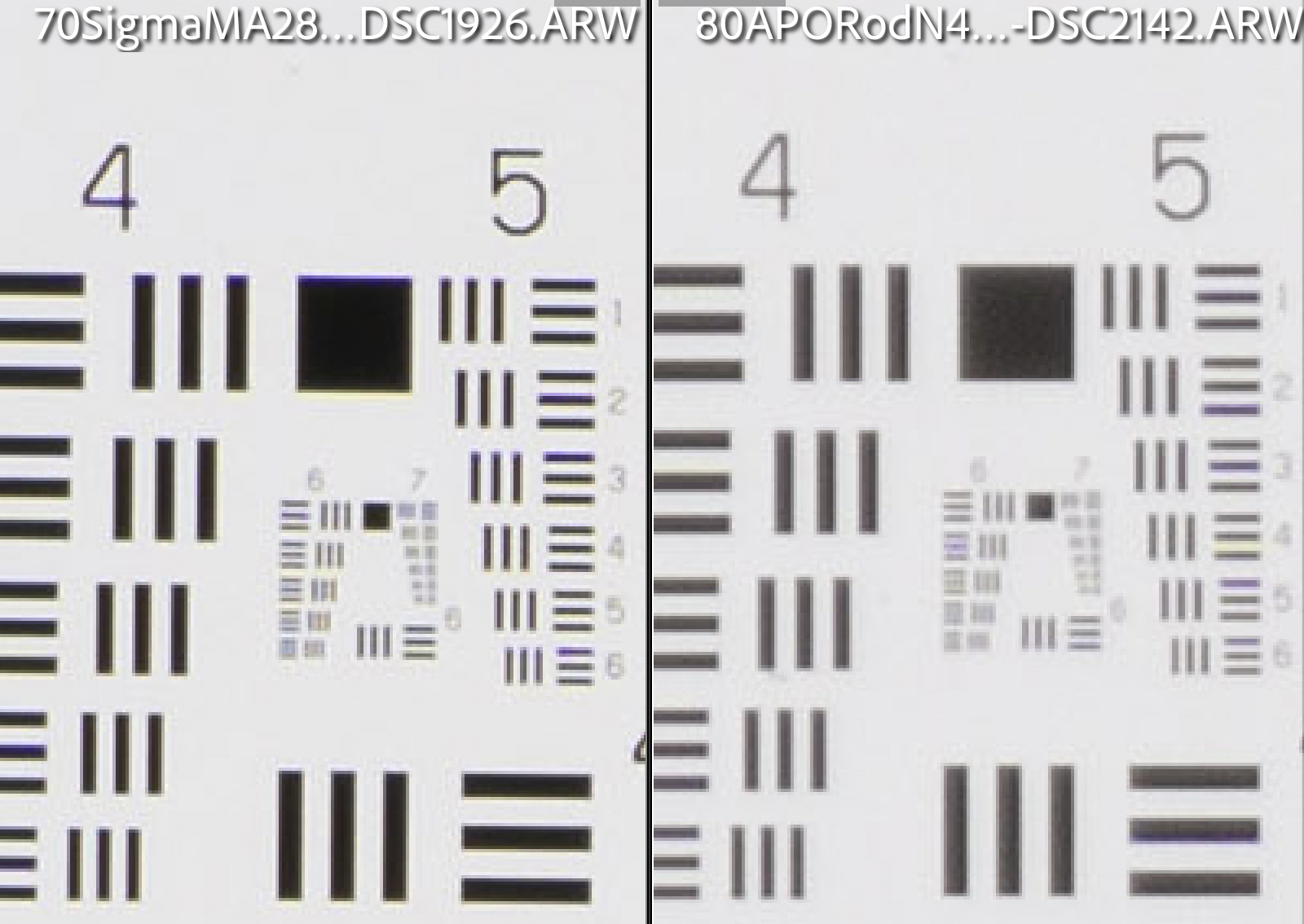
Each Group number doubles resolution. Group 6 Element 1 is 64 lp/mm. G5-E1 is 32.
Six element changes in each group. Group 6 Element 4 is 1.41x G6-E1 or 91 lp/mm
Each element change is about 12%.
How much detail can film record? The lenses on our film cameras? For both, probably 50 lp/mm.
The Nikon Coolscan 35mm scanners are respected as high quality. They record 4000 pixels per inch which in practice results in about 60 lp/mm. At this resollution, most film grain shows clearly.
Here's the USAF target at 1x with two of my "best" lenses.
Test conditions: 1x to a 50MPx sensor, well off-axis to the mid-corner of FF sensor (extreme corner on APS). Best aperture. Shown at 400% screen grab.
This result is typical of my half-dozen best lenses.
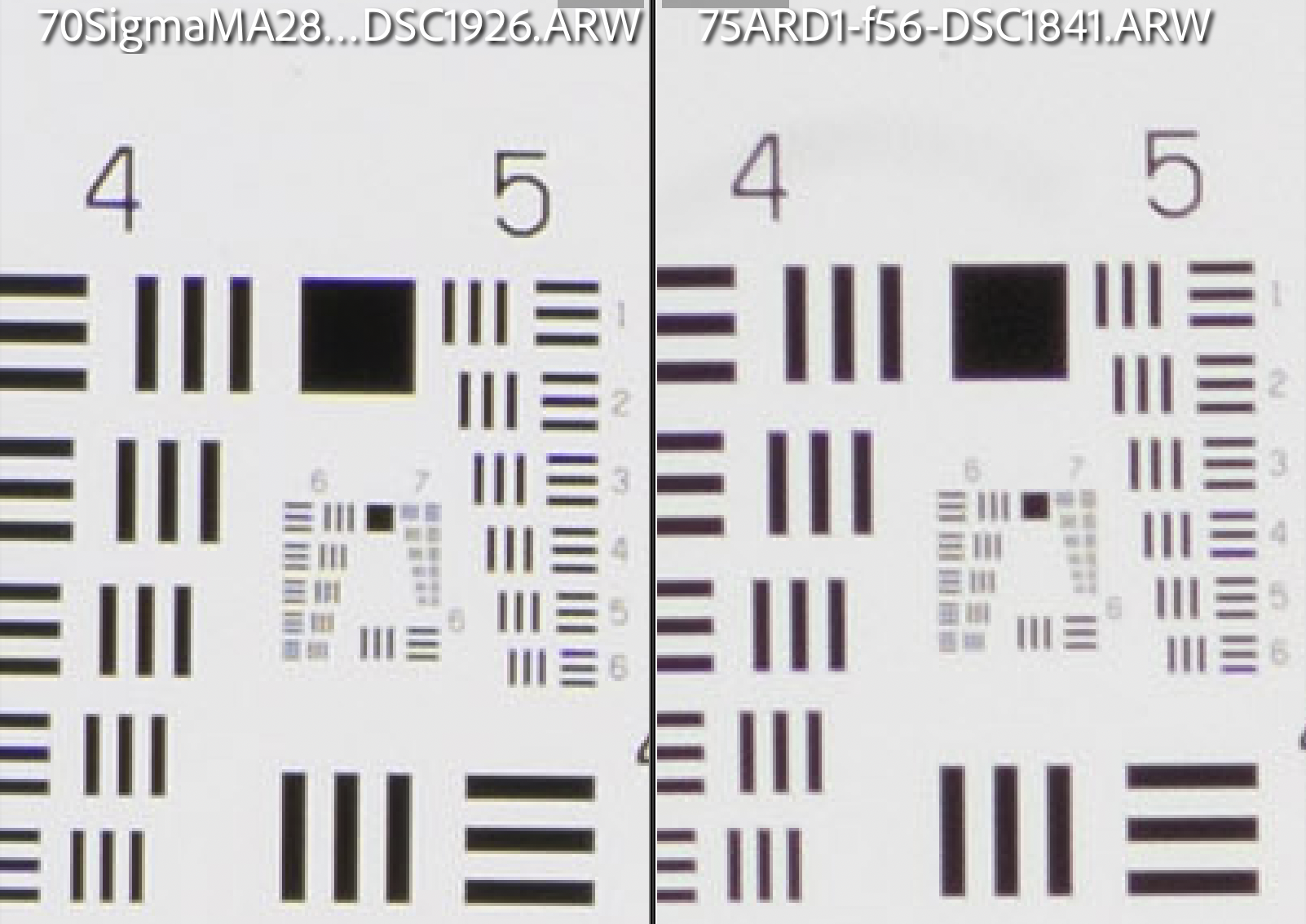
My "Best" lenses Resolving G6-E4 at extinction 91 lp/mm to 50MPx 3.8µ sensor:
50 f/2.8 Sigma EX DG macro
50 f/4.5 Tominon
55 f/2.8 Micro-Nikkor AI or AIS
70 f/2.8 Sigma Macro ART
75 f/4 APO Rodagon-D 1x Copy Lens
75 f/4.5 APO Rodagon-D 2x Copy Lens, Normal Orientation
90 f/2.8 Sony Macro
100 f/2.x CoolScan 8000/9000 lens
This got me thinking: What would define "very best?" Best cam-scan image quality when everything else is optimal? Good enough to give cam-scan results equal to the best? Best image quality given the rest of my setup? Best tradeoff of usability, fit to my setup, and cost?
Back story: Earlier in the digital age, I realized I could mount most any lens to my digital body and see quickly what it would do. I set out to buy a number of enlarging, movie, duplicating, macro, and legacy normal lenses plus macro gadgets. Back then, at 6MPx, half the lenses out-resolved the sensor. Things shifted at 12MPx, more at 24MPx, and now I have 50 MPx bodies.
At 50MPx, I have a handful of lenses that all perform at about the same highest level, all give ~80 lp/mm on the sensor (more than most any films). I'm sure that there are optical differences in these lenses, but I cannot see them at 50MPx and I doubt they would make a difference in cam-scan images.
So, what considerations for selecting a "best" lens? Here are some of my reflections after testing a lot of lenses and setups.
Tight Rig - You want your whole rig as close to rock-steady as possible. Any wiggle, looseness, any "play" will make it very hard to do manual focusing and can show movement during exposure. This suggests a lens with native mount to the body (no adapters) and a tripod-mount solidly fixed on the lens. You want a tight mount-camera-lens combination.
AF or Manual? - I have a really tight copy stand. I can adjust focus moving the whole camera-lens combination, find precise focus, pull my hand back and nothing moves at all. And, my Sony bodies have excellent focus-aids. With this rig, I prefer manual focusing, even with an AF lens. But, most copy stands aren't this tight. Everything shakes as you adjust position. MF by turning the focus ring jitters the image. Maybe your body doesn't have good enough focus-aids; the focus-confirmation dot on my Nikon bodies is not precise enough for cam-scan. Ditto a Canon 5DSR I've tried. For all these cases, I think you want AF.
So, with any wobble in the setup, I'm going to suggest a lens with native mount to body and AF. With a really tight copy stand and willing to do MF, then enlarging/copy lenses on tubes and adapters can work, better if tight.
Lighting? and shutter speed? - With any potential for vibration, flash is an easy recommendation but requires more setup. If your rig is really tight, and your body is free of shutter-slap, then ~1/3 sec on a light panel can work. Video lights give about 1/100th.
Film Flatness and aperture? - Film is not flat; the natural curve persists with any holder short of glass-mount. This affects lens choice. The highest resolving lenses are best at f/4. Lens in CoolScan 8000/9000 is f/2-something. Are you willing to do glass mount? Or focus stacking? If so, then a more exotic lens may can give you better results. If not, then I'll recommend f/8 to give better across-frame sharpness.
Resolution? - How much resolution do you want? How much detail is in the film? How big a print do you want to make? If you want ultimate resolution, you'll want to setup for 2x to a 50MPx body and stitch. This will give well over 100 lp/mm. The excellent test negative by Vladimir Serebryany has distinguishable lines to about 80 lp/mm in the center, 60 at corners, and that is with exotic film stock and a lot of care; this makes me think 60 lp/mm in cam-scan is plenty for most film images. Further how big do you want to print?
I'm very happy with 20x30" prints from my 24MPx bodies, even better prints from 42MPx, and processing gives further improvements ("Super Resolution" in ACR, Topaz DeNoise AI, etc.) If you choose a 24MPx body, you'll get fine cam-scan images, and the top dozen lenses in my tests all give the same result. At 50MPx, a half-dozen lenses all give the same top result at f/5.6 or f/8. There are more exotic lenses, but "Best" in my book, with my gear, doesn't go beyond these choices.
Alignment - This is a little nit for ease of use. I use a mirror for alignment. My script: Setup as normal, place a mirror on top of the film holder, move camera and lens back a bit so I can see the whole front of the lens, align until the lens is exactly in the middle of the frame, then move things down into position for 1x. (Thank you, Peter Krogh.) This requires refocusing the lens from 1x to something less. Here's the nit: I cannot do this with an enlarging/copy lens on tubes and adapter. Maybe with a focusing ext tube, but it's just less practical. Setting alignment in this way is far easier with a macro lens (with focusing helical) than with an adapted lens. Once again, this takes me to prefer a macro lens, even better one I can switch to AF.
Net for me: A high quality native-mount macro lens is my go-to choice for camera scanning. With my Sony bodies, that's the 70 f/2.8 Sigma Macro ART with a tripod mount ring (I use it in AF for alignment, then set for 1x and focus manually with the copy stand). Sony 90 is equal, even possibly better, at double the price; will need a tripod mount. I use flash to eliminate any issues of movement.
Also: On Nikon bodies, I use the 50 f/2.8 Sigma EX DG Macro in auto-focus.
A note aobut USAF target testing
Each Group number doubles resolution. Group 6 Element 1 is 64 lp/mm. G5-E1 is 32.
Six element changes in each group. Group 6 Element 4 is 1.41x G6-E1 or 91 lp/mm
Each element change is about 12%.
How much detail can film record? The lenses on our film cameras? For both, probably 50 lp/mm.
The Nikon Coolscan 35mm scanners are respected as high quality. They record 4000 pixels per inch which in practice results in about 60 lp/mm. At this resollution, most film grain shows clearly.
Here's the USAF target at 1x with two of my "best" lenses.
Test conditions: 1x to a 50MPx sensor, well off-axis to the mid-corner of FF sensor (extreme corner on APS). Best aperture. Shown at 400% screen grab.
This result is typical of my half-dozen best lenses.
My "Best" lenses Resolving G6-E4 at extinction 91 lp/mm to 50MPx 3.8µ sensor:
50 f/2.8 Sigma EX DG macro
50 f/4.5 Tominon
55 f/2.8 Micro-Nikkor AI or AIS
70 f/2.8 Sigma Macro ART
75 f/4 APO Rodagon-D 1x Copy Lens
75 f/4.5 APO Rodagon-D 2x Copy Lens, Normal Orientation
90 f/2.8 Sony Macro
100 f/2.x CoolScan 8000/9000 lens