What's your favourite Light Meter?

Bosk

Make photos, not war.
Local time
9:00 PM
Joined
Aug 17, 2006
Messages
202
Location
Ballarat, Australia
Yesterday I was lucky enough to win an eBay auction for a Summicron 50/2, so now all I need is a rangefinder body to use it with.

I'm leaning towards a used Leica M3 having read so many great things about their reliability, build quality and accuracy.

Assuming I get one, I will of course need a portable light meter of some sort and was hoping to hear some suggestions for which types you'd recommend. Naturally my preference is to spend less rather than more, but I'm pretty flexible.
More than anything else I'd like something that's small and portable, accurate and very quick & easy to use.

Cheers, I look forward to hearing your opinons.
 
I have two meters, one cheap/ small/ old, the other rather expensive/ modern/ bulky.
The old one is a Sekonic Auto Leader 38. No batteries! It's accurate within its limits and a little slow to use. Minimum sensitivity can be limiting with extremely fast film.
The other is a Gossen Luna Star F. It gets about 6 months per 9 volt battery, is sensitive enough to use under the enlarger or even full moon(!) and quite versatile, acting as a flash, area, spot, or incident meter. Negatives? A little bulky, cost actual money, and seems to recommend about a stop too little light under tungsten lighting.
Hope this helps!
 
A leica kit deserves a Sekonic L-308. There are smaller meters, but they may require more expensive batteries and may be harder to read (depending on your eyesight). The L-308 uses a standard Alkaline AA cell and has a nice display. There are (at least) three versions of this meter, distinguished by different letters following '308' and they are all good.

In any case, I would recommend a meter which can take both incident and reflected readings. Some meters which only do reflected can be as expensive as the L-308. There is no advantage (and possibly disadvantages) to a meter which mounts in the accessory shoe.

By the way, the Leica M2 is every bit as good as the M3 and has the advantage of including 35mm framelines, in case that may be important to you.

Richard
 
I have being using a Gossen Digisix for a couple of years, It's accurate, tough and very tiny. It does both reflected and ambient readings. It is a little hard on 2032 cell batteries though.
 
I use a LeicameterMR attached to the top of my M3. The red scale stil works and is accurate enough for exposures of Fuji Velvia.

Otherwise I use an old Sekonic handheld selenium meter
 
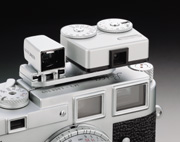
If you are after a small meter, try the Voigtlander VC Meter II, you won't be disappointed. You can buy it for $174.00 from Cameraquest. It fits perfectly on a M3 accessory shoe, as you can see on the following picture (linked from Stephen Gandy' s webpage).

vcII-w-shoe.jpeg


If size is of no concern, go for a Gossen Lunapro F (great lightmeter/flashmeter) or for a dedicated spotmeter (several models, I prefer the Pentax Spotmeter, but Minolta is also good).

Try to avoid old technology meters, either with CdS or selenium sensor cells. CdS suffer from memory effect, while selenium is not very sensitive and has a limited life span, which is a problem with old devices with not spare parts available.

Abbazz
 
First you should try to decide if You want a handheld or shoe-mounted meter. The latter is obviously allways with the camera but is often more limited in functions (no ambient metering), makes the camera a little more bulky and it destroys the beauty of the M shape (in my eyes). I have tried the Voigtlander VC-meter mk 1 which is neat but rather fiddly to use. The mk 2 is probably easier to handle since it is has a smarter read out of exp. values and locks the metered value for some time. The old Leicameters are coupled to the shutter dial and has the virtue of directly showing the right f-stop to a chosen speed (=less knobturning). But beware, they are old and could need a service if not completely dead...
Among the small handhelds I have tried the high-techy Gossen Digiflash wich is very small, gives You either reflected or ambient values (and flash!) but a little complicated since it gives You EV values which have to be transferred to a dial for the right F-stop/speed. Can be mounted in the acc shoe where it looks like SS Enterprise on its way through Milky Way. I have also handled a defective Gossen Sixtino II/Pilot II. It was simple small and light but felt cheap. I am myself curious of the small Sekonic L-208.
Among these I think the Digiflash is the "best" i terms of reliability and versatility, like a much bigger meter, even though it might not be as handy in use.
Good luck with Your choice
Jacob
 
Sekonic L-398 and its ancestors (Brockway, etc.). Spectra for cine work.

Most Gossen meters are not hard to like: Luna Pro, Pilot. There was one Gossen once made that used a 9V battery and had LED matching that I loved -- never can remember its name -- I could use one now.
 
The Digisix/Digiflash is a wonderful meter, very accurate and dependable. I had one and sold it because my old eyes had trouble reading it. (I don't like to wear glasses when taking pictures.) I replaced it with a Sekonic L-308 because of the fairly large digital readout. It turned out that the Sekonic was slightly faster and easier for me to use, but that may not be true for someone else. I really like the Gossen's giving the reading in EVs. There is an EV mode on the Sekonic, but it seems superfluous somehow. Both the Gossen and the larger Sekonic are splendid meters. It should be a difficult choice between the two for someone with good eyes.

Richard
 
I have a couple of old weston selenium meters & a gossen luna 6 pro. But the one I use the most is a minolta 1V F,it is very accurate easy to read, both flash & ambient, uses AA batteries, but is bulky & can be expensive.
 
I have a sekonic twinmate L-208 that I really like. Its small, easy to read and use, and not too expensive. I also have a CVII meter that works great if you want a meter to mount on your camera. The ASA dial has a tendency to move off its setting, so I've added a very small piece of gaffers tape to keep it in place. It works fine.
 
I have a few favorites. The Gossen Digisix is a very small and accurate meter, although the tiny numbers on the dial are getting hard for my aging eyes to read. I also use a Gossen Lunastar digital meter, mostly because I really like the 1/2 inch tall numbers on the LCD display. A bit bulky, though.

For a back-to-basics approach I use a cheap Sekonic selenium meter, the L- 158. Very light and small, quite accurate too, provided you do not need low-light metering.
 
I have been using a Pentax digital spotmeter for over ten years now, and I would not switch from it. A spotmeter is great for learning exact exposures with slide film to get a certain effect with light and colors.

Before joining the ranks of rangefinder users, the Canon T90 and Canon F1N spoiled me with their built-in spotmeter capabilities for many years, and I was hooked on them.

Raid
 
Another vote for the Sekonic L-308. I got the "s" version that even does flash metering. It replaced a dead Ikophot and a Sixtar that needed Hg batteries. Even took the MR-4 Leica meter off the camera to make for a smaller package. It's the one meter that gives exactly the same readings as my Minolta F, 1 degree spotmeter. All my other meters could never come to a consensus. The single AA battery is also a big plus. I like a handheld meter for discreet street photography as it does not telegraph your intentions like camera to eye.

For checking out meters have found that using a totally white computer screen as a target works very well for comparisons. Just make an empty JPG the size of your monitor using any photo editor.

Glenn
 
I first bought a Gossen Luna Pro SBC which is excellent.. you can meter moonlight with that thing, and it's the quickest meter to operate that I've ever used.. the one drawback to it is its size.. about the size of a pack of cigarettes, but quite a bit thicker

since I wasn't so pleased with the size of the Luna Pro, I then bought a Digisix.. it's small enough to put in your pocket and forget you brought it.. but it, like the Luna Pro, comes on a neckstrap.. so it can be worn in an easily accessible way.. at first I wasn't so sure it would be as accurate as the Luna Pro.. it certainly doesn't meter as low.. but I found out I'm never shooting in available darkness, so it didn't matter

as others have said, the Digisix isn't as easy to read, and takes a few seconds longer to convert from a meter reading into shutter/aperture combinations.. but it definitely gets the job done right.. I have shot many rolls of slide film with great results

but if you'd prefer a shoe-mount meter, the Voigtlander is clearly the way to go.. it's tiny, accurate, and looks great on an M3
 
Back
Top Bottom