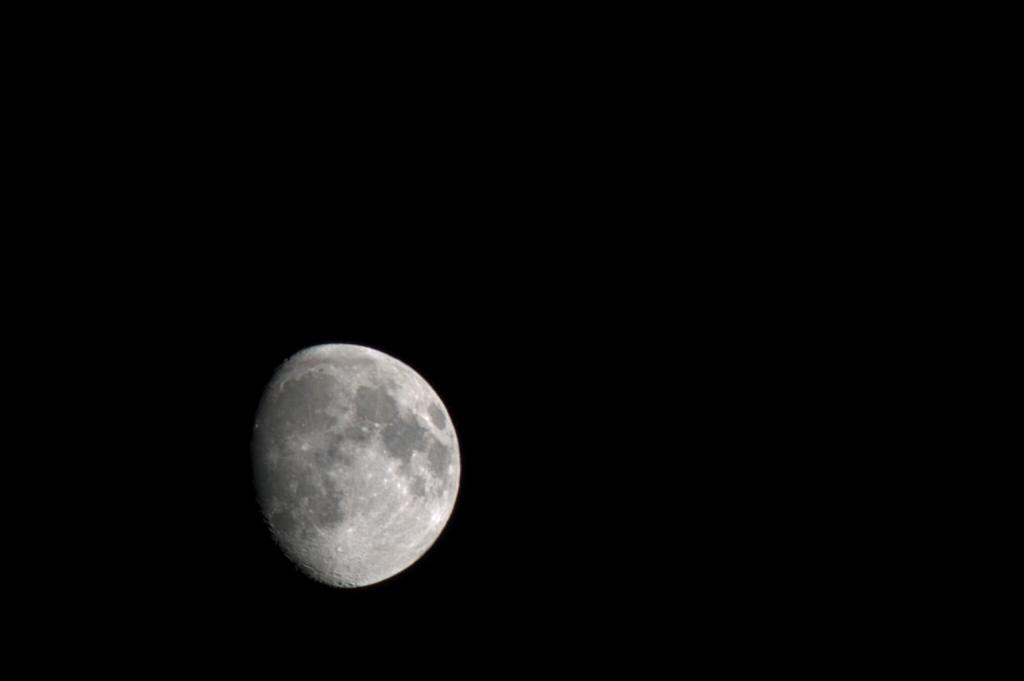
Why do my moon photos look like

Range-rover

Veteran
Local time
2:56 AM
Joined
May 18, 2012
Messages
2,491
Hi all,
There's been some nice full moons lately and I've been
trying to get some good shots but with the digital mirrorless
cameras it been a bit of a pain in the a%^, only coming out
like a white spot but the moon has ton's of detail in it because
it's just coming up. So any advice would be great.

Range
 
Use tripod.
Use manual exposure.
Set ISO to 800, shutter speed to 1/1000, aperture to f11
What focal length do you have on the camera?
For 100mm of focal length the moon will have a diameter of .9mm, therefor:
as an example, with a 300mm lens the moon will have a diameter of 2.7mm at the focal plane.
 
The moon is very bright compared to the black sky surrounding it so, as the camera does not "know" what you are trying to achieve or what your subject is, this confuses the camera and it will automatically expose for the black sky (which is more of the image area) washing out any detail in the moon itself. So avoid using auto anything and do everything manually by setting the camera from P or A to M setting.

Set your cameras lens focus to infinity manually if possible and also use the longest focal length available on with your lens if it is a zoom. Auto focus will work on many cameras but dark conditions can confuse some of them and they may not focus correctly.

Manually set the aperture to at least f5.6 or even f8 or f11 but you may need a tripod or something to rest on for some settings.

Also make sure the automatic ISO setting is turned off and instead set the camera to ISO 100 or 200 sensitivity if possible - a low number is better depending on the limit for your camera but 200 is pretty safe if your camera does not go lower.

Also set your exposure manually by turning your dial to M.

Try using the following settings but be prepared to experiment by changing one or other variables - start by trying ISO 200, Aperture f/11, Shutter Speed 1/250. If your lens does not go to f11 (some small format cameras do not for technical reasons) try this setting as a starting point - ISO 200, Aperture f/8, Shutter Speed 1/125.

Remember digital cameras do not, as a general rule, like large areas of shadow or large black areas in an image where there there is limited light. You will most likely get lots of digital artifacts (ugly colored or white grain or splotches) in the large black areas surrounding the moon in your final image. This can be compensated for using a digital noise correction tool some of which can be downloaded if you are not familiar with them. That should get rid of some of this noise.

You will find better articles on this by Googling "Photographing the moon" but they will essentially tell you what I have said.
 
The full moon is lit dead on and so there's little shadow to give shape or outline to things. It's like in-your-face flash being used.

Also the old fashioned technique was to cover the camera without touching it and open the shutter, wait and then carefully remove the cover. That way there's no chance of movement of the camera.

With SLR's you can lock up the mirror, of course. Some even lock up the mirror and put a bean bag on the camera to deaden any slight movement.

As for lenses, the moon's only half a degree across. Compare that with the FoV of the lens to see the obvious.

Regards, David
 
The sun-lit moon is pretty bright so bulb-exposure is probably not so useful 🙂
Tripod + selftimer might help, though.

I see on one of the better of my old moon-shots (Canon EOS D30, EF 200 f/2.8L + 1.4 extender) that I got 1/20 at f/11 with ISO 100. Still, the shutter time was probably on the long side - the moon isn't stationary...

This is a 1:1 crop from the 3MP original and the sharpness does not impress - camera shake? moon movement? and focus error?
crw_8230.crop.jpg
 
Last edited:
There's already lots of great advise on the camera side of things, so I won't repeat that. However to get the most out of shooting the moon, there are some extra things you can do..

Even the full moon displays a tremendous amount of contrast. If it's not already clear from the above advise; use the lowest ISO, sharpening and contrast settings to retain as much dynamic range as possible.

You'll find that the greatest images of the moon that you see on the internet are rarely single still images, but rather software selected stacks of video frames. The reason is that the light has to plough through the entire atmosphere, and even though the naked eye doesn't show it, turbulence distorts (always some part of) the image. If you do prefer to shoot stills, shoot a lot of them in a row and select the best. You'll be amazed at the differences in detail between consecutive shots with the same settings and everything.

General seeing conditions also play a major role. You're good if you touch the tripod and your hands freeze off.. in other words when the sky is as clear and clean as a whistle. Dust, clouds and humidity rob detail.

But if you get past all that, the moon is a very rewarding subject to shoot.. not only when full, but also when going through its phases.

 
Back
Top Bottom