
can someone explain filters to me?

ESG said:
Oh, absolutely. But that's not quite the same as doing ANY filter.

Incontestable. But then the original poster asked about the standard filters, not the more esoteric ones. Sorry for being too condensed, but I do think my meaning was clear.

ESG said:
If you can get the results you want with post-processing (I can too) then all well and good. But there might be some things you still want to consider using a filter for. Am I wrong?

No you are not. In fact I agree 100%. But how do you want to implement the use of colour filters when converting a colour scan or output from a digital image?
 
jaapv said:
Incontestable. But then the original poster asked about the standard filters, not the more esoteric ones. Sorry for being too condensed, but I do think my meaning was clear.


No you are not. In fact I agree 100%. But how do you want to implement the use of colour filters when converting a colour scan or output from a digital image?
I don't think there's anything you could do after you've shot standard film, because it only has three emulsions. And ditto for a standard three-channel digital image - you can't put information back into the image that you lost when you captured it. But, thinking off-the-wall for a second, inkjet printers now have up to 8 inks because three colour channels (albeit subtractive mixing of cyan, magenta and yellow) can be insufficient.

What if there were films with six layers of emulsion, or digital cameras that recorded six channels, each filtered more narrowly than a broad red, blue and green channel?

I can see plenty of disadvantages, but one advantage would be that the implementation of 'filtering' - or its post processing equivalent - could pull more out of the image. Another advantage might be that you could get more vibrant colours out of your eight channel ink-jet prints, and perhaps prints that looked better under different lights, and so on. You'd be stuffed editing on a regular PC of course because that's limited to the three regular red, blue, green channels in its display so you'd need a six-channel computer display (with six colours of phosphor) and so on.

Entirely impractical of course, but just daydreaming.
 
Example: B&W sells a "digital pol filter" There are claims floating on the Internet that it works, but I for the life of me cannot see how it could remove reflections, nor penetrate haze. I downloaded the trial version. It did darken blue skies, enhanced contrast and colour saturation, but that was about all. It looked rather horrible , actually.
 
Obiously a "digital polarizer" is not possible. What is is most likely doing is contrast, edge, and satuaration adjustments, but it not dealing with polarized light nor its properties. A polarizer is affecting the optical system which cannot be added to data. If you don't separate the polarized light before it is captured, you can't do it afterwards.

Digital processing can duplicate standard photographic filters. There is an amazing amount of control you can have with simply the primary colors - red, green, and blue. The only time more than those colors are needed is when the system used is using dyes that are imperfect. This is usually a problem wiith inks.

Obviously, like the polarizer, there are filters than cannot be duplicated electronically. But those filters are for fairly specialized applications. Very few would be used with pictorial photography that most folks are used too.

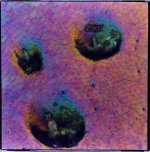
BTW, polarized light has some great specialized applications. The colors in this image are do to the fact that the object causes a phase shift in the polarized light; the specimen is colorless otherwise.
 

Attachments

  • bug_skin_02_sm.jpg
    bug_skin_02_sm.jpg
    34.8 KB · Views: 0
Back
Top Bottom