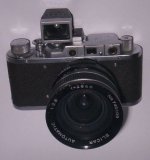
Paul is right - most LTM lenses that were designed to be directly mounted on a Leica or similar screw-mount camera body have some sort of mechanical tab or collar or coupling device that sticks out from the back of the lens. As you twist the focus ring, the coupling tab goes in or out some small distance. This is designed to couple with a receiver in the camera body, which in turn moves the rangefinder patch in your viewfinder.
SLR lenses do not have rangefinder patches, and no rangefinder coupling - so no tab or collar sticking out, and therefore, the rangefinder patch does not move no matter how you focus.
This means you must establish the distance to your subject in some other way (guess, measure, use external ranging device, etc), and set that distance on your lens barrel manually. If you are wrong about the distance, then you will be out of focus as well.
The saving grace is that very wide lenses - like a 28mm - have a very deep depth-of-field once you get about 15 feet or so away from your subject. So DOF covers a multitude of sins, in terms of guessing distance. You can get away with a lot of mistakes, in other words. A 50mm lens is not so forgiving, a 135 not even a little bit. But if you had, say an ultra-wide lens (24mm or wider), then you'd be in hog heaven.
Many people buy the classic Canon FL-mount (pre FD and pre EOS) 19mm retrofocus f3.5 and then buy a Canon FD -> LTM adapter.
http://www.canon.com/camera-museum/camera/lens/fl/data/fl_19_35r.html
Same effect as an M42 to LTM adapter, but there are not so many M42 ultra-wides running around. And you don't really miss the rangefinder coupling when you stop down a bit and everything is in focus due to massive DOF.
Best Regards,
Bill Mattocks